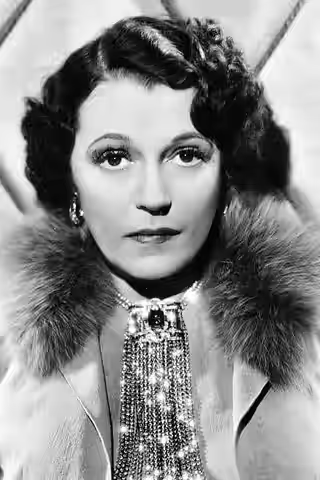
Alice Brady's society matrons in the comedies of the 1930s never finish a sentence and never notice. She made dithering exact, and when a director asked her to play it straight, in In Old Chicago and Young Mr. Lincoln, she could.
Fi1m perspective
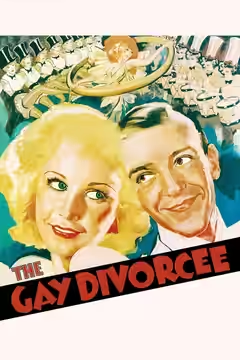
Watch her for a minute in The Gay Divorcee (1934). Hortense starts every sentence three times and finishes none of them, and Brady plays her as a woman who has no idea this is happening. Everyone else in the room is waiting for the end of a thought that never arrives, and their waiting is the scene. We laughed at her more than at the plot, and the reason is that she never once asks for the laugh; she is simply trying to get a sentence out. Fred Astaire and Ginger Rogers have the dance, Edward Everett Horton and Erik Rhodes have the farce, and Brady has the pauses.
She had been doing something else for twenty years first. Brady made her Broadway debut in 1911 and had her first success the next year as Meg March in Little Women. From 1914 she was in silent films, more than fifty of them, made through her father William A. Brady's production company, while keeping up the stage work; the plays included Eugene O'Neill's. Then from 1923 to 1933 she left the screen for Broadway altogether. When she came back in 1933 films could talk, she was in her forties, and the parts had changed: not the heroine but the heroine's mother or aunt, in more than twenty-five films before her death in 1939.
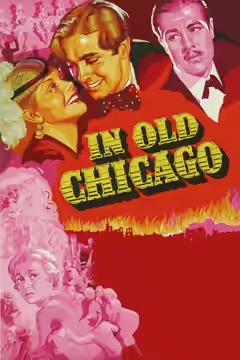
The type she settled into was the flighty rich woman who talks, and she was good enough at it to be asked for it again and again. Angelica Bullock in My Man Godfrey (1936) is the one people remember, and it is the same instrument as Hortense turned up a notch. The fairest reservation about the second career is that the studios rarely let her do anything else. When they did, she could. Molly O'Leary in In Old Chicago (1938) is a straight dramatic part in a period picture, and her last film, John Ford's Young Mr. Lincoln (1939), gave her Abigail Clay, with nothing to dither about. Nobody who has watched Hortense closely should be surprised that the actress who had played O'Neill on stage was still in there.
Start with The Gay Divorcee, and watch the edges of the frame rather than the middle. The dancing is the reason the film survives; Brady is one of the reasons it is bearable between dances. That is a modest kind of importance, but comedies of that decade ran on people like her, and few of them could get a laugh out of a sentence that never ends.
Biography
Alice Brady was an American actress of stage and film. She began her career in the theatre in 1911 and made her Broadway debut the following year. She appeared in numerous silent films from 1914 before returning to the stage and later resuming screen work with the advent of sound pictures.
Brady is known for her roles in The Gay Divorcee (1934), My Man Godfrey (1936), Gold Diggers of 1935 (1935), In Old Chicago (1938) and Young Mr. Lincoln (1939). She won the Academy Award for Best Supporting Actress for her performance in In Old Chicago.