Mann put one man who wanted one thing into a landscape too big for him and watched what it cost. His noirs and his Westerns with James Stewart are hard and exact; the epics that followed are grander and less sure.
Fi1m perspective
A man gets hurt in an Anthony Mann film and the camera stays on him. In the noirs he made with John Alton from 1947, starting with T-Men, the faces are half in shadow and the blows land close to the lens. In the Westerns that followed from 1950 the same thing happens in daylight, against rock and river, and the country carries on around it without much interest. That is the Mann picture: one man, one want, and a place that makes him look small. He said films are pictures and you ground them pictorially, and he meant it. His people explain very little, and they are better for it.
He came out of the New York theatre, arrived in Hollywood in 1938 as a talent scout and assistant director, and served his time on B-pictures after Dr. Broadway (1942). The Alton noirs got him noticed. Then came the Stewart years, eight films together, beginning with Winchester '73 (1950) and including The Naked Spur (1953), with Borden Chase writing three of them. These are the films the reputation rests on, and rightly. Stewart plays men who are obsessive and not always likeable, and Mann lets the landscape do the arguing. Man of the West (1958) pushed the violence further still. Then the 1960s brought the epics, El Cid (1961) and The Fall of the Roman Empire (1964), and a great deal more money and a great many more extras. He died in Berlin on 29 April 1967, in the middle of shooting A Dandy in Aspic, which others finished.
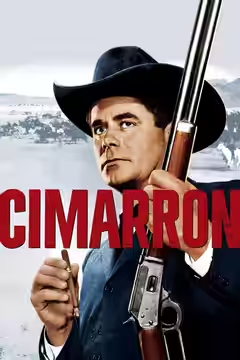
Cimarron (1960) is the one we have reviewed, and it shows both halves of him in the same film. Mann left the production amid disputes and is credited as director, and the finished picture behaves like a film that lost its director partway through. The land rush is his: Robert L. Surtees puts the camera low and wide, the wagons stretch to both edges of the frame, and when the gun goes off the whole horizon lurches. We sat up, and for ten minutes we would have followed it anywhere. Then Edna Ferber's chronicle takes over, the film settles into a marriage that goes round in circles for two hours, and Mann's gift for pressure inside a frame has nothing to press on. He was a director of single men in tight spots, not of territories growing up, and Cimarron proves it the hard way.
Start with the Stewart Westerns, where the shape of the man and the shape of the country are the same shape. Come to the epics knowing they are handsome and long. Come to Cimarron for its first quarter of an hour, and be honest with yourself about whether you need the rest.
Biography
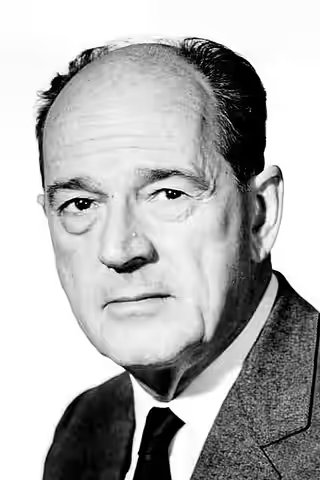
Anthony Mann (born Emil Anton Bundsmann) was an American film director. He began his career as a stage actor and director in New York under the name Anton Bundsmann before moving to Hollywood in the late 1930s. He worked as an assistant director and made his feature directorial debut with Dr. Broadway (1942).
Mann directed numerous films across genres, including film noirs and a series of Westerns in the 1950s such as Winchester '73 (1950), The Naked Spur (1953) and The Man from Laramie (1955). He later directed historical epics including El Cid (1961) and The Fall of the Roman Empire (1964). He was credited as director of Cimarron (1960), though he left the production before completion following disputes with the producer.
Mann died of a heart attack in 1967 while filming A Dandy in Aspic. He received a star on the Hollywood Walk of Fame.