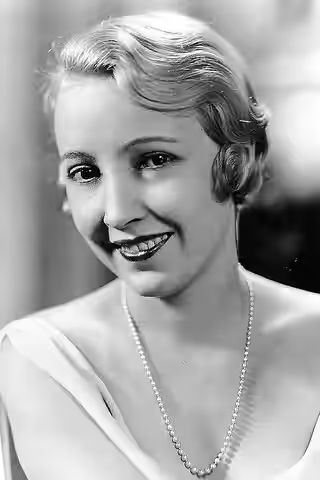
Bessie Love talked fast and kept busy, then let the busyness stop so the face underneath could show. The talkies found out what she could do in 1929 and lost interest within two years. That one performance is reason enough to know her.
Fi1m perspective
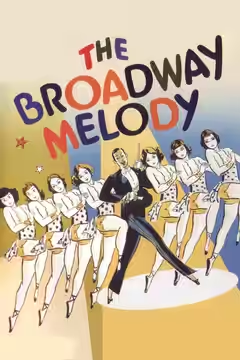
In The Broadway Melody (1929) Bessie Love plays Hank Mahoney, the plain sister in a vaudeville act who does the sums and loves a man who is looking past her at the pretty one. She talks fast, cracks wise and keeps busy, and she is the only person in the film who seems to know the camera can see a thought. Every so often the chatter stops and the face underneath shows. The film around her is a museum piece whose camera cannot move and whose numbers lie flat, and she makes the stiffness look almost deliberate. Nearly everything we liked about it is her.
She had been in pictures for thirteen years by then. D.W. Griffith found her while she was still at school and used her in five films, beginning in 1915 and 1916 at Fine Arts and Triangle; she is the Bride of Cana in the Judean story of Intolerance (1916). Through the 1920s she played innocent girls and wholesome leading ladies, at Vitagraph and then on her own, and turned up as Paula White in The Lost World (1925). When sound arrived she went to MGM and sang and danced through the musicals of 1928 to 1930, and The Broadway Melody was the peak, the film that got her called the screen's first musical comedy star.
What she did that the others could not was let a thought arrive. Silent acting had taught her to work in the face, and the microphone did not frighten her out of it; she kept the patter going and let the eyes do the rest. There is a scene in the second half of The Broadway Melody, alone in a room, which we will not describe, except that she plays it without music and almost without words, and it moved us more than we thought anything in a 1929 talkie could. The studio around her is still finding out what a microphone is for. She already knows.
Then the work stopped. After 1930 the parts thinned out, and in 1935 she moved to Britain, where she spent the next five decades in theatre, radio and small film roles, often as the American in a British production. Of that turn she said, "I guess I'm through. They don't seem to want me any more." She was not through, exactly. She is the answering service lady in Sunday Bloody Sunday (1971), Mrs Partlow in Reds (1981) and Lillybelle in The Hunger (1983), her last film. We have not reviewed those, and the parts are small.
So the case for Bessie Love rests on one performance in one stiff film, which is a strange position for someone who worked for nearly seventy years. Watch The Broadway Melody for her and not for the songs. When she stops talking, look at her face.
Biography
Bessie Love (born Juanita Horton) was an American-British actress whose career spanned silent films to sound cinema, theatre, radio and television from 1915 to 1983. Born in Midland, Texas, she moved with her family to Los Angeles and began working in films after being sent to Biograph Studios. Director D.W. Griffith cast her in several early productions, including Intolerance: Love's Struggle Throughout the Ages (1916).
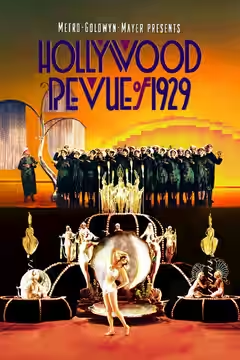
She gained popularity in the silent era and successfully transitioned to sound films. Her performance as Harriet 'Hank' Mahoney in The Broadway Melody (1929) earned her a nomination for the Academy Award for Best Actress. She also appeared in The Hollywood Revue of 1929 (1929). In 1929 she married director William Hawks; the couple divorced in 1936 and had one daughter. Love was named a WAMPAS Baby Star in 1922 and received a star on the Hollywood Walk of Fame.
She moved to the United Kingdom in 1935 and later became a British subject. Her later screen credits include uncredited or supporting roles in films such as The Barefoot Contessa (1954), On Her Majesty's Secret Service (1969), Sunday Bloody Sunday (1971), Reds (1981) and The Hunger (1983). She died in London on 26 April 1986.