Crosby's trick was to make acting look like not acting: he leaned on a doorframe, spoke as if the microphone were listening, and let the film come to him. It is restful company for two hours, and it is rarely more than that.
Fi1m perspective
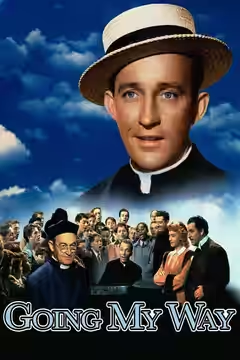
Father Chuck O'Malley walks into St. Dominic's in Going My Way (1944) wearing a straw hat and a St. Louis Browns sweatshirt, carrying a golf bag, and is taken for a tramp. Bing Crosby does not correct anyone. He leans in the doorway and waits for the parish to come round to him, which it does, and that is the Crosby method in one shot. He does not go out to meet a scene. He stands still, keeps his voice down, and lets the scene arrive.
The stillness came from the microphone. Crosby learned early that a singer did not have to fill a hall, only a microphone, and he built a relaxed, conversational way of singing on that discovery, long easy phrases with small ornaments on them. He said himself that if he got by in pictures it would be "as a singer, with about as much acting as you would expect from a guy standing in front of a microphone", and he was being accurate rather than modest. From The Big Broadcast (1932) through the Road comedies with Bob Hope and Dorothy Lamour, he played variations on a man who was already at ease before the plot started. Road to Morocco (1942) is the one to try for the ad-libbing and the winks at the camera; Holiday Inn (1942), with Fred Astaire, is the one with the song everybody knows.
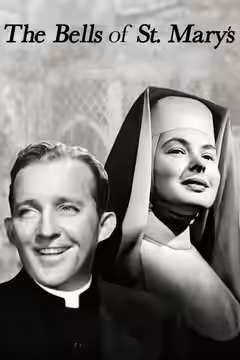
Leo McCarey's Going My Way was where the ease became a character rather than a persona, and we like the film without quite believing in him. Every problem in it softens on contact with O'Malley, mostly between scenes, so that Crosby is asked to be likeable and nothing else. When he sits a street gang down and sings them Swinging on a Star, we were won over in spite of ourselves, because for once the persuading happens in front of us and the voice is doing the work the script elsewhere skips. Then Barry Fitzgerald shuffles in as the old priest with the mended cassock and takes the picture away from him, because Fitzgerald is playing a man who might lose something. Crosby played O'Malley again in The Bells of St. Mary's (1945) opposite Ingrid Bergman, and it helps that her nun argues back.
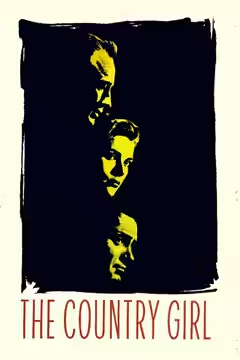
The knock on Crosby is that the smoothness never went anywhere. His 1930s records had more nerve than what came after, and by the 1960s a younger audience had decided he was their parents' idea of a good time, which he was. The Country Girl (1954), opposite Grace Kelly, showed he could play a man who was not at ease, and White Christmas the same year showed he could still coast handsomely. Given the choice, he coasted.
Start with Going My Way, watch how little he does, and decide for yourself whether the doing-little is a gift or a limit. We think it is both, and that Fitzgerald knew exactly which one to sit next to.
Biography
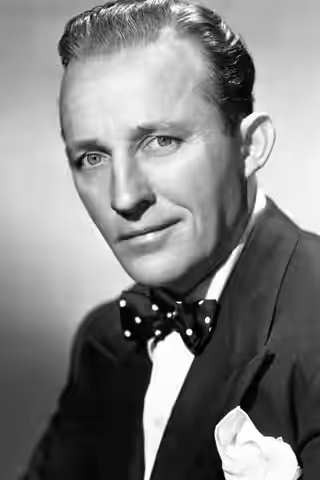
Bing Crosby was an American singer and actor. Born Harry Lillis Crosby on 3 May 1903 in Tacoma, Washington, he died on 14 October 1977 near Madrid, Spain.
Crosby is known for his film roles including Father Chuck O'Malley in Going My Way (1944), for which he won the Academy Award for Best Actor, and Bob Wallace in White Christmas (1954). He also appeared in Holiday Inn (1942), High Society (1956) and the Road to... series of films with Bob Hope from 1940 to 1962.
He received three stars on the Hollywood Walk of Fame, in motion pictures, radio and audio recording, and was the first recipient of the Grammy Lifetime Achievement Award in 1963.