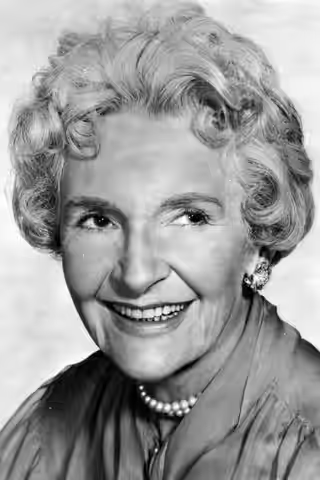
Cathleen Nesbitt spent seven decades on the stage and came to Hollywood in her sixties to play grandmothers and dowagers. The parts were small, she was witty and urbane in them, and she knew exactly how long to wait before speaking.
Fi1m perspective
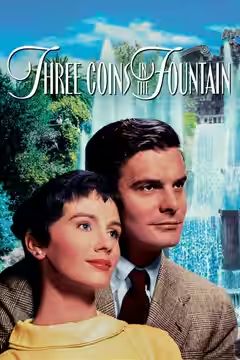
In Three Coins in the Fountain (1954) Cathleen Nesbitt plays the Principessa, mother of the prince Maggie McNamara's Maria is chasing, and it is a small part. She gets the two best lines in the picture and delivers them as though she had been waiting all afternoon for someone to give her the chance. That, as far as the cinema ever saw it, is the Nesbitt method: sit still, say little, make the one line count. She was in her sixties, and it was her first Hollywood part of any size.
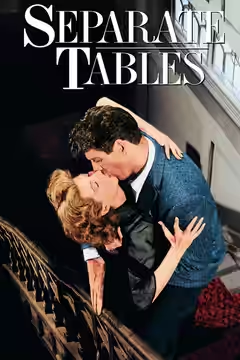
She had been acting since 1910, a London stage debut and then Broadway the following year with the Irish Players, and she kept at it across seven decades on both sides of the Atlantic. Film had her briefly in the silent era and then more or less forgot her until Hollywood needed a supply of society women with good posture. From 1954 she supplied them: Cary Grant's grandmother Janou in An Affair to Remember (1957), Lady Matheson in Separate Tables (1958), and, as late as 1976, Julia Rainbird, the old woman who sets Hitchcock's last film, Family Plot, in motion. The stage remained the main job. She was the first Mrs Higgins in My Fair Lady on Broadway in 1956 and went back to the part in 1981, when she was in her nineties.
Separate Tables is where to see her. Delbert Mann's Rattigan adaptation splits down the middle, with David Niven and Deborah Kerr on one side and Burt Lancaster and Rita Hayworth on the other, and Nesbitt belongs to the good half. She and May Hallatt, one with her wireless and the other with her racing form, are the chorus of the hotel, and their ten minutes of gossip over the crossword are worth more than most of the plot. Every time the film cut back to Lancaster and Hayworth being unhappy at each other we wanted it to return to that table, because two old women disapproving of the other guests was doing more for us than anything the leads had been given. Gladys Cooper is in the same cast, and the film is a small lesson in how English character acting of that period worked: nobody raises a voice, and nobody misses.
The complaint, such as it is, is that the parts were small and the films were not always up to her. Three Coins is a travelogue with love stories attached, and she is a footnote to the thinnest of them. Even in Family Plot she is there to start the engine and then step aside. She seems to have known this and not minded. "I haven't been known as a great actress, but I've been a very successful one," she said the year before she died, and it is hard to argue with either half. Start with Separate Tables. Then keep an eye out for her in anything else, because she will be at the edge of the frame, waiting, and when she speaks the film will briefly be better than it was.
Biography
Cathleen Nesbitt was an English actress whose career spanned seven decades on stage and screen. Born Kathleen Mary Nesbitt in Birkenhead, Cheshire, she studied at Queen's University Belfast and the Sorbonne, and made her London stage debut in 1910.
She appeared in numerous films, including Pygmalion (1938), Three Coins in the Fountain (1954) as the Principessa, An Affair to Remember (1957), Separate Tables (1958), The Parent Trap (1961), French Connection II (1975) and Family Plot (1976). She was appointed CBE in 1978.