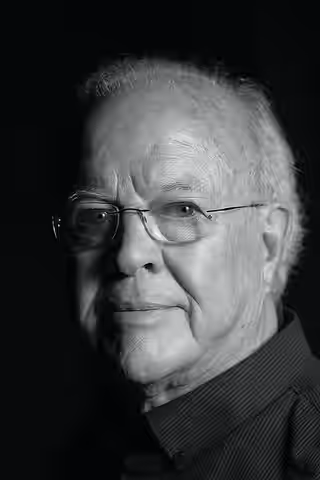
Trumbull built the future from things you could photograph: smoke, projections, miniatures moved an inch at a time, and it is why his spaceships look heavy. As a director he was sincere to the point of embarrassment, and Silent Running is the better for it.
Fi1m perspective
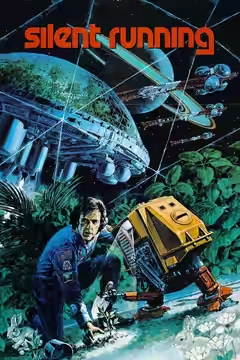
Two drones sit at a table on a spaceship and one of them considers its poker hand. It is a joke, and it is also a demonstration. Douglas Trumbull put actors inside the casings, so Huey and Dewey rock slightly when they walk and turn their heads a fraction late, as if thinking, and he had them photographed in flat working light so that nothing about them looked like a trick. That was the habit of his working life. He built the thing, then he pointed a camera at it.
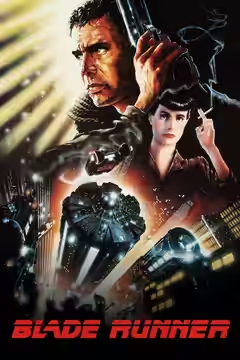
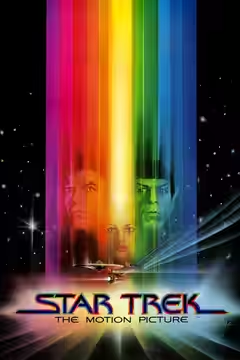
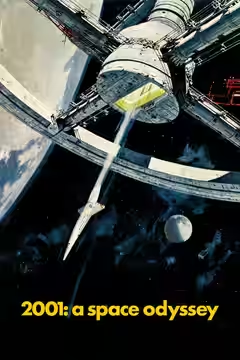
He started in the mid-1960s at Graphic Films in Los Angeles, drawing for NASA and the Air Force, and went to 2001: A Space Odyssey (1968) to make screen graphics. He left it having supervised the Stargate sequence, shot with a slit-scan technique he pioneered. He then made one film of his own, Silent Running (1972), as director and producer, and spent most of the next decade back on the effects floor: The Andromeda Strain (1971), Close Encounters of the Third Kind (1977), Star Trek: The Motion Picture (1979), for which he delivered a great many complex shots against a deadline that had the film in trouble, and Blade Runner (1982). He directed once more, Brainstorm (1983), then gave most of his time to large-format and simulator work, including Back to the Future: The Ride, before coming back for The Tree of Life (2011).
The strength is weight. His freighters in Silent Running are long, boxy things hung with domes like lanterns, and they pass Saturn's rings slowly enough that you believe in the mass, because the model existed and the camera moved past it. The Los Angeles of Blade Runner is smoke, projections and miniatures, and the smoke is what makes you believe in it. With Richard Yuricich, who worked beside him on three films, he refined the motion-control photography that gave Spielberg the UFOs and the mothership in Close Encounters. Robert Wise used him twice. Directors who hired Trumbull got a cinematographer for the parts of the film that did not exist yet.
As a director he is harder to defend and easier to like. Silent Running is a fable about a man who loves trees more than people, and Bruce Dern will not stop talking; the speeches are shrill and the songs are worse. We laughed at the poker game, and then Trumbull cut to Dern eating alone at a long mess table and we stopped, because the company he had made for himself was company and it was not enough. That cut is direction, not effects, and it is why we scored the film higher than its script deserves. Brainstorm tried an experimental large-format camera on the subject of virtual reality, and we have not reviewed it.
He said in 1978, "I'm in the area of creating experiences that are beyond the realm of physical reality." The freighter passing Saturn is the case for that. The rabbit in the grass under the dome is the case against it, and it is the shot we think of first.
Biography
Douglas Trumbull (1942–2022) was an American film director and visual effects supervisor. Born in Los Angeles, he began his career working on special photographic effects for 2001: A Space Odyssey (1968).
Trumbull directed and produced Silent Running (1972), his feature directorial debut. He supervised visual effects on Close Encounters of the Third Kind (1977), Star Trek: The Motion Picture (1979) and Blade Runner (1982). He also directed Brainstorm (1983). His father, Donald Trumbull, had worked in visual effects on The Wizard of Oz (1939).