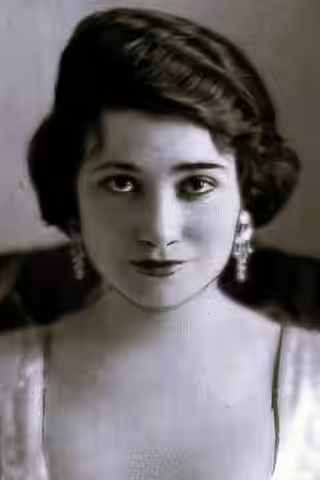
Fay Bainter came to films at forty and spent her time there as the aunt, the mother, the wife at the edge of the frame, doing the listening. She plays disappointment as tenderness, and in Jezebel she is the one to watch when Davis is off screen.
Fi1m perspective
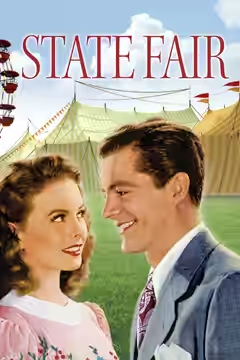
In State Fair (1945), Donald Meek takes a spoonful of Melissa Frake's brandied mincemeat, pauses, and comes back for another. Fay Bainter, as Melissa, does nothing a script could record. She watches him, and her face carries the scene: the pride, the alarm, the slow understanding of what the brandy in her mincemeat is doing to a judge. We laughed, and then felt slightly sorry for the man, and both reactions came from her rather than from him. Someone else has the line; she has the response, and the response is where the scene lives.
She got to it late. Bainter was a child performer in Los Angeles from 1908 and on Broadway from 1912, with a run of stage successes from East Is West onwards, and she did not make a film until This Side of Heaven in 1934, at forty. That is not the age at which Hollywood builds a leading lady, and it did not try. It made her the put-upon daughter-in-law of Make Way for Tomorrow (1937), and a year later it gave her the two parts, in White Banners and Jezebel, on which the reputation rests. Supporting roles followed through the 1940s; in the 1950s she went back to the stage and into television; her last film was The Children's Hour in 1961.
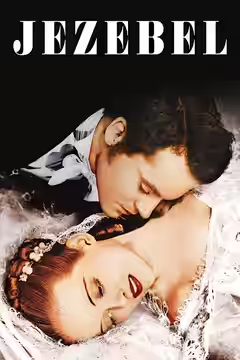
Jezebel (1938) is the one to see. Aunt Belle Massey is the conscience of a film that has Bette Davis at its centre in the wrong dress, and a lesser actress would have played the conscience as a scold. Bainter plays every disappointment as tenderness. She reproves Julie the way you would reprove a child you had already forgiven, so that Davis's cruelty registers on Belle's face before it registers anywhere else. We kept finding our eyes on her when Davis was off screen, and we do not think the film suffers for it. William Wyler directed her twice, and he plainly knew what she could do with a reaction shot.
The reservation, and it is the only one anyone has raised, is that she was never asked to do anything else. After 1938 the parts were genteel and maternal, and Quality Street (1937) already shows the pattern setting. She had the voice for more, warm and a little smoky, stage-trained, at home in comedy and drama alike. But she seems to have understood the bargain. "There comes a day when the flush of youth disappears from every woman's face," she said of the move into character parts. "Most women dread it. I did. Like so many things, however, it is worse in anticipation than actual fact."
Watch Jezebel for the ball, as we said, and then watch it once more with your eyes on the woman standing behind Davis. Bainter spent nearly thirty years on screen being the person who notices, and it turns out to be a part with no age limit.
Biography
Fay Okell Bainter was an American stage and film actress. Born in Los Angeles, California, on 7 December 1893, she died in the same city on 16 April 1968. She began her stage career in 1908 and made her Broadway debut in 1912. Her first film role came in 1934.
Bainter was nominated for the Academy Award for Best Actress and Best Supporting Actress in the same year for performances in White Banners (1938) and Jezebel (1938), winning the latter. She played Melissa Frake in the 1945 musical film State Fair. Other film roles include Make Way for Tomorrow (1937), Woman of the Year (1942) and The Children's Hour (1961). She received a star on the Hollywood Walk of Fame.