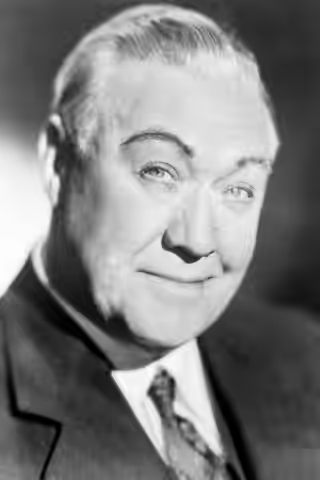
George Barbier played the man in charge who is never really in charge: kings, commissioners and fathers, fat and fond and outmanoeuvred by the young. He did it for Lubitsch three times, and he did it well without once doing it differently.
Fi1m perspective
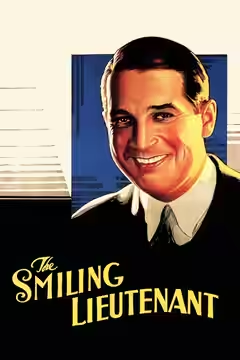
A king in The Smiling Lieutenant (1931) sits across a draughts board from a daughter who is sulking at him, and it is plain from the set of his shoulders that he has lost this argument before and will lose it again. That is George Barbier's method in one scene. He was large and white-haired and he carried authority the way a man carries a coat that no longer fits: it is his, everyone can see it is his, and it is not doing him much good.
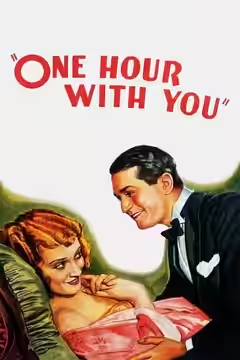
He came to films late. He had started in light opera and stock companies after giving up on the ministry, played seven Broadway productions between 1922 and 1930, including The Front Page, and signed with Paramount in 1929, making his debut in The Big Pond (1930). He was in his mid-sixties when the studio put him to work and he worked without stopping, around eighty-eight films in fifteen years. Three were for Ernst Lubitsch: King Adolf in The Smiling Lieutenant, the Police Commissioner in One Hour with You (1932), King Achmed II in The Merry Widow (1934). Later he was Dr Bradley in The Man Who Came to Dinner (1942) and Erlanger in Yankee Doodle Dandy (1942), still the man behind a desk while other people had the film.
The parts were nearly always the same: pompous but kind-hearted businessmen and patriarchs, judges, commissioners, kings, executives. The only reservation anyone has ever raised about him is that, and it is a fair one. We called his Adolf fat, fond and easily managed, and we could have written the same sentence about most of what he did. In One Hour with You he is the commissioner and our review did not mention him at all, which is a fair description of the job he was hired for.
But he did the job with more warmth than it required. We liked King Adolf a good deal more than the film needed us to; a monarch who spends his scenes being sulked at over a board game is hard to fear and easy to feel for, and Barbier never asked for the laugh at his own expense, he simply let it happen. That is why Lubitsch kept using him. A farce needs someone solid for the young people to run rings round, and it needs him not to mind.
Watch the two Lubitsch films we have reviewed for Hopkins and Colbert and Chevalier, and notice, somewhere behind them, a large man in a uniform being agreeable while the plot happens to him. He kept that job until the year he died.
Biography
George W. Barbier was an American stage and film actor. Born in Philadelphia, Pennsylvania, he studied for the ministry at Crozer Theological Seminary before turning to the stage. He appeared in several Broadway productions in the 1920s, including The Front Page.
Barbier made his film debut in The Big Pond (1930) and went on to appear in around 88 films, typically in supporting roles as businessmen or patriarchs. His credits include King Adolf XV in The Smiling Lieutenant (1931), the Police Commissioner in One Hour with You (1932), King Achmet in The Merry Widow (1934), and Dr. Bradley in The Man Who Came to Dinner (1941). He also appeared in Yankee Doodle Dandy (1942) and The Return of Frank James (1940).
He was married to the stage actress Caroline Thatcher until her death in 1939. Barbier died in Hollywood, California, in 1945.