George Seaton wrote for people who had reasons. His best scripts give the doubters their due before the miracle arrives, and treat the miracle as a matter of commerce as much as faith. A craftsman, and the better for it.
Fi1m perspective
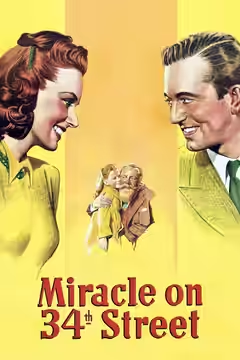
An old man in a department store lifts a small Dutch girl onto his knee. She has no English and has just been adopted; he talks to her, then sings to her, in her own language, while her new mother stands back and cries. Off to the side, Doris Walker, who has arranged her life so that nothing like this can get in, watches and sees something that will not fit her rules. It is the scene from Miracle on 34th Street (1947) we would keep if we could keep only one, and it moved us more than a studio comedy had any right to. George Seaton wrote it and directed it, and it shows what he could do: put the doubter in the frame and give her a good reason to doubt.
That habit runs through his best work. In Miracle nobody is stupid; the people who think Kris Kringle is mad have reasons, most of them reasonable, and the film is a comedy about commerce before it is a fable about faith. Seaton lets Edmund Gwenn play Kris as a courteous old man with a temper rather than a twinkling saint, and lets Natalie Wood's Susan come round slowly rather than all at once. The hokum of the second half goes down easily because the first half has been so sensible.
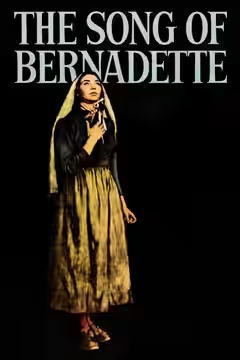
He came up as a contract writer at MGM from 1933, after stage and radio work, with an early credit on the Marx Brothers' A Day at the Races (1937), then moved to Columbia and 20th Century Fox, where he wrote The Song of Bernadette (1943). He began directing in 1945 with Diamond Horseshoe, and from 1950 worked almost entirely in partnership with the producer William Perlberg, at Paramount and later MGM and Universal. Most of what followed was adaptation: Clifford Odets's play for The Country Girl (1954), Arthur Hailey's novel for Airport (1970), with comedies such as Teacher's Pet (1958) and dramas such as 36 Hours (1964) in between.
Bernadette shows the other side of the same patience. The best of it is the first half hour, where Seaton's script sits with the Soubirous family in the disused jail they live in, François going out each morning to look for a day's work and Louise counting what is left, and Arthur Charles Miller shoots it so that it looks like a place where people are cold. Henry King then runs it for two and a half hours, and we found it a good hour too long. Sincerity that is a virtue at 96 minutes becomes a weight at 150.
He said once of writing, producing and directing at the same time that "It's too much work." Start with Miracle, where he did two of the three and neither shows the strain, then the first half hour of Bernadette, and be prepared to sit through the remaining two.
Biography
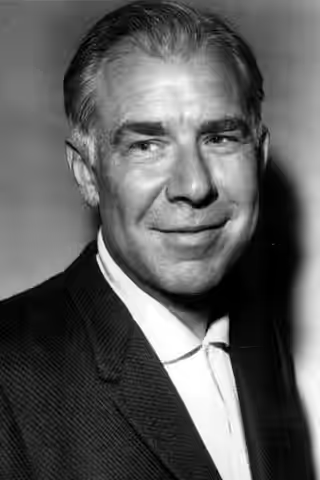
George Seaton (born George Edward Stenius) was an American screenwriter, film director and producer. He was born on 17 April 1911 in South Bend, Indiana, and died on 28 July 1979 in Beverly Hills, California.
Seaton began his Hollywood career as a contract writer at Metro-Goldwyn-Mayer in 1933. His early credits include the screenplay for A Day at the Races (1937). He later joined 20th Century Fox, where he wrote the screenplay for The Song of Bernadette (1943). He made his directorial debut with Diamond Horseshoe (1945) and went on to write and direct Miracle on 34th Street (1947) and The Country Girl (1954).
Seaton won Academy Awards for Best Adapted Screenplay for Miracle on 34th Street and The Country Girl. He also directed Airport (1970). He served as president of the Academy of Motion Picture Arts and Sciences and the Writers Guild of America West.