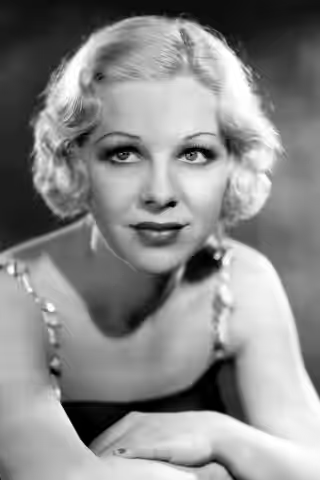
Glenda Farrell's rapid-fire delivery made her stand out in the supporting roles she was handed. Warner Bros. spent a decade casting her as the wisecracking blonde; she spent it quietly making the type into a person, and the Torchy Blane films are where it shows.
Fi1m perspective
Glenda Farrell says her line before the other actor has finished theirs, and she is nearly always the one in the scene who has worked out what is going on. That was her trade at Warner Bros. for most of the 1930s: the chorus girl, the gold-digger, the gangster's woman who has heard every promise before, and, best of all, the reporter who has the story while the police are still finding their hats. She was rarely the lead. She did not need to be; she needed a doorway and a line.
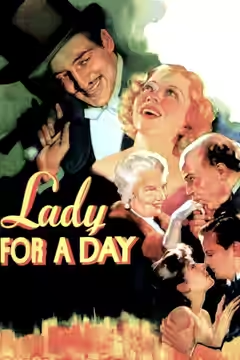
She came up through stock theatre as a child and reached Broadway in the late 1920s, then signed with Warners around 1930 and worked at the rate the studio expected. Little Caesar (1931), opposite Edward G. Robinson, put her in the gangster pictures. Mystery of the Wax Museum (1933) gave her an early go at the fast-talking newspaperwoman, and Frank Capra used her in Lady for a Day the same year. Nine times she was paired with Joan Blondell as a double act, two blondes talking over each other and over the men. Then came Smart Blonde (1937) and Torchy Blane, seven films in three years with Barton MacLane as the policeman she keeps beating to the facts. She left Warners in 1939 and did character parts in film, television and theatre into the late 1960s, among them Regina Bush in George Stevens's The Talk of the Town (1942).
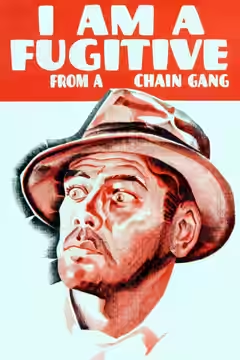
The one film of hers we have reviewed shows the studio using her badly. In Mervyn LeRoy's I Am a Fugitive from a Chain Gang (1932), the first of her four films with him, she is Marie Woods, the landlady who works out who Paul Muni's fugitive is. The part asks her to sneer and nothing else, and she sneers well; the film is too busy and too angry to give her more. We were irritated on her behalf. In a stretch where Muni is waiting for his new life to be taken away, Farrell is the only person who plainly knows what she wants and says so, and the script treats that as a fault in the character rather than an asset in the actress.
She knew what the type was worth and what it was not. Before the first Torchy film, she said, "I determined to create a real human being—and not an exaggerated comedy type," and she went and watched working newswomen to do it. That is the difference between her and the dozens of other quick blondes on the lot: the speed is not the joke, it is the character thinking. The cost was that the studios could see nothing else. After Torchy the parts repeated themselves, and the later pictures mostly hand her the same woman with a new name.
Start with the Torchy Blane films, which were built around her. Then watch I Am a Fugitive from a Chain Gang and notice how much of her a great film could afford to waste.
Biography
Glenda Farrell was an American actress whose career in film, television and theatre spanned more than four decades. She began acting on stage as a child and appeared in numerous Broadway productions before signing a contract with Warner Bros. in the early 1930s.
She is known for roles in Little Caesar (1931), I Am a Fugitive from a Chain Gang (1932) as Marie Woods, Mystery of the Wax Museum (1933) and Lady for a Day (1933) as Missouri Martin. Farrell starred as the reporter Torchy Blane in a series of Warner Bros. films from 1937 to 1939. Later credits include The Talk of the Town (1942) and television appearances such as Ben Casey, for which she received an Emmy Award in 1963 for outstanding supporting actress. She was awarded a star on the Hollywood Walk of Fame in 1960.