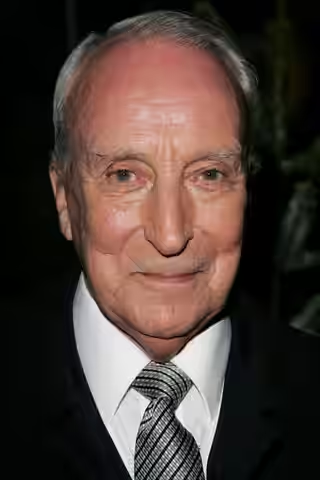
Ian Richardson could make courtesy sound like a warning without losing a word of it. We value the precision, but House of Cards shows the greater skill: making an appalling man entertaining without excusing him.
Fi1m perspective
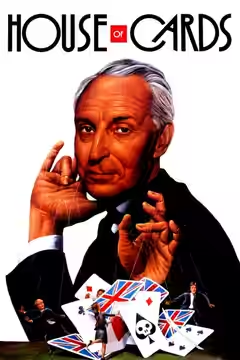
In House of Cards (1990), Ian Richardson looks towards the camera as though he has decided we are worth taking into his confidence. Francis Urquhart's asides give us access to a man we have good reason not to trust. Richardson makes the invitation hard to resist, with diction so exact that the courtesy and the insult arrive together. We laughed at his polite contempt, then felt uncomfortable about how much we had enjoyed it. He keeps us entertained without allowing us to mistake Urquhart for a decent man.
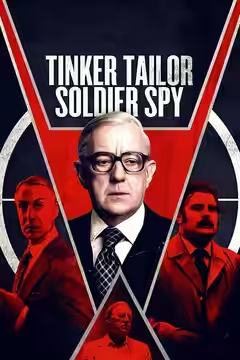
The stage work helps explain how little of a sentence he wastes. Leading Shakespearean roles with the Royal Shakespeare Company came before broader work, including Henry Higgins in My Fair Lady (1976). Bill Haydon in Tinker Tailor Soldier Spy (1979) was his first major television role, and television became a home for his cutting delivery and aptitude for villains and authority figures. By the Urquhart trilogy, which ran from 1990 to 1995, that voice had found the part which would define his public image. There is a risk of mannerism in such exact delivery, but in House of Cards Richardson knows when to leave a line alone.
Paul Seed's direction gives him room to be arch without turning every sentence into a bid for applause. Cinematographers Jim Fyans and Ian Punter keep the images formal around him, wisely declining to compete with his knowingness. Ken Ledsham's production design gives the surroundings a persuasive air of entitlement. Howard Billingham's editing keeps the manoeuvres clear, leaving Richardson to supply the amusement and menace. Jim Parker's music sometimes insists on the wickedness when the actor has already made it plain.
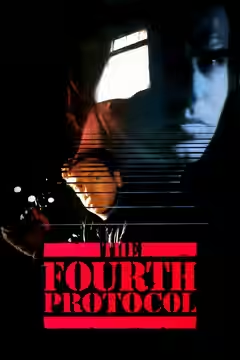
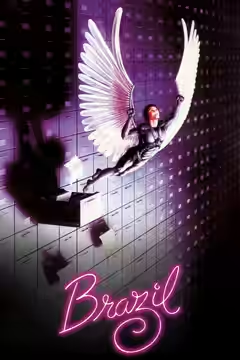
The series does depend too heavily on him: its supporting characters need more life of their own. Richardson can make Urquhart's certainty about other people funny, but he cannot supply everything the writing has left out of those people. His film parts, including Mr Warrenn in Brazil (1985) and Mr Book in Dark City (1998), offer routes beyond the role that came to dominate his reputation. We would not mistake that dominance for a complete account of his work. Start with House of Cards, but do not expect to feel pleased with yourself for laughing.
Biography
Ian Richardson (1934–2007) was a Scottish actor. He trained at the Royal Scottish Academy of Music and Drama and began his career in repertory theatre before becoming a founding member of the Royal Shakespeare Company in 1960, where he performed leading Shakespearean roles for many years.
Richardson gained wider recognition for his television work. He played Bill Haydon in the 1979 BBC adaptation of Tinker Tailor Soldier Spy and Francis Urquhart in the BBC trilogy House of Cards (1990), To Play the King (1993) and The Final Cut (1995). He received a BAFTA Television Award for Best Actor for the first series of House of Cards. He was appointed CBE in 1989.
His other screen credits include roles in Brazil (1985), M. Butterfly (1993) and Dark City (1998). He was married to actress Maroussia Frank from 1961 until his death; they had two sons, one of whom, Miles Richardson, is also an actor.