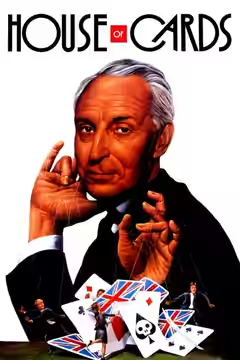
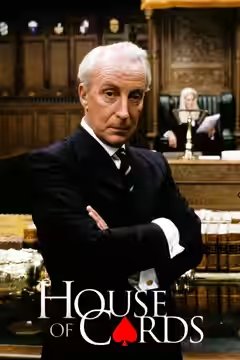
Ian Richardson makes this sharply written political thriller a disreputable pleasure. The supporting characters need more life of their own, but the scheming is brisk, funny and worth the time it asks of us.
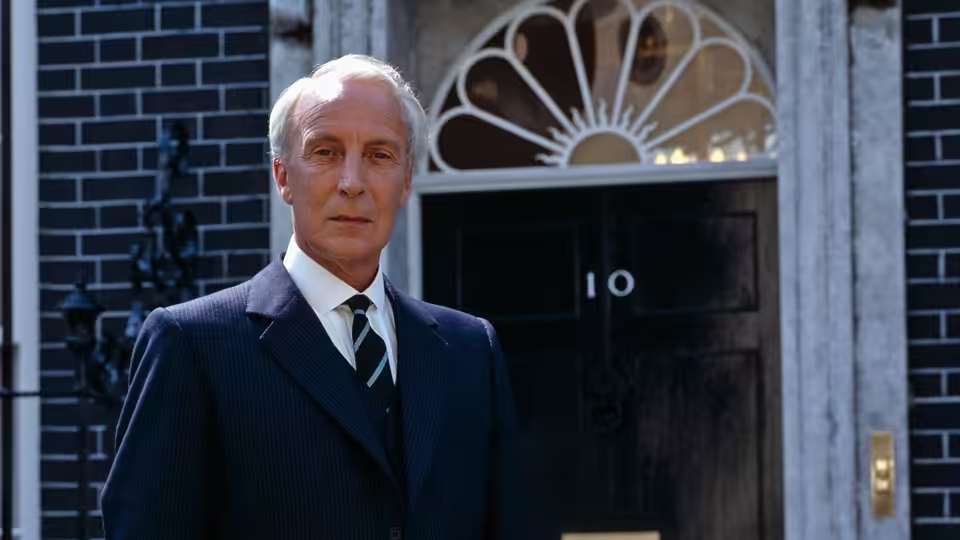
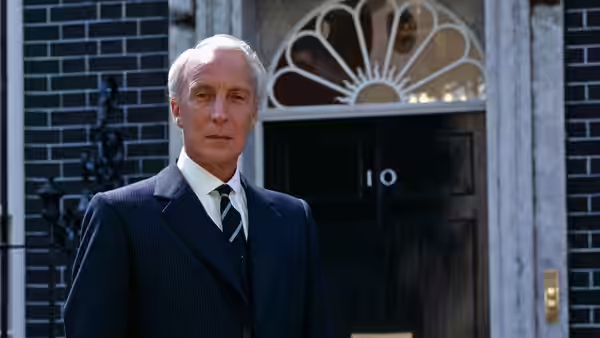
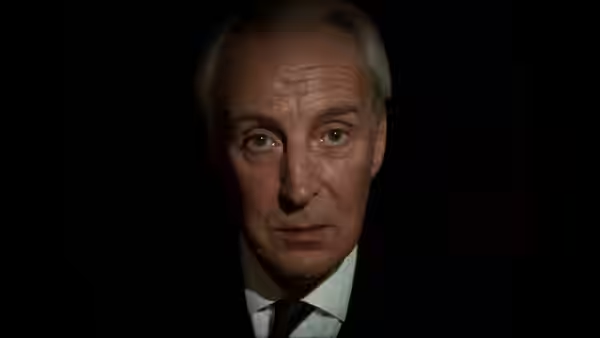
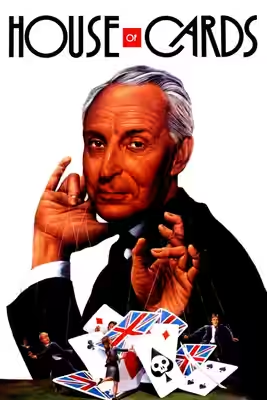
House of Cards is a sharply entertaining political thriller with one considerable advantage: Ian Richardson makes its chief schemer worth watching even when everyone else needs more to do. Paul Seed directs the four-part series with a welcome appetite for the unpleasantness of Francis Urquhart, a chief whip impatient for promotion. The humour depends on our enjoying a man we would have good reason to distrust. Richardson makes that bargain easy to accept, which is where some of the discomfort comes from.
Richardson’s delivery is arch, but he avoids making every line sound like an invitation to applaud. His Urquhart seems certain that he has understood the people around him before they have finished understanding themselves. We laughed at the way he makes contempt sound courteous, then felt grubby for enjoying it. That reaction matters: the performance keeps the scheming entertaining without asking us to mistake Urquhart for a decent man.
Andrew Davies’s script gives him plenty to work with. Adapted from Michael Dobbs’s novel, it takes evident pleasure in political calculation and in the language used to make ambition sound respectable. Seed treats the material as melodrama and allows it to be theatrical without letting the humour cancel the threat. The plotting is devious enough to hold our attention, though the sharpest writing is concentrated so heavily on Urquhart that the imbalance eventually begins to show.
Jim Fyans and Ian Punter’s cinematography feels appropriately formal around Richardson, whose performance would not benefit from a camera trying to be equally knowing. Ken Ledsham’s production design gives the pursuit of office a persuasive air of entitlement. These are useful choices for a story about people who regard proximity to power as their natural condition. The surroundings support the performances without demanding that we admire them separately.
Howard Billingham’s editing is particularly valuable in keeping the plotting clear. There is pleasure in following the manoeuvres, and the cutting does not confuse complication with excitement. Jim Parker’s music is more insistent about the drama’s wickedness than we always need it to be. Richardson already supplies so much amusement and menace that the extra encouragement can feel unnecessary, though it is a small complaint in a series that generally knows how to maintain its pace.
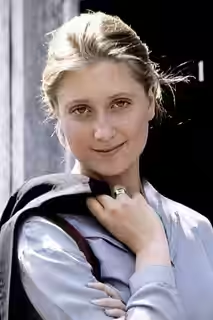
The supporting characters are the more substantial limitation. Susannah Harker’s Mattie Storin and Miles Anderson’s Roger O’Neill have to hold our attention beside a central role that gets most of the wit and psychological interest. Davies does not give the surrounding people enough independent life, and their usefulness to Urquhart can become too apparent. A thriller benefits from characters whose desires seem to continue beyond the immediate plot; here, we too often find ourselves waiting for Richardson to return.
As political melodrama, this asks us to accept a concentrated dose of calculation and vanity. Anyone after a broad account of how government works should adjust their expectations before settling in. Four episodes is a sensible commitment for this much enjoyable bad behaviour, even with the thinner roles. Choose it when the prospect of a well-spoken scoundrel sounds like better company than someone admirable.