J. Lee Thompson made honest British dramas in the 1950s and then decades of Hollywood thrillers and action films, some good, many not. He was at his best with a grievance and a small budget, and Conquest of the Planet of the Apes (1972) shows why.
Fi1m perspective
The whole of 1991, in Conquest of the Planet of the Apes (1972), is one concrete plaza. There are no jungle sets and no money for them, so J. Lee Thompson puts his police in helmets and jackboots, his apes in colour-coded jumpsuits, has Bruce Surtees shoot the ramps and blank glass in hard sun, and lets the place do the work. The first wide shot of that plaza, with humans in black standing over their property, gave us a chill the rubber masks should have made impossible, because the location is real and the arrangement of bodies on it reads at once as a chart of who owns whom. That is Thompson at his best: a blunt script, a small budget, and no apology for either.
He came to it late in a long career. Thompson started in theatre and screenwriting in the 1930s, served in the RAF during the war, and directed his first feature, Murder Without Crime, in 1950. The decade that followed is the one his admirers point to: a run of British dramas and thrillers, Yield to the Night, Woman in a Dressing Gown (1957), Ice Cold in Alex (1958), Tiger Bay, that kept looking at people the rest of the country would rather not have looked at, and asking what a conscience is for. Then The Guns of Navarone (1961) made his name abroad, and he stayed abroad, making thrillers and adventures in Hollywood for the rest of his working life. Cape Fear (1962) is the one from that period people still talk about. The Charles Bronson pictures he made for Cannon towards the end are not.
The turn is not hard to read, and Thompson read it himself. Looking back, he said: "I would rather have stuck to making films like Yield to the Night which had some integrity and importance. But the British film industry caved in." So he took the work that was there, four films with Gregory Peck, nine with Bronson, and did what could be done with the scripts he was given. When the script had a grievance in it, as Paul Dehn's did for Conquest, that was a great deal. When it did not, and by the Cannon years it mostly did not, the result was competent and forgettable, and even his defenders do not pretend otherwise.
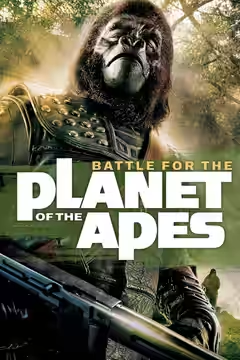
Start with Conquest. It is the cheapest of the Apes films and the angriest, and Thompson's refusal to dress up the poverty is what makes the anger land. He directed the next one too, in 1973, for the same producer, Arthur P. Jacobs. The 1950s films are where the reputation lives and where we would go after that. A man who wanted to make films of integrity and importance spent his last working years making Charles Bronson films; the plaza suggests the earlier man was still in there, waiting for someone to hand him a reason.
Biography
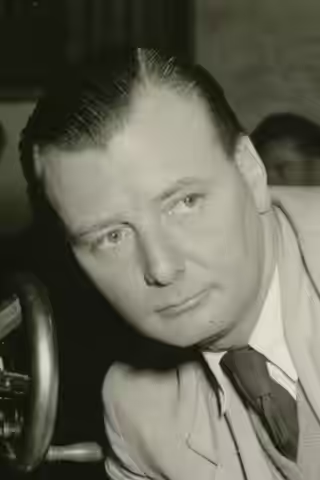
J. Lee Thompson (also credited as John Lee Thompson) was an English film director, screenwriter and producer. Born John Lee Thompson on 1 August 1914 in Bristol, England, he died on 30 August 2002 in Sooke, British Columbia, Canada. He began his career in the British film industry in the 1930s and later worked extensively in Hollywood.
Thompson directed a wide range of films, including the social realist drama Woman in a Dressing Gown (1957), the war film Ice Cold in Alex (1958), the adventure The Guns of Navarone (1961), the thriller Cape Fear (1962) and the Planet of the Apes sequels Conquest of the Planet of the Apes (1972) and Battle for the Planet of the Apes (1973). Later credits include Mackenna's Gold (1969), Happy Birthday to Me (1981), 10 to Midnight (1983), King Solomon's Mines (1985) and several Charles Bronson action films.
He received an Academy Award nomination for Best Director for The Guns of Navarone and was nominated multiple times for BAFTA Awards.