Film review

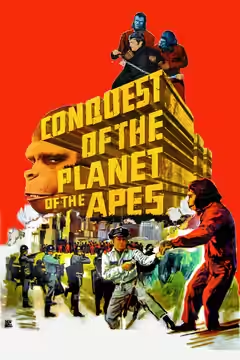
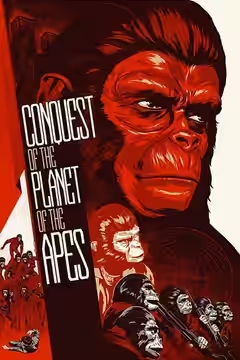
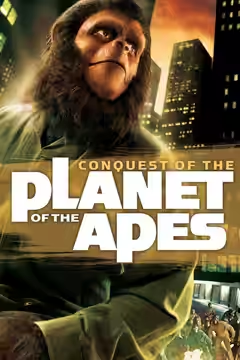
Conquest of the Planet of the Apes

1972 · Directed by J. Lee Thompson · 1h 28m · MPA PG

In a sentenceEighty-eight minutes of men in black beating chimpanzees in an office plaza, until the chimps have had enough

ActionScience Fiction

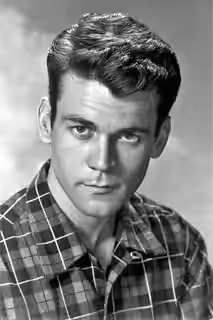
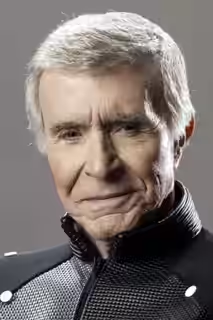
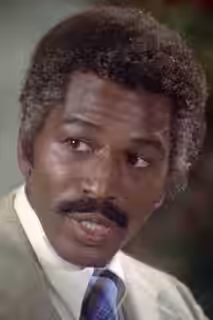
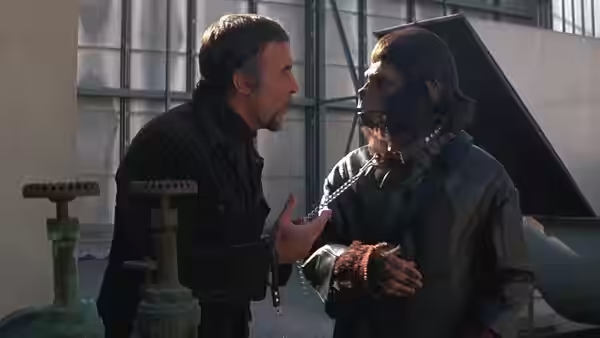
North America, 1991. A plague has killed the world’s cats and dogs, and humans have taken apes first as pets and then as servants. Armando (Ricardo Montalban), a circus owner, arrives in a city of concrete walkways and black-uniformed police with Caesar (Roddy McDowall), the talking chimpanzee son of Cornelius and Zira, whom he has raised in secret and passed off as a performing animal. Caesar sees an ape beaten in the street and cannot keep quiet. Armando takes the blame and is held for questioning by Kolp (Severn Darden), the governor’s interrogator. Alone, Caesar hides among a shipment of orangutans, passes through the state’s conditioning centre and is sold at auction to Governor Breck (Don Murray), whose assistant MacDonald (Hari Rhodes) is the one human who looks at the apes with anything like pity.

Fi1m review

The fourth Apes film is the cheapest and the angriest, a slave revolt staged on a concrete plaza with rubber masks and real fury. J. Lee Thompson cannot hide the budget and does not try; what he has instead is Roddy McDowall and a grievance.

By the fourth film the Apes series had run out of planet and started on the calendar. Escape from the Planet of the Apes (1971) brought two talking chimpanzees back to the present day and left their infant behind; Conquest jumps to 1991 to show how that infant, now grown, starts the war the first film only remembered. Paul Dehn’s script has one idea and it is a blunt one: the apes are slaves, the city is a police state, and a revolt is coming. J. Lee Thompson directs it without apology.

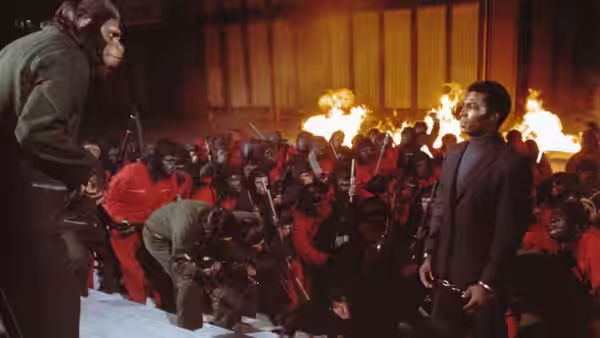
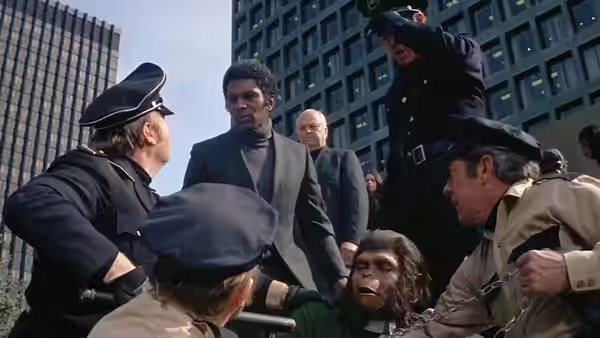
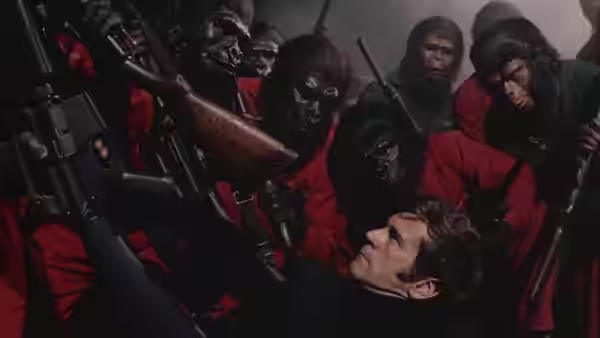
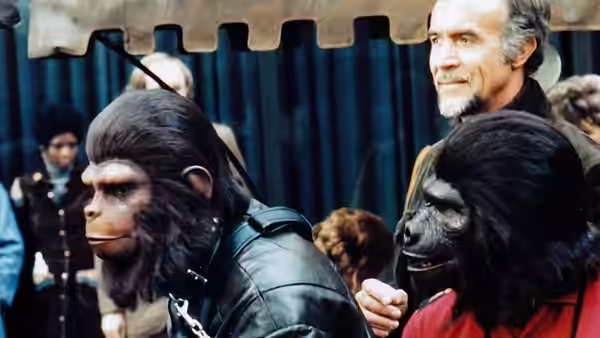
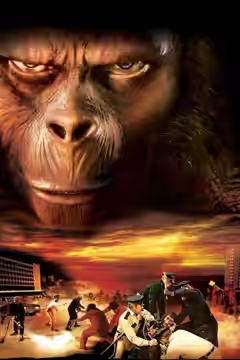
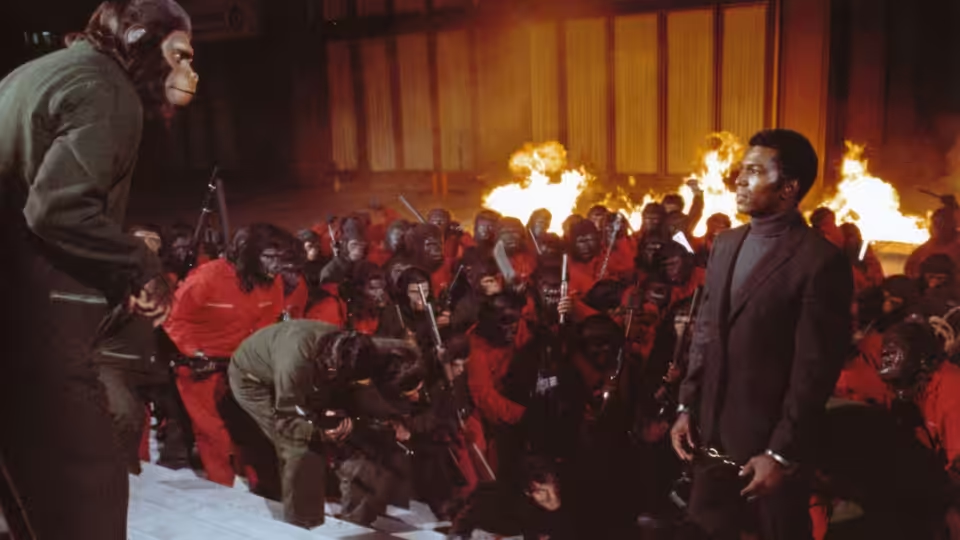
The budget shows, and Thompson turns that into the look of the film. There are no jungle sets; the whole of 1991 is one real modern plaza of concrete ramps, walkways and blank glass, shot by Bruce Surtees in hard sun and deep shadow so the place looks abandoned while people are still standing in it. Morton Haack puts every human in black, the police in helmets and jackboots, and the apes in colour-coded jumpsuits, so a crowd shot reads as a diagram of who owns whom. Philip M. Jefferies’s interiors are white tile and steel, an Ape Management centre that looks like an abattoir with paperwork. Tom Scott’s score is not the usual orchestral thunder but a jittery, percussive thing, closer to a nightclub than a concert hall, and it keeps the film nervous.

McDowall played Cornelius in the first and third films, and Caesar is a different job. Under the rubber he is playing a young man learning in a single day that everything he was told about the world was a kindness. Watch him at the auction, standing very still while the bidding goes on around him, and in the scene where Breck hands him a book and tells him to choose his own name. He gives the chimpanzee stillness first and then, when the fury arrives, a voice that seems too large for the face. It is the best sustained performance in the series, and it is done through a mask that leaves only the eyes.

The humans are a mixed lot. Don Murray’s Breck is a small-town bully given a city, sweating through his black suit and shouting at subordinates because he can. Severn Darden’s Kolp does the interrogating with a clammy patience. Hari Rhodes has the hard part as MacDonald, the governor’s black assistant who sees exactly what the apes’ condition rhymes with and says so, and Rhodes plays it with a tiredness that stops the allegory becoming a lecture. Ricardo Montalban is courtly and warm and slightly in a different film, which is not entirely a fault; Armando is the last kind man in the picture, and the picture needs one.

We were angrier than we expected to be, and it was the conditioning centre that did it: apes strapped down and taught their commands with flame and electric shock while a calm voice repeats the word and the camera simply watches. It is done cheaply and it works. Then the revolt comes and the cheapness starts to cost. The extras’ masks are a step down from the leads’, the same three corridors are fought over several times, and Marjorie Fowler and Alan Jaggs cut the riot so fast that the geography goes and we lose track of who is winning where. For a stretch of the last twenty minutes we were watching men in rubber heads run past the same glass door.

The ending was altered before release, and a longer cut restoring the original exists; several critics prefer it, and we will describe neither. What can be said is that the last few minutes of the theatrical version do not match the eighty that come before them, and the seams are easy to see.

Against the series’ own standards this is the boldest thing after the 1968 original and the roughest thing in it. Rise of the Planet of the Apes (2011) told the same story with a great deal more money and, in places, less nerve. This one runs 88 minutes and carries a 15, and it does not waste many of them. Watch it for McDowall, for Surtees’s shadows, and for the rare sight of a studio sequel that is furious about something.

Critical consensus AI synthesised

71
Positive
9
Mixed
3
Negative
1

Most critics come down in favour, and the warmest reviews are the most recent ones. Several call this the angriest and boldest film in the series, a slavery-and-fascism allegory that builds resentment towards a riot-scale uprising. Praise clusters on J. Lee Thompson’s direction, credited with hiding a small budget behind claustrophobic sets, expressive lighting and clashes staged to look like real riots, and on Roddy McDowall’s Caesar, whose speech several reviews single out. Where the director’s cut and its harsher original ending are mentioned, they are preferred.

The reservations are about money and repetition. Empire finds the film going through the motions, ticking off series lore; RogerEbert.com is the lone negative, calling the production cheesy, the action repetitive and the story seemingly improvised. Film Stories notes the budget straining in the finale and Ricardo Montalban sitting oddly against the serious tone. The spread is wide, from the low thirties to ninety, with the 1970s notices settled in the middle.

The AV Club
11 July 2017 · Noel Murray
90*

The critic calls it the boldest film in the series, crediting J. Lee Thompson with pure cinematic artistry through minimal dialogue and effective use of locations to depict a dystopian world of ape servitude. They single out the large-scale violent clashes resembling real-world riots and the despairing original ending.

Read the full review →
The Hollywood Reporter
15 May 2024 · Richard Newby
90*

The critic praises the film as pure rage and revolution, highlighting its anger and impact on the modern franchise despite its place in a commercial series. They single out the violent revolution, Caesar’s impassioned speech, and the director’s cut’s uncompromising conclusion.

Read the full review →
The New York Times
30 June 1972 · Howard Thompson
70*

The fourth entry in the series is not bad, propelled by furious direction and crisp philosophizing, with Roddy McDowall stealing the picture as the articulate ape leader leading a revolt.

Read the full review →
Vulture
10 May 2024
70*

The critic notes the director disguises the low budget well and praises the potent political allegory along with claustrophobic sets and expressive lighting. They single out the director’s cut for its more faithful and satisfying conclusion over the theatrical ending.

Read the full review →
Empire
28 March 2006 · Sam Toy
60*

The film feels like going through the motions even for fans, drawing slavery and fascism analogies while checking off series lore. It strains to stay engaging but remains true enough to the spirit of the series to get over the line.

Read the full review →
Radio Times
★★★ · Alan Jones
60

The fourth film in the sci-fi saga illustrates how the ape revolt happened in the first place, with Caesar leading enslaved simians against humans. Gritty direction from J Lee Thompson and fun philosophising with moral lessons and role reversals make it a compelling outing.

Read the full review →

Cast

If you liked this, try…