Film review

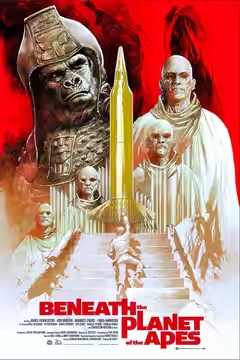
Beneath the Planet of the Apes

1970 · Directed by Ted Post · 1h 35m · MPA G

In a sentenceCharlton Heston turns up, sighs, walks into the desert, and for the next forty minutes we understood the impulse

AdventureScience FictionMystery

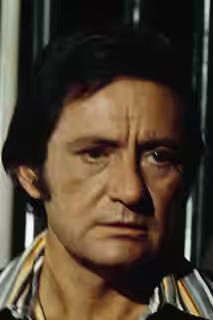
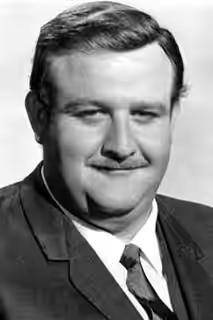
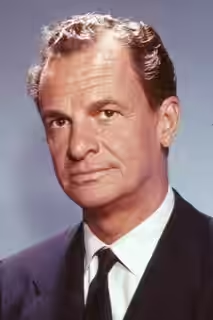
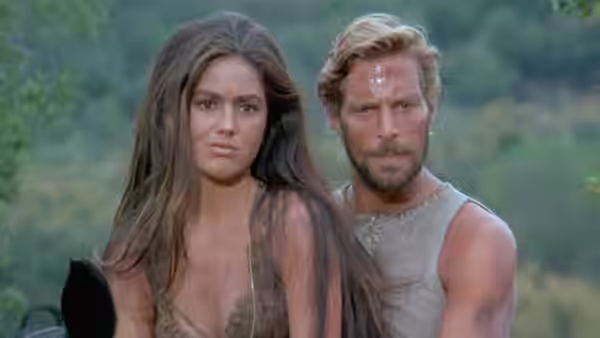
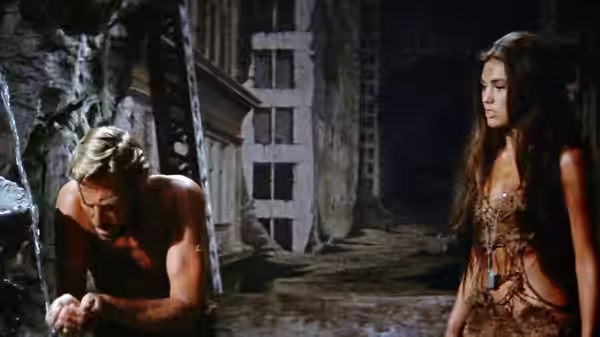
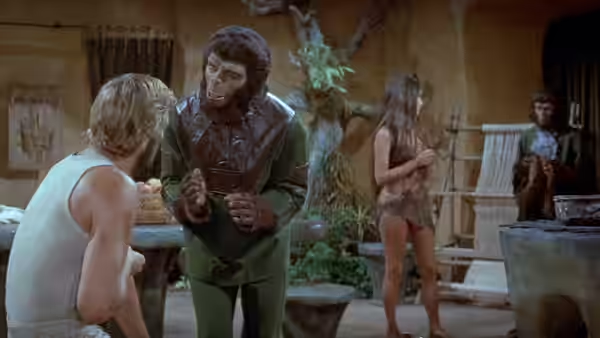
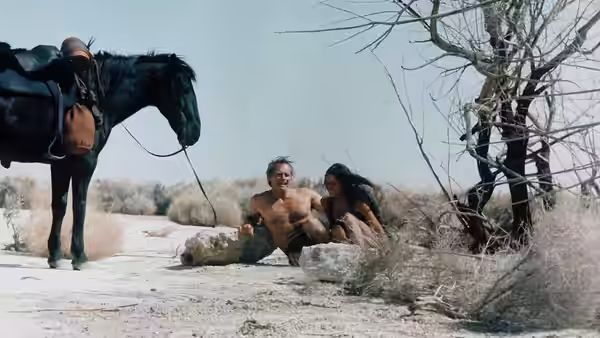
Astronaut Brent (James Franciscus) crash-lands in a desert, the sole survivor of a ship sent to find out what became of Taylor’s expedition. Taylor (Charlton Heston) has already ridden into the Forbidden Zone with the mute Nova (Linda Harrison) and vanished in front of her; Brent finds her wandering alone, wearing Taylor’s dog tags. She leads him to Ape City, where General Ursus (James Gregory) is whipping the gorillas into a war against whatever lives in the Zone, while Dr. Zaius (Maurice Evans) counsels caution and then rides with him. Chimpanzee scientists Zira (Kim Hunter) and Cornelius (David Watson) hide the human at their own risk. Brent and Nova flee ahead of the gorilla army and find a way down into tunnels beneath the desert.

Fi1m review

Ted Post’s sequel spends its first half retracing the original with a smaller cast and its second half somewhere far stranger. A gorilla general, a Leonard Rosenman score and a last minute of real nerve; not quite enough for a whole evening.

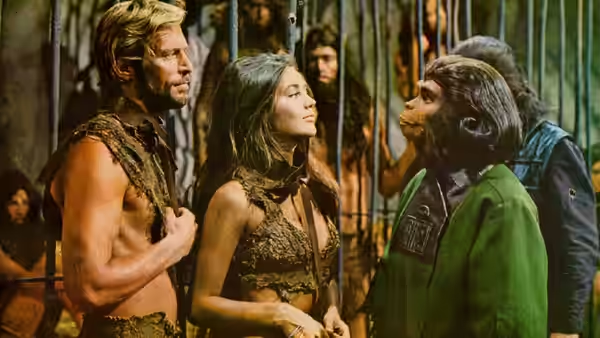
Two years after Planet of the Apes, Ted Post’s sequel picks up where Franklin J. Schaffner’s film left off and, for its first forty minutes, does the same things again in cheaper clothes. Another spaceship comes down in the desert. Another man in a torn shirt is dragged into Ape City with a rope round his neck. Paul Dehn and Mort Abrahams wrote the script, and it knows it is repeating itself and hurries, and the hurry shows. The film runs 95 minutes, and about half of them are new.

James Franciscus has the thankless part. Brent is Taylor without the temper, and Franciscus plays him as a decent, baffled man who keeps asking where he is. Charlton Heston appears at the start, walks into the Forbidden Zone, and comes back for the end, and his scenes have the air of a favour being repaid. Linda Harrison’s Nova has no lines and does more with a look than the script manages for anyone else. Kim Hunter’s Zira is still the kindest presence the series has, and Cornelius has been recast with David Watson, which is the sort of economy a viewer notices.

The film wakes up when the apes start talking politics. James Gregory’s General Ursus is a gorilla with a podium, and his rally, fists in the air, the only good human a dead one, is staged with the crowd roaring back and the camera set low. Maurice Evans’s Dr. Zaius sits beside him with the face of a man who knows better and will go along anyway. A line of chimpanzees turn up with placards to protest the march and are ridden down. It is broad. It is also 1970, and Dehn is not hiding what he means by it. We laughed at the placards and then felt uneasy about laughing, because the gorillas’ cheering had started to sound like something we had heard on the news.

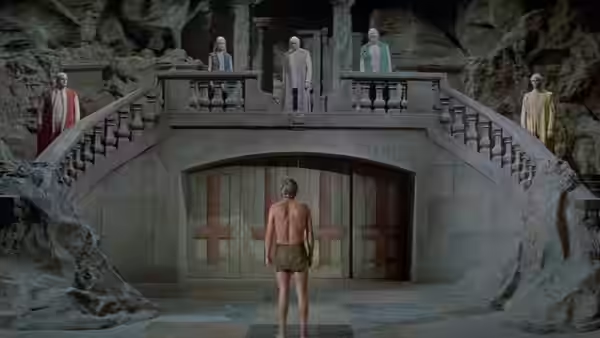
Then the film goes underground, and here Post and his crew earn their keep. Milton Krasner shoots the Forbidden Zone in bleached, flat daylight and the tunnels beneath it in green and amber, so that Brent and Nova seem to climb down out of a photograph into a stained-glass window. What they find there we will leave alone, beyond saying that there is a congregation, that Victor Buono and Paul Richards preside over it with evident enjoyment, and that Leonard Rosenman’s score, which has been all brass and clatter above ground, drops into an organ mass with the words of a familiar hymn turned inside out. We were unnerved. It was the hymn that did it, sung straight-faced by people who believe every word.

What does not work is the joins. Marion Rothman cuts a film that is two half-films, a western with apes and a horror picture in a cellar, and the seam runs straight across the middle. Once below ground the dialogue explains and explains, and every time the film has a good image it stops to tell us what it means. The gorilla army’s march across the desert is handsomely shot and takes a long time to arrive anywhere. The masks that were so good in the first film are visibly cheaper on the back rows here, and the crowd scenes have the thin look of a production told to spend less.

Schaffner’s film had a joke to tell and saved it for the last shot. This one has a point to make about the Bomb and makes it out loud, several times. The reviews at the time complained that the story could not carry ideas that size, and they were right: the congregation’s rites and the apes’ warmongering each get a good half-hour, and neither becomes more than a sketch.

Then there is the final minute, which is the one thing everyone remembers. We will not describe it. It is the most reckless thing a studio sequel of its era attempted, the film has not done the work to earn it, and we admired the nerve anyway.

Worth an evening if the first film is fresh and you want to see where the series lost its head and found a different one. Otherwise it is a curiosity with a good score and a gorilla who can hold a rally. The 15 certificate looks steep; it was made for boys who wanted apes on horseback, and it gives them plenty.
Critical consensus AI synthesised

43
Positive
2
Mixed
2
Negative
6

Most critics find this a lesser sequel to Planet of the Apes, and six of the ten reviews are negative. Where praise exists, it gathers in two places: the production design of the underground mutant city, with its ruined New York landmarks, and the ending, which even the harshest notices concede is bold and bleak.

Reservations centre on everything before that finale. Several critics see the first half as a clunky rehash of the original, reusing sets and plot beats on a reduced budget, with Charlton Heston barely present. The telepathic mutants and their bomb cult are called schlocky by some and heavy-handed by others; The New Yorker objects to the film lecturing on imperialism and the Bomb rather than satirising anything. The spread is wide. The contemporary notices from 1970 are the most hostile, while later writers at HeyUGuys and Film Stories rate it a brave, imaginative sequel, and Radio Times calls it the best of the follow-ups.

Radio Times
★★★ · Alan Jones
60

The first sequel to the enormously successful Planet of the Apes is also the best. Less subtle and profound than its predecessor, it's still an exciting and colourful action adventure with a startling finale.

Read the full review →
Empire
28 March 2006 · Ian Nathan
40*

The critic views it as a fair but lesser sequel to the original film, hampered by a reduced budget and Charlton Heston's minimal involvement. They praise the elaborate design of the Forbidden City while noting the shift to a more gothic, action-oriented tone replaces the original's sharp satire.

Read the full review →
The New Yorker
13 June 1970 · Penelope Gilliatt
35*

This is the most left-wing ape picture yet, overloaded with thunderingly platitudinous opinions on every large subject from imperialism to the Bomb. It is frightening in the wrong way, by weight of attitudinizing rather than force of satire, and the story is not the right receptacle for such big notions.

Read the full review →
RogerEbert.com
8 April 2024 · Gerardo Valero
30*

This is one of the lesser films in the series, rehashing sets and plot elements from the original while introducing implausible elements like telepathic mutants worshiping a bomb. The apocalyptic ending works reasonably well but the film loses impact without the original's surprise factor.

Read the full review →
The New York Times
29 May 1970 · A. H. Weiler
30*

The sequel is a derivative melodrama and pretty juvenile, proving that a follow-up to striking science fiction can fall short. It has a few amusing and creative scenes to its credit, such as chimps picketing for peace and views of ruined New York landmarks as the mutants' sanctuary.

Read the full review →
Variety
31 December 1969 · Variety Staff
20*

This sequel is hokey and slapdash, with the story and direction falling far short of the original. Dialog, acting and direction are substandard, though the apocalyptic ending draws on the first film's closing sequence.

Read the full review →

Cast

If you liked this, try…

Planet of the Apes poster84

Planet of the Apes

1968 · The original, where the joke is kept for the last shot and lands harder.

Dr. Strangelove poster93

Dr. Strangelove

1964 · The Bomb played for laughs by people who understood it was not funny.

Quatermass and the Pit poster

Quatermass and the Pit

1967 · Something old under London, and the past explaining the present with a straight face.

La Jetée poster

La Jetée

1962 · Twenty-eight minutes of stills that do more with ruins than most features manage.

The Omega Man poster

The Omega Man

1971 · Heston alone in an emptied Los Angeles, taking the end of the world personally.