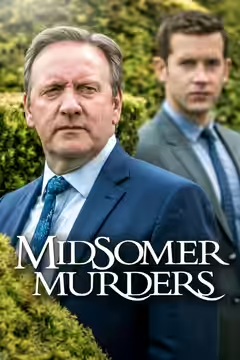
Jeremy Silberston set the table for two of British television's longest-running detective series and then stepped back while others sat down. His direction is designed not to be noticed. On Midsomer Murders that is the point, and also the limit.
Fi1m perspective
Put on an early episode of Midsomer Murders and nothing announces a director. The lawns are green, the stone is gold, the light is flat and bright, and the camera sits where a polite guest would sit. Jeremy Silberston directed the 1997 pilot, The Killings at Badger's Drift, and nine episodes in all, and when we reviewed the series we could not tell his work from Renny Rye's or Peter Smith's. That is not an accident. He worked out how the thing should look and then made it look that way until everyone else could do it too.
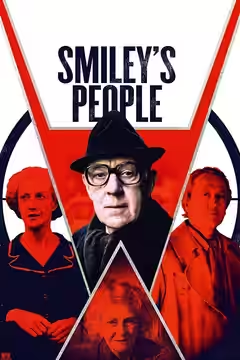
He came up through the BBC's production side: assistant floor manager on Tinker Tailor Soldier Spy in 1979, then production manager on Smiley's People, Doctor Who and Bleak House. He turned to directing in the 1980s and 1990s on Brookside, EastEnders, Casualty, The House of Eliott and around 29 episodes of The Bill, a decade of bringing stories in on time with nobody watching the director. Then he and the writer Anthony Horowitz developed Midsomer Murders together, Horowitz passed him the script of Foyle's War early, and he directed eight episodes of that from 2002. He kept working, on Where the Heart Is, The Inspector Lynley Mysteries and more Foyle's War, until his death in 2006.
The Midsomer look is a team effort, and he was the one who first assembled the team's habits. Doug Hallows lights the villages so that nothing stays in shadow, corpses included; Jim Parker's theremin tells you in ten seconds not to worry; Derek Bain cuts at a Sunday pace. We put an episode on again for this piece and found it restful in a way we slightly resented. Nothing in the frame asked to be looked at twice, and by the second body we had stopped trying. That is the design, it is why the series has run for nearly three decades, and it is also why our review said it asks nothing of you.
Foyle's War suggests the brightness was a choice rather than a default. There he went the other way, towards muted photography and real locations rather than the chocolate-box look, and he said the point was the period: "We do not attempt to portray war in terms of fighting, but its influence on the home front fills the stories." We have not reviewed it and will not judge it at length. But the same man made one county look like a postcard and the war years look muted and real, and in both cases the direction stayed out of the way.
The complaint in our review, that you cannot tell one episode's direction from another, is a complaint about the series and a compliment to the man who made it possible. Both programmes carried on for years without him, because he had made sure they could. If you want to see what he did, watch an early episode and a late one and notice that you cannot tell them apart. That was the job.
Biography
Jeremy Silberston (1 April 1950 – 9 March 2006) was an English television director. After training at the BBC as a production director in the late 1970s, he worked on a range of popular drama series including EastEnders, Casualty and The Bill.
He directed nine episodes of Midsomer Murders (1997) between 1997 and 2003, including the pilot. With writer Anthony Horowitz he co-developed both Midsomer Murders and Foyle's War (2002), directing eight episodes of the latter series.