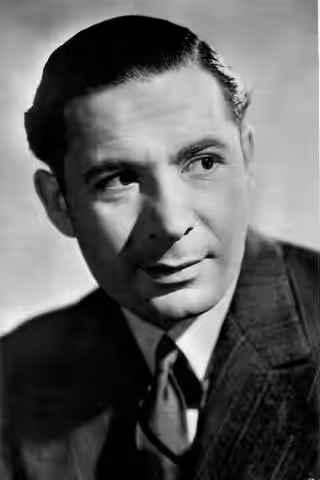
Leo Genn's instrument was a low, unhurried voice and a face that gave nothing away, and he spent thirty years lending both to doctors, officers and Romans. He was never dull to listen to; he was sometimes hard to remember afterwards.
Fi1m perspective
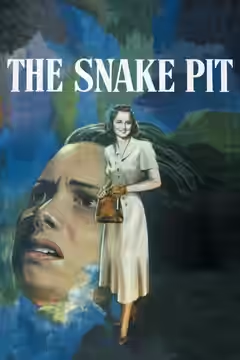
Watch Leo Genn tell someone bad news. He does not lean in and he does not lower his eyes. The voice does the work, low and even, the one that got him called black velvet in his own lifetime, and the face waits to see how it lands. In The Snake Pit (1948) his Dr Mark Kik takes on Olivia de Havilland's Virginia and starts her on electroshock in the tone of a man confirming an appointment. That sequence horrified us, and part of the horror is Genn. Anatole Litvak stages it as routine, a trolley, a gag, a nurse counting, and Genn plays it as routine too; the doctor's voice never rises. Leo Tover keeps the camera on de Havilland, and Genn is the calm at the edge of the frame, which is where he did his best work.
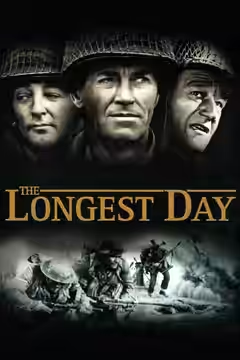
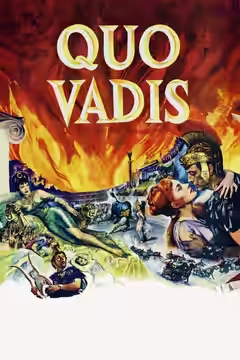
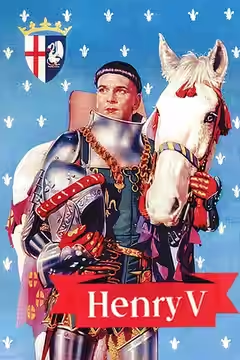
He came to it late. He practised as a barrister before turning to the stage at the Old Vic in the early 1930s, and he was in films from 1935. The war took him away, as a Lieutenant-Colonel in the Royal Artillery, and when he came back in 1945 the industry cast him, more or less for the rest of his life, as the one man present who has seen worse. Olivier had already used him as the Constable of France in Henry V (1944), where he speaks the verse as if it were conversation. Then Hollywood: Kik in 1948, Petronius in Quo Vadis (1951), Starbuck in John Huston's Moby Dick (1956), a brigadier general among the crowd in The Longest Day (1962), and smaller parts on into the 1970s.
Petronius is the performance people remember, the poker face turned to sarcasm, and by most accounts it is his wittiest hour. We have not reviewed it and will not pretend to. What we can say from The Snake Pit is that the stillness needs something to push against. De Havilland gives him a face that never settles, and his settled one means something beside it. Hand him a script with nothing to steady and he simply stays steady, and the word that followed him through the fifties and sixties was bland. We would put it differently: he was an actor who did not audition for the audience. He was rarely cast as the lover, and one can see why. The voice promises and the face declines.
Our own reservation about The Snake Pit lands partly on him. The psychiatry the film uses to explain Virginia is tidier than any mind we have met, and Kik is its spokesman; Genn delivers the tidiness so gently that we wanted to believe it, which is the film's problem and his gift in one. He said of leaving the law that "somewhere inside me there was an actor trying to be heard". Heard is the right word. Start with The Snake Pit, and watch what he does while de Havilland is talking. The answer is almost nothing, and it is enough.
Biography
Leo Genn (also credited as Leo John Genn) was an English actor and barrister. Born in London in 1905, he qualified as a barrister in 1928 after studying law at the University of Cambridge. He began acting in the early 1930s, appearing with the Old Vic company, and made his film debut in 1935.
During the Second World War he served in the Royal Artillery, reaching the rank of lieutenant-colonel, and later assisted with war crimes investigations at Belsen. Genn appeared as The Constable of France in Laurence Olivier’s Henry V (1944). He received an Academy Award nomination for Best Supporting Actor for his performance as Petronius in Quo Vadis (1951). Other notable screen roles include Starbuck in Moby Dick (1956) and Brigadier General Edwin P. Parker Jr. in The Longest Day (1962). He continued working in film, television and radio until the mid-1970s and died in London in 1978.