Marc Munden makes unsettling drama with real sympathy for the people caught in it. We rate the performances he draws from young actors; sometimes his camera needs to trust them and stop insisting on the horror.
Fi1m perspective
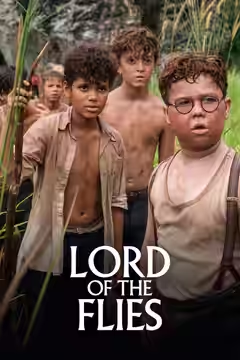
In Lord of the Flies (2026), Marc Munden keeps bringing us back to faces too young for the cruelty around them. We were frightened by those close-ups because the boys still looked like children, not figures safely removed from us by a familiar story. Mark Wolf's cinematography makes the island hard to enjoy as scenery, using distorted views as well as that uncomfortable proximity. Munden and writer Jack Thorne approach the boys with sympathy without excusing them. It is a persuasive reason to adapt the story again, and the performances are strong enough to survive some overemphasis behind the camera.
With The Mark of Cain (2007), he established himself in hard-edged contemporary drama. Utopia (2013–14) brought a heightened visual style to a conspiracy story. His subsequent work includes National Treasure (2016) and Help (2021), the latter written by Thorne and concerned with care-home workers during the pandemic. Thorne has become a recurring collaborator on stories about power, vulnerability and institutions failing the people in them. Those subjects give Munden something to do beyond devising unusual pictures.
In Lord of the Flies, David McKenna's Nicholas “Piggy” and Lox Pratt's Jack Merridew are allowed to seem uncertain rather than arrive as ready-made illustrations of human wickedness. Winston Sawyers's Ralph belongs convincingly alongside them. We watch children responding to each other, with little sense of a young cast patiently demonstrating the importance of the book. Munden deserves credit for getting that plainness from the ensemble while making such deliberately peculiar pictures. It also makes us less forgiving when a camera choice announces that something is disturbing before the actors have finished showing us.
Simon Walker's production design gives the island enough credibility to accommodate those distortions, and Cristóbal Tapia de Veer's music keeps us uneasy. The craft supports the children until Munden presses it too hard. Four episodes also leave the adaptation with more space than it needs, a real reservation about a director drawn to extended stories of breakdown. We would still start with Lord of the Flies. Give its young cast time; they need less assistance from the camera than Munden sometimes thinks.
Biography
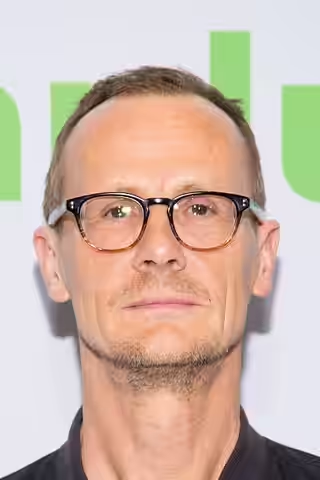
Marc Munden is an English film and television director. Born in London, he studied mathematics and philosophy at University College London. He began his career as an assistant to directors including Mike Leigh, Derek Jarman and Terence Davies, before directing documentaries for the BBC.
His television credits include directing episodes of Utopia (2013), Black Sails (2014), Quantico (2015), National Treasure (2016), Philip K. Dick's Electric Dreams (2017), The Third Day (2020), Help (2021), The Sympathizer (2024) and the four-part series Lord of the Flies (2026). He has also directed the feature films The Mark of Cain (2007) and The Secret Garden (2020).
Munden has received three BAFTA Awards and multiple nominations, along with Royal Television Society Awards, an International Emmy and a Peabody Award.