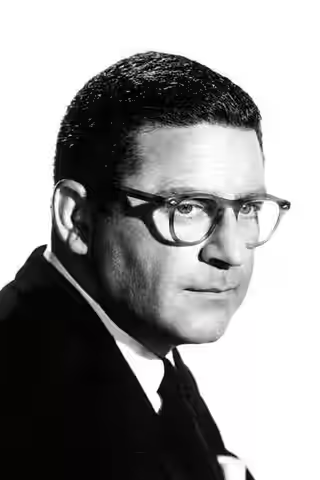
Mark Robson began as an editor and directed like one: plainly, at a steady pace, with the volume kept down. It made him a safe pair of hands for scandalous bestsellers and expensive disaster pictures, and it is why so few of them are anyone's favourite.
Fi1m perspective
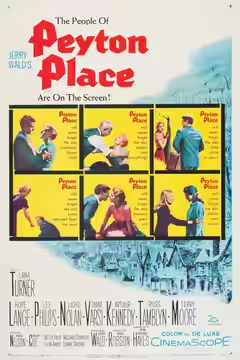
The best scene in Peyton Place (1957) has no music. Lucas Cross has come home drunk to the shack across the tracks, the lamp is low, and Robson does the one thing the rest of the film never dares: he holds on Selena's face and lets the silence do the work. It frightened us, and nothing in the pastel town around it had prepared us for that. Then the film draws the curtains, quickly, and goes back to opening doors one household at a time. That is Robson in a paragraph: a director who could do the plain hard thing when he chose to, and who mostly chose not to.
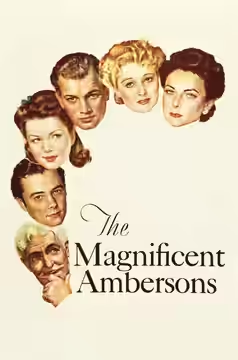
He came up as an editor at RKO in the early 1940s, assisted on Citizen Kane, and worked on horror pictures for Val Lewton before being promoted to direct one. The Seventh Victim (1943) was the first; Isle of the Dead (1945) and Bedlam (1946) followed, five films with Lewton in all. They are cheap, dark and quiet, and quiet is the word that stays with him. The break came in 1949 with Champion and Home of the Brave, both for Stanley Kramer: a boxing picture and a drama about racism, made a decade before the studios found either subject comfortable.
From there he became the man a studio sent for when it had bought something big. Peyton Place was a scandalous bestseller; he made it handsome, well acted and a good deal politer than the book, while Douglas Sirk, working the same ground at the same time, let the colour do the screaming. The Inn of the Sixth Happiness (1958) came the next year. Then the pictures got larger and the notices got worse: Von Ryan's Express (1965), Valley of the Dolls (1967), which most critics could not stand, and Earthquake (1974), which he also produced and which shook the seats with a system called Sensurround. He died in London in 1978, having just finished Avalanche Express.
What works is the steadiness. He opens a dozen households in Peyton Place and never loses a thread, and John Michael Hayes's screenplay, with its watched neighbourhood, suits him. What does not work is the same thing. George Axelrod, who wrote Phffft (1954), thought the editor in Robson got in the way of the comedy, and we would go further: it got in the way of anything that needed the director to lose his composure. Sirk shouted; Lewton whispered; Robson, having learned from the second, spent thirty years declining to do the first.
Start with Peyton Place, for Hope Lange and Diane Varsi and that one scene in the shack, then go back to the Lewton films to see what he could do with no money and the lights off. The big pictures of the sixties and seventies can wait. They were built to be seen once, and once is enough.
Biography
Mark Robson (4 December 1913 – 20 June 1978) was a Canadian-born film director, producer and editor who worked in Hollywood. He began his career as a film editor before directing his first feature in 1943.
Robson directed 34 films, including Champion (1949), The Bridges at Toko-Ri (1954), Peyton Place (1957), The Inn of the Sixth Happiness (1958), Von Ryan's Express (1965), Valley of the Dolls (1967) and Earthquake (1974). He received Academy Award nominations for Best Director for Peyton Place and The Inn of the Sixth Happiness, and was awarded a star on the Hollywood Walk of Fame in 1960.