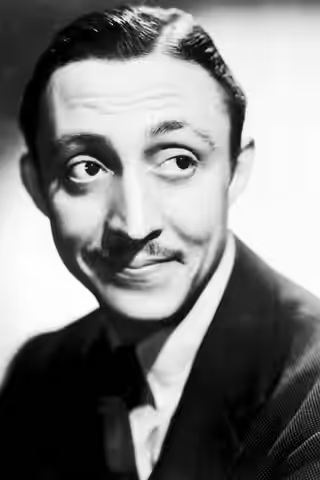
Mischa Auer played the Mad Russian for Hollywood for thirty years: the accent, the manner, the grand verdicts on other people's art delivered to a room that had not asked. It is one note. In the right ensemble it is the one you remember.
Fi1m perspective
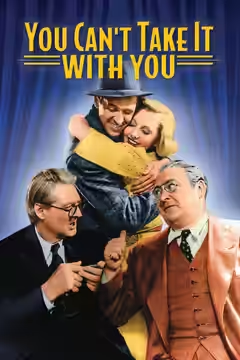
In the Vanderhof parlour in You Can't Take It with You (1938), Essie dances across the parlour in a tutu, her husband plays the xylophone for her, fireworks go off in the cellar, and a tall Russian at the edge of it all watches the dancing and announces that, confidentially, it stinks. That is Mischa Auer's part in one line. He is the man in the corner with opinions about art, a heavy accent and no intention of leaving. Capra gives him little else to do, and he does not need it.
He had been in American films since 1928, mostly uncredited or as villainous foreigners, when Gregory La Cava cast him as Carlo in My Man Godfrey (1936). It changed what Hollywood wanted from him. "That one role made a comedian out of me," he said later. "I haven't been anything else since." What followed was a run of eccentric Russians and assorted foreigners in the comedies of the late thirties and early forties: Kolenkhov for Capra, Boris in Destry Rides Again (1939), Pepi in Hellzapoppin' (1941). Later there was television, European work, and the Professor in Orson Welles's Mr. Arkadin (1955).
What works is the ensemble. In the Capra film Joseph Walker shoots the house in depth, so there are always two or three things going on behind whoever is talking, and Gene Havlick cuts to the racket rather than to the lines. Auer is built for that arrangement. He does not need a scene of his own; he needs a room to disapprove of. We laughed at the verdict on Essie's dancing, and then found we were still watching him after the line had gone, waiting to see what else he would find wanting. He is funnier waiting than talking.
What does not work is anything that asks for a second note. After 1936 the parts changed their names and hardly changed their manner, and the complaint that there was little light or shade in him followed him to the end, into the stage revivals of the sixties. On the evidence we have, it is fair. He did not seem to mind. The Mad Russian was a type Hollywood wanted for a long time, and he supplied it.
So see him in the Vanderhof house, where the film is at its best when it is simply making noise and he is one of the noises. Do not go looking for another Auer somewhere in the filmography. He told us himself there was not one.
Biography
Mischa Auer was a Russian-born American actor. Born Mikhail Semyonovich Unskovsky in Saint Petersburg in 1905, he moved to the United States as a teenager and began his career on the stage in the 1920s, including work in Yiddish theatre in New York. He made his film debut in 1928 and appeared in numerous supporting roles through the early 1930s.
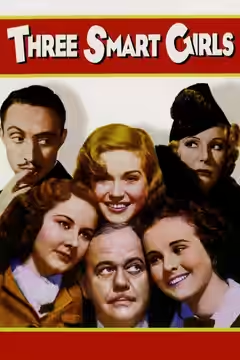
Auer gained prominence in the mid-1930s with comic character parts. He played Count Arisztid in the musical comedy Three Smart Girls (1936) and was nominated for the Academy Award for Best Supporting Actor for his role as Carlo in My Man Godfrey (1936). He is also known for appearances as Kolenkhov in You Can't Take It with You (1938), Boris in Destry Rides Again (1939) and Nikita Starloff in And Then There Were None (1945).
Auer continued working in films and later television into the 1960s, including roles in European productions. He died in Rome in 1967.