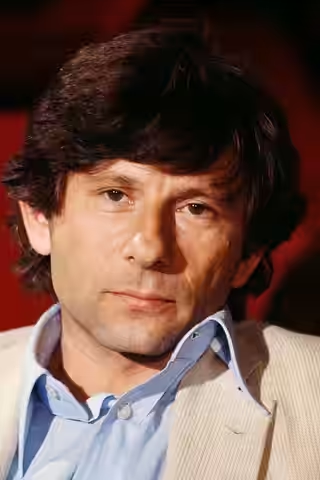
Roman Polanski makes suspense out of people under pressure, often with little room to escape. We rate his patient, unsettling work highly, especially Chinatown, though the confined settings and repeated struggles for control can become familiar.
Fi1m perspective
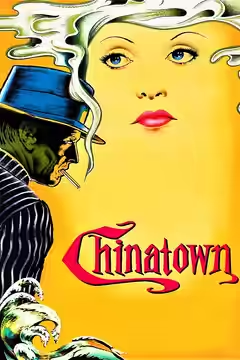
In Chinatown (1974), Jack Nicholson makes private investigator Jake Gittes's confidence dangerously persuasive. Polanski keeps the enquiry close to what Gittes can understand, so following a clue does not necessarily make us feel safer. We were unsettled by the way Nicholson's assurance stopped being reassuring; we had been persuaded to rely on it. This is Polanski working at a high level, giving us an investigator worth following without asking us to accept his judgement.
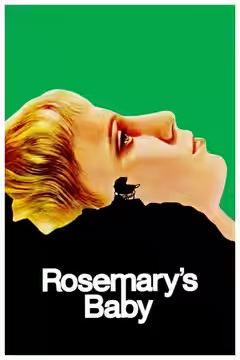
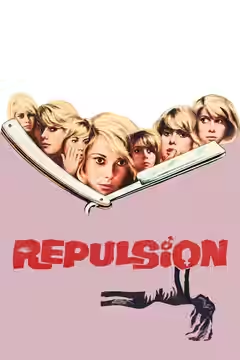
His first feature, Knife in the Water (1962), built tension around a psychological triangle. Repulsion (1965) used confined space for horror, while Rosemary's Baby (1968) developed his interest in paranoia and isolation. These restrictions suit his attention to atmosphere, but they also establish habits that can become predictable.
Chinatown benefits from giving that suspicion something concrete to investigate: an irrigation scandal in 1930s Los Angeles. Robert Towne and Polanski's screenplay makes ownership and control part of the mystery rather than background information to be endured. The people withholding information are interesting enough to keep the case alive. There are crowded stretches when tracking the enquiry takes work, but the complication rarely overwhelms our interest in those involved.
Sam O'Steen's editing gives new information time to register, though even his patience cannot make every connection easy to follow. Jerry Goldsmith's restrained score lets the unease persist without continually announcing danger. These are crucial contributions to a film that still offers the satisfaction of following clues. Polanski does not need to discard the pleasures of a detective story to make us question the detective.
His later European work includes The Pianist (2002), followed by chamber pieces and adaptations through the 2010s. The less adventurous Based on a True Story (2017) is a reminder that his familiar methods need not produce the same tension each time. Start with Chinatown, and give its crowded investigation your full attention.
Biography
Roman Polanski is a Polish-French film director, screenwriter and actor. Born in Paris on 18 August 1933, he trained at the Łódź Film School in Poland after surviving the Second World War.
His feature debut Knife in the Water (1962) brought international attention. Subsequent films include Repulsion (1965), Rosemary's Baby (1968), Macbeth (1971), Chinatown (1974) — on which he served as director and writer and appeared as the man with a knife — Tess (1979) and The Pianist (2002).
Polanski has received an Academy Award for Best Director, multiple BAFTA and César awards, a Golden Globe and the Palme d'Or.