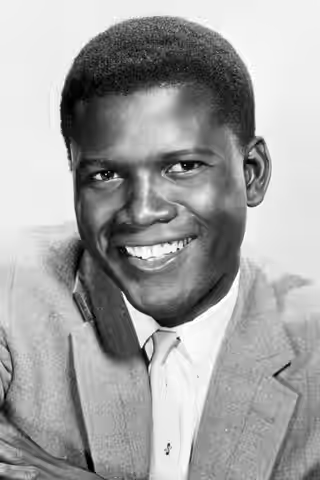
Poitier's leading men held everything back and let the little they released count double. The stillness made him a star and, for a stretch of the 1960s, a target; watch The Defiant Ones and see why both were fair.
Fi1m perspective
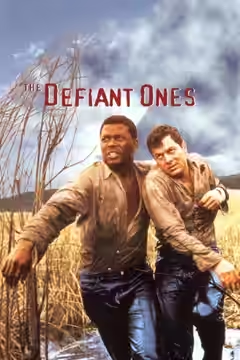
Watch Noah Cullen while Tony Curtis is talking. In The Defiant Ones (1958) Poitier spends long stretches saying nothing, chained at the wrist to a man who will not shut up, and the stillness does most of the work. When he does open his mouth it is to sing, low and unbothered, a song about a man who got clean away, and it drives Curtis's Joker to fury. He saves his anger for the two or three moments when it will land. Most of what he does on screen works like that.
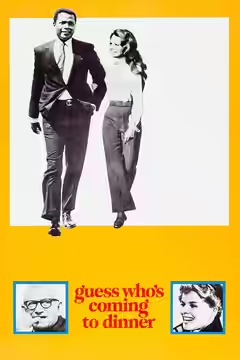
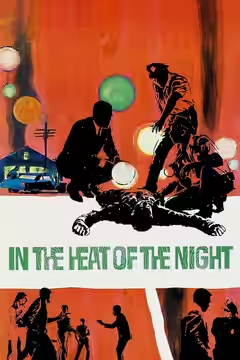
He arrived in No Way Out (1950), was noticed in Blackboard Jungle (1955), and became a star opposite Curtis under Stanley Kramer, who would direct him again. A Raisin in the Sun (1961) let him play Walter Lee Younger, a part he had done on stage, and gave him room to lose his temper properly. Then came 1967 and three leading roles in a year: Virgil Tibbs in In the Heat of the Night for Norman Jewison, John Prentice in Guess Who's Coming to Dinner, Mark Thackeray in To Sir, with Love. From the early 1970s he directed, Stir Crazy (1980) among them, and acted only now and then into the 1990s.
The voice was a made thing, a Bahamian accent worked down in New York, and it came out warm, measured and slightly formal, so that his men sounded as if they had thought before speaking. Against Rod Steiger in In the Heat of the Night that composure is the whole point of the casting. Set him next to a louder actor and he gets better, which is why the pairings with Curtis and Steiger are the ones people remember.
The cost is well known and it is real. Too often the parts asked him to be patient, wise and forgiving while the white man in the scene was allowed to be wrong and to grow, and the film's sympathy went to the man who changed. We noticed it in The Defiant Ones and it nagged at us; by the late 1960s some Black writers were saying so far more sharply. Poitier knew. "If the fabric of the society were different, I would scream to high heaven to play villains... But I'll be damned if I do that at this stage of the game," he said in 1967. He chose those parts, and he said why. It does mean a run of films in which the most interesting man on screen is not permitted to be interesting.
Our own reaction is the case for him. In The Defiant Ones the speeches about race were written to be quoted and we sat through them dutifully; the song got under our skin, because a chained man humming about escape as though he had all the time in the world told us more about Cullen than anything he was given to say. Start there, and keep your eyes on him whenever someone else has the lines.
Biography
Sidney Poitier was a Bahamian-American actor and film director. Born in Miami, Florida, on 20 February 1927, he died on 6 January 2022.
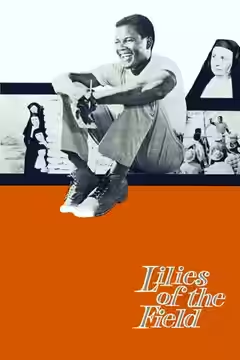
He rose to prominence in the 1950s and 1960s with leading roles in The Defiant Ones (1958), Lilies of the Field (1963), for which he won the Academy Award for Best Actor, To Sir, with Love (1967), Guess Who's Coming to Dinner (1967) and In the Heat of the Night (1967). He later directed films including Stir Crazy (1980) and Ghost Dad (1990).