Derren Litten’s package-holiday sitcom had a sharp first series and, in Sheila Reid’s Madge, a character worth the airfare, then spent a decade reheating both. Broad, loud and often lazy, it is funnier than its reputation and not as funny as it thinks.
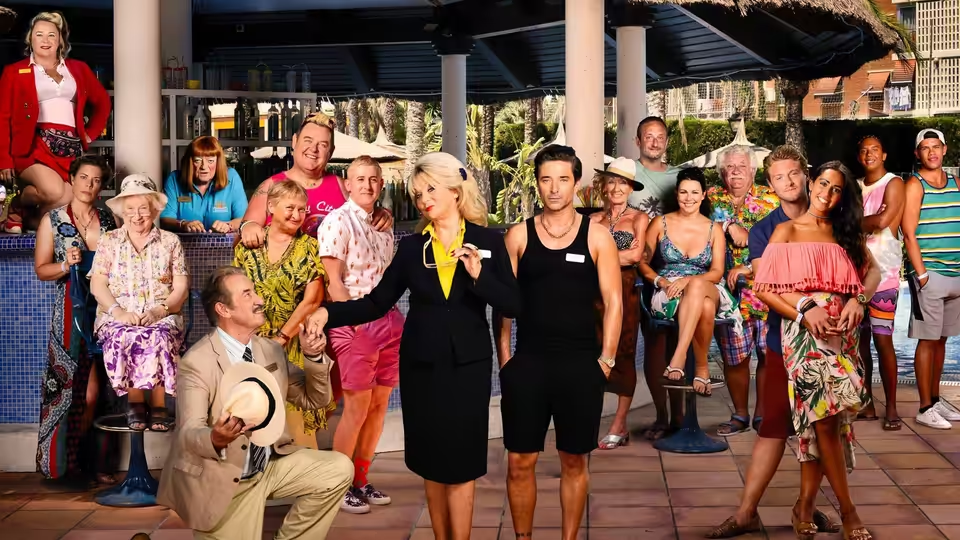
Derren Litten created Benidorm and wrote it, with Mark Brotherhood and Neil Fitzmaurice, and the idea is as plain as the resort it is named after. A hotel full of British holidaymakers who have paid for everything up front and mean to get their money’s worth, a fortnight of sun, and nowhere for any of them to go when they have had enough of each other. It first aired on 1 February 2007 and ran for ten series, the last of them starting on 28 February 2018, which is a long time to spend beside one pool. The first series is a decent, rude, well-built comedy. Most of what came after is the same comedy with the volume up.
The reason to watch is the Garveys, and the reason to watch the Garveys is Sheila Reid. Madge is a tiny woman in a sun visor who takes a mobility scooter everywhere, including places with steps, smokes as if being paid to, and says the one thing nobody else in the scene will. Reid plays her without a flicker of apology, and her timing is the show’s best asset: she waits, the table waits, then it lands. We laughed at her, out loud and more than we expected to, because Reid never once signals that Madge is meant to be funny. Siobhan Finneran as Janice does the quiet work of holding the family together and is given the few moments the series wants taken seriously. Steve Pemberton’s Mick is the man at the pool who believes he is its entertainment, and Pemberton is exact about how little he listens.
The rest of the hotel is a set of double acts. Gavin (Hugh Sachs) and Troy (Paul Bazely) snipe at each other over sun loungers and get the sharpest lines, which is to say the lines that depend on a word rather than a bodily function. Kenny Ireland’s Donald, red from the neck up and in a straw hat, asks every couple he meets what they are doing later and is never once embarrassed. Abigail Cruttenden’s Kate Weedon is the one guest who seems to have noticed where she is, and Cruttenden plays her as quietly appalled. Geoffrey Hutchings turns up as Mel Harvey, leathery and amiable, and Sheridan Smith passes through as Brandy. Nobody in this cast is coasting, which matters, because the scripts increasingly assume they will.
The jokes are the problem. Litten’s instincts run to the body: wind, sunburn, bowels, bosoms, a man in trunks that do not fit. One of each is fine. Ten series of each is a rota. The directors, John Henderson, Sandy Johnson and David Sant, shoot it bright and flat, which suits a hotel built for sun, but nobody has told the camera to trust the actors. Every gag is set up, delivered and then explained by a reaction shot, in case we were looking at the pool. We laughed at Madge, and a scene later we were laughing at a joke whose whole point is that a foreigner cannot speak English, and the laugh went sour in our mouths.
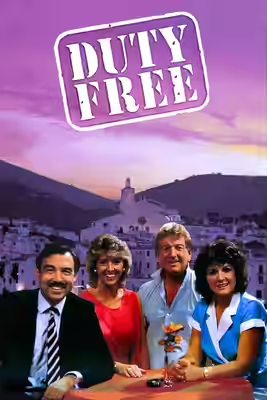
Against the long line of British sitcoms about the British abroad, it sits in the middle. Duty Free (1984) did the Marbella version with four people and a bar; Litten has a whole hotel and, some weeks, fewer jokes. The first series was six episodes; the ninth and tenth were nine each, and you can feel the stretch. Plots arrive, go nowhere and are replaced by a karaoke number. The two reviews we have read are harsher than we are, one of them considerably, and we see the case: watched in bulk, the repetition wears you down. Watched a series at a time, a year apart, as it was made to be seen, it is a cheerful evening with people you would avoid in real life, and that has always been enough to fill a hotel.
Start with the first series, which is the show at its most careful, and judge for yourselves how long the sunburn stays funny. For us it was a couple of years. Geoffrey Perkins produced it, and it is never worse than watchable and never once ambitious, which at an all-inclusive is not a complaint anyone makes. It ran for eleven years. The guests never seem to have gone home.