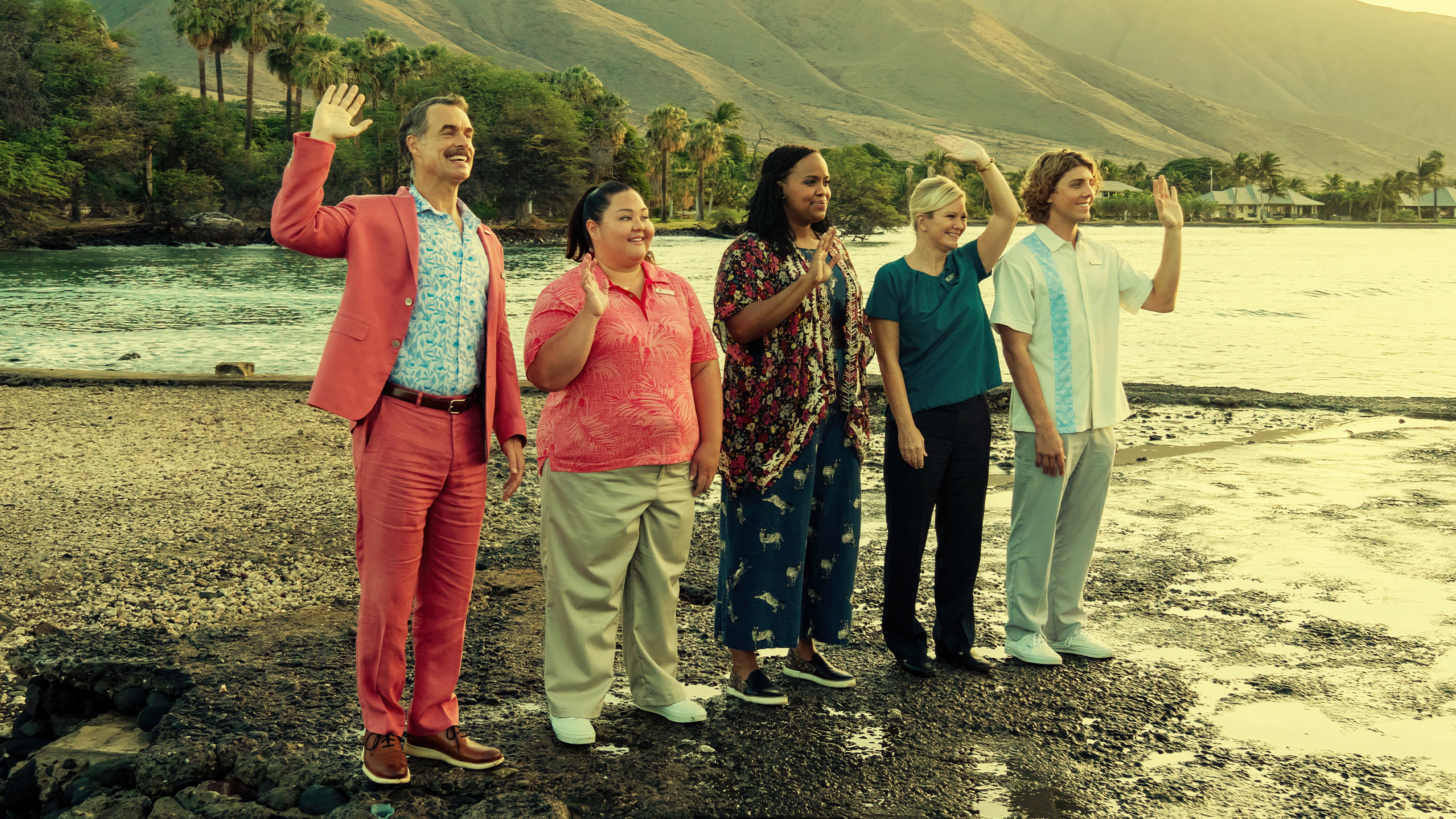
Mike White’s resort satire is funny, cruel and unexpectedly tender towards people who make tenderness difficult. The first season’s guests get more attention than its workers, but Murray Bartlett and Jennifer Coolidge make the imbalance worth tolerating.
The six-episode opening season of Mike White’s The White Lotus is sharply funny and unexpectedly affecting, though its wealthy guests get more attention than its workers. We recommend it for the performances, with that imbalance in mind. White writes and directs, keeping the holidaymakers’ demands close to the strain they cause the staff. He also gives the guests enough unhappiness to complicate the pleasure of disliking them.
Murray Bartlett’s Armond, the hotel manager, has to be funny while being worn down. Bartlett plays his unravelling as an exhausting effort to keep doing a job for people who make that job intolerable. We laughed at Armond’s hostility, then felt ashamed when Bartlett let the strain behind it show. He makes the damage convincing enough that we cannot simply enjoy the sight of a man losing control.
Jennifer Coolidge gives Tanya McQuoid a vulnerability that prevents the wealthy guest from becoming another easy target. Her neediness is funny because it takes up so much space, and painful because Coolidge makes the unhappiness beneath it convincing. White allows that unhappiness to matter without treating it as an excuse for her behaviour. Coolidge is particularly good at making Tanya’s self-absorption seem exhausting for everyone involved, including Tanya herself, and gives the comedy much of its sadness.
Xavier Grobet’s cinematography gives the Hawaiian resort enough appeal that the guests’ dissatisfaction looks faintly ridiculous. Laura Fox’s production design makes the expensive surroundings count: comfort is everywhere, yet the holidaymakers seem poorly equipped to enjoy it. That is a useful choice for a satire, since making the hotel look ghastly would let us dismiss its customers without admitting we might want their holiday. The luxury remains attractive even when the company does not.
Heather Persons’s editing gives the exchanges time to become awkward without losing the comic rhythm. There is pleasure in how long White can keep an unpleasant encounter going, although the guests’ self-absorption does begin to wear after repeated exposure. Cristóbal Tapia de Veer’s score is especially effective at making a holiday feel unsettled; it keeps us alert when the setting suggests we should relax. The music makes even the prospect of a quiet interval feel doubtful.
The weakness is in White’s writing of the staff, who can be crowded out by the guests’ more elaborately explored troubles. For a programme concerned with class, that is more than a question of balancing the cast. Too often, the workers are there to demonstrate what dealing with the rich costs, without being given comparable attention in their own right. Bartlett does much to resist that reduction, but there are stretches when the series seems satisfied with recognising entitlement, having made us expect a closer look at the people obliged to serve it.
As a comedy of bad manners, though, it is unusually attentive to the feelings behind the bad behaviour. White can make us dislike someone without turning every scene into an invitation to sneer, and Coolidge is essential to that. There is enough care in the performances to keep the nastiness from becoming routine, even when the examination of class is less searching than it could be. Start with those six episodes, but choose another programme if the purpose of the evening is to unwind.