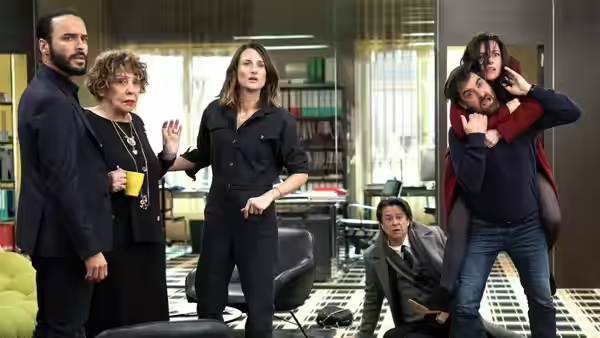
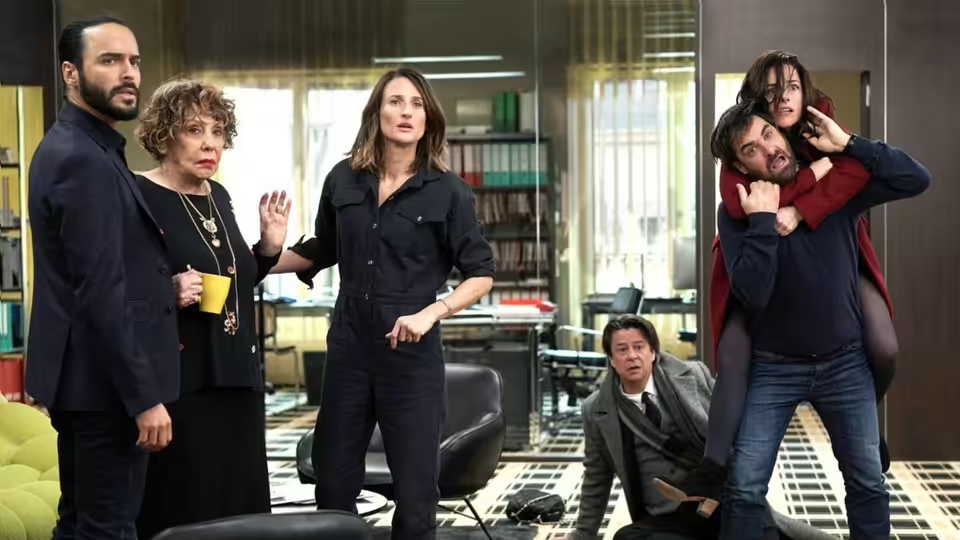
In a bright office a woman gestures while a man carries another on his back
Series review

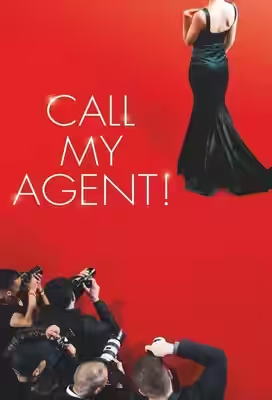
Call My Agent!

2015 · Created by Dominique Besnehard, Fanny Herrero · Series · 52m

In a sentenceFour seasons of Parisians lying into mobile phones, and by the end we would have taken their calls

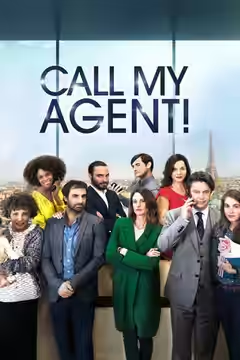
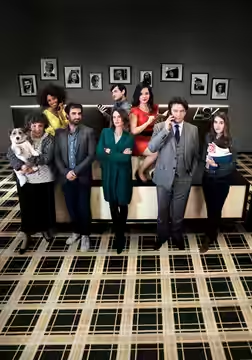
Paris, the present. A talent agency loses its founder in the opening episode, and the four agents who worked for him must stop the clients from walking out of the door. Andréa Martel (Camille Cottin) is the sharpest of them and the least able to run her own life; Mathias Barneville (Thibault de Montalembert) is smooth, senior and hiding something; Gabriel Sarda (Grégory Montel) apologises for a living; Arlette Azémar (Liliane Rovère) has done the job longer than anyone. Into reception arrives Camille Valentini (Fanny Sidney), young, provincial and with her own reason for choosing this agency. Each week a real French star comes in playing themselves, with a crisis the agents must talk around.

Fi1m review

Fanny Herrero’s comedy about a Paris talent agency is quicker, kinder and better acted than its premise promised, and Camille Cottin is the reason to start. It is fond of the business it mocks, which keeps it warm and stops it drawing blood.

Fanny Herrero and Dominique Besnehard have built a comedy on a simple engine. Four agents run a talent agency in Paris, and every week a real French actor walks in playing themselves, with a problem the agents must lie their way around. The stars are vain, frightened, ageing or all three; the agents are worse, and paid ten per cent for it. Across four seasons of six episodes each, from 2015 to 2020, the engine barely misses. This is a quick, well-acted workplace comedy that likes everyone in it, and we will come to what that costs.

The stars-as-themselves conceit could have been a parade of winks. It is not, because the actors agree to look vain, cowardly and easily bruised, and because the writing cares more about the agents’ scramble than about the star. Sigourney Weaver turns up late in the run and the joke is on the agency rather than on her. We laughed a great deal, often at people we had never heard of, which tells you the jokes do not depend on recognising anyone. They depend on watching someone lie smoothly on the phone while their face does something else.

Camille Cottin’s Andréa is the reason to start. She is the best agent in the building and the worst at everything that is not the job: she seduces, forgets, offends, and turns up to the wrong lunch. Cottin plays her fast and low-voiced, with a stare that ends conversations. When Andréa loses a client, which happens, Cottin keeps the face still and lets the loss show only in how quickly she picks up the next call. We were more moved by that than by any of the show’s proper tears, because by then the series had taught us how much the job is her, and the stillness read as damage.

Around her the ensemble is unusually even. Thibault de Montalembert gives Mathias the ease of a man who has never had to explain himself and is about to. Grégory Montel’s Gabriel is all soft panic, a good man in the wrong profession, and Liliane Rovère’s Arlette is the dry old hand who has seen every version of every crisis. The assistants are where the best comedy lives. Laure Calamy plays Noémie as a woman whose devotion to Mathias is a full-time job of its own, and Nicolas Maury’s Hervé turns every slight into an opera. Fanny Sidney has the hardest part as Camille, the newcomer we are meant to see the place through, and she grows into it. Philippine Leroy-Beaulieu, as Mathias’s wife Catherine, gets less than she deserves and does a great deal with it.

Six directors share the run, Cédric Klapisch among them, and it looks like one show. Denis Rouden, Yves Cape, Antoine Monod and Antoine Roch film the agency as a working office: glass partitions, corridors, people walking and talking with a phone at each ear, and Paris kept mostly to taxi windows and restaurant terraces. Guillaume Lauras, Sophie Brunet and Catherine Schwartz cut at the speed of a phone call and rarely hold a shot long enough for anyone to feel sorry for themselves. Each episode runs 52 minutes, and most of them earn it.

What does not work is the soap. Between the star of the week and the office, everyone is sleeping with, leaving or lying to someone, and by the third season the secrets rotate rather than develop. There is a stretch in the middle of the run where we found ourselves waiting through a romance to get back to the job, and we were irritated, because the job is what the show does well. More seriously, the series loves the industry it mocks. Nobody is ruined. No producer is a real monster. Every crisis is fixable by minute forty-five, and the fondness that makes the show so pleasant to sit with also means it never quite says what it plainly knows about how actresses of a certain age are treated. It raises the subject, and then somebody’s phone rings.

Set beside the office comedies it will be compared with, the difference is warmth and speed. The British and American versions of this idea tend to hate their characters a little; Herrero’s show cannot manage it, and after twenty-four episodes neither could we. Watch two at a time, with the subtitles on and a glass of something, and do not be put off by a first episode that is busier than it is funny. It settles within the hour.

Critical consensus AI synthesised

81
Positive
6
Mixed
0
Negative
0

The reviews are uniformly warm. Most critics take the Parisian talent agency comedy as sophisticated escapism, and the praise clusters on two things: the running joke of real French stars playing exaggerated versions of themselves, and Camille Cottin as the hard-nosed agent Andréa. Several note that the backstabbing and constant crisis are held up by a plain affection for the people involved and for cinema itself, and that the final run ends properly rather than fizzling.

Reservations are thin. The spread is narrow, from a comfortable pass at the low end to the Guardian’s near-rave, and no review is mixed or negative. The Telegraph observes that nothing really nasty happens amid the panic, which reads as a mild caveat about stakes rather than a complaint. The i Paper, the least effusive, still finds the final season silly in the best way and sharp with it. Vulture is alone in framing the show as cutthroat and Succession-like; the others see farce with a warm centre.

The Guardian
21 January 2021
90*

The series is an utterly charming word-of-mouth hit that concludes its run with cinematic flourishes and celebrity cameos, balancing soapiness with serious moments and ending properly and satisfactorily. It props up backstabbing scheming at a Parisian talent agency with a deep-rooted love of people and cinema.

Read the full review →
The Telegraph
21 January 2021 · ★★★★
80

The ritzy Parisian talent agency comedy offers sparkling sophisticated escapism with pitch-perfect performances, especially Camille Cottin as the hard-nosed agent Andréa, and a clever twist of stars playing parodic versions of themselves. Nothing really nasty occurs amid the constant panic and crisis.

Read the full review →
The Times
14 January 2021
80*

The critic praises the French series as a sharp, light, funny and warm dramedy about a Parisian talent agency whose staff navigate crises with real-life stars playing exaggerated versions of themselves. The guest star cameos and the agents' story arcs are singled out for their engaging mix of farce, drama and romcom.

Read the full review →
Vulture
20 January 2021
80*

The series offers a cutthroat, Succession-like view of the Parisian talent agency world, full of scheming, negotiation, and industry absurdity rather than cynicism or fantasy. It excels at showing the day-to-day precarity, opportunism, and memorable cameos from stars playing heightened versions of themselves.

Read the full review →
The i Paper
21 January 2021 · Gwendolyn Smith
75*

The fourth and final season is hailed as uproariously silly and still full of bite, with strong performances from the core agents and entertaining guest stars like Charlotte Gainsbourg. The behind-the-scenes agency drama and Gallic charm are praised as keeping viewers hooked.

Read the full review →
Paste
22 March 2021 · Allison Keene
85*

The critic praises the French series as an excellent, funny and emotionally deep comedy-drama about a Parisian talent agency, highlighting its well-drawn characters, satisfying resolutions, and thoughtful exploration of women in the entertainment industry.

Read the full review →

Straight answers AI written, from our review

How long is Call My Agent!, and what is it rated?
Call My Agent! has episodes of about 52m. It is a comedy and drama series.
Where can I watch Call My Agent! in Slovenia?
Call My Agent! is not on any streaming or rental service in Slovenia at the moment. It is available in 22 other countries; change your country at the top of the page to see where. Availability is checked daily.
What should I watch after Call My Agent!?
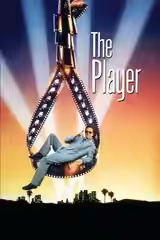
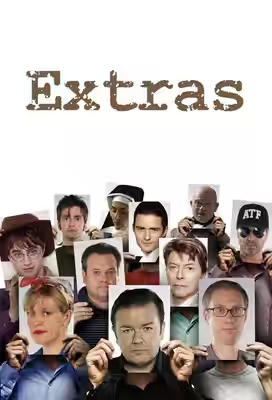
After Call My Agent!, try Extras (2005, Fi1m 81): Gervais and Merchant’s stars-as-themselves comedy, crueller than this and nearly as funny. Then The Player (1992, Fi1m 85): Altman’s Hollywood satire, where the agents and executives actually do have blood on their hands; and Hacks (2021, Fi1m 77): A comedian and her young writer, and a working relationship that becomes the real story.

Cast

If you liked this, try…

  1. Extras (2005, Fi1m 81)Gervais and Merchant’s stars-as-themselves comedy, crueller than this and nearly as funny.

  2. The Player (1992, Fi1m 85)Altman’s Hollywood satire, where the agents and executives actually do have blood on their hands.

  3. Irma Vep (1996) · not reviewed yetAssayas follows Maggie Cheung through a Paris film shoot that is falling apart around her.

  4. The Bureau (2015) · not reviewed yetFrench spies instead of French agents, same Paris, same pace, far higher stakes.

  5. Hacks (2021, Fi1m 77)A comedian and her young writer, and a working relationship that becomes the real story.

Free account

Know what to watch tonight

Two lists that know where things are streaming, collections you can share, your own score beside ours, and Discover that remembers what you have seen.

  • Want to see, sorted by what is streaming now
  • Seen, with your score out of ten
  • No adverts, ever