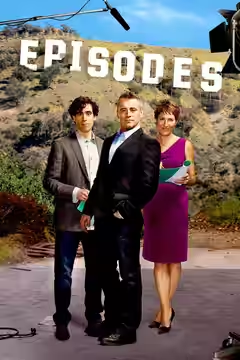
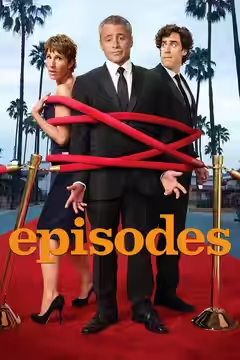
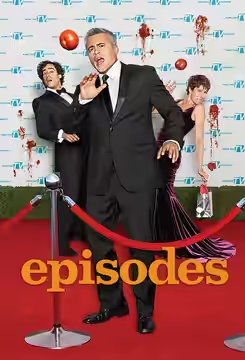
Episodes is an enjoyable, uneven television comedy whose actors are often sharper than its industry jokes. Tamsin Greig, Stephen Mangan and Matt LeBlanc make it worth trying, provided predictable satire does not spoil the evening.
Television people making a comedy about television have a head start on the details and a particular temptation to mistake recognition for a joke. Episodes, created by David Crane and Jeffrey Klarik, falls into that trap often enough to be irritating, but its actors keep rescuing it. We recommend it for their company, with reservations about how much the industry material can surprise. The comedy is most persuasive when somebody is being difficult and the person opposite has to endure it.
Tamsin Greig and Stephen Mangan give Beverly Lincoln and Sean Lincoln enough friction to sustain interest when the jokes are running thin. Their bickering works because both performances make an argument feel worth pursuing, even when we would welcome an end to it. We laughed more readily at their irritation with one another than at the programme’s cleverness about television. Their watchability makes the early predictability easier to forgive, though it cannot produce laughs that the writing has not supplied.
Matt LeBlanc, playing Matt LeBlanc, is the obvious reason to look in, and he earns the attention. Playing a named version of oneself can become an indulgence, with the audience expected to applaud the willingness to look foolish. His performance has enough assurance that we can enjoy it without congratulating him for taking the part. He also finds feeling in material that could have remained a prolonged joke about a celebrity, giving the series something useful beyond the initial curiosity of watching him play himself.
The American supporting characters supply some of the pleasure too. John Pankow plays Merc Lapidus and Kathleen Rose Perkins plays Carol Rance, and the programme benefits from looking beyond its central trio. Its account of television can be perceptive without being especially surprising. Anyone already inclined to distrust the business will find plenty to recognise, but fewer occasions to reconsider that view.
Rob Kitzmann’s cinematography is unobtrusive, and we would not choose Episodes for the images alone. The production design, credited to Miranda Jones, Chris Hansen, Jonathan Paul Green, Grenville Horner and P. Erik Carlson, is similarly discreet; the performers remain the attraction. Nigel Williams’s editing makes a more noticeable contribution to the quieter comedy, allowing small reactions enough room to register. Those passages are welcome in a programme that sometimes seems too eager to establish that it knows how the business works.
We grew impatient with the recurring security-guard gag, which keeps returning long after its joke is clear. As writers, David Crane and Jeffrey Klarik are too willing to repeat something familiar when the early episodes could use a fresh source of trouble. The later material has a better grasp of how to let feeling into the comedy without stopping to announce it. That development earns some patience, although the early shortage of laughs remains a real cost.
Television satire tends to attract an audience already willing to believe the worst about television, so a little less certainty would help here. There is enough feeling in the performances to interest anyone with no particular appetite for production gossip. Give the opening a little patience; its actors deserve the chance even when the jokes are slow to arrive.