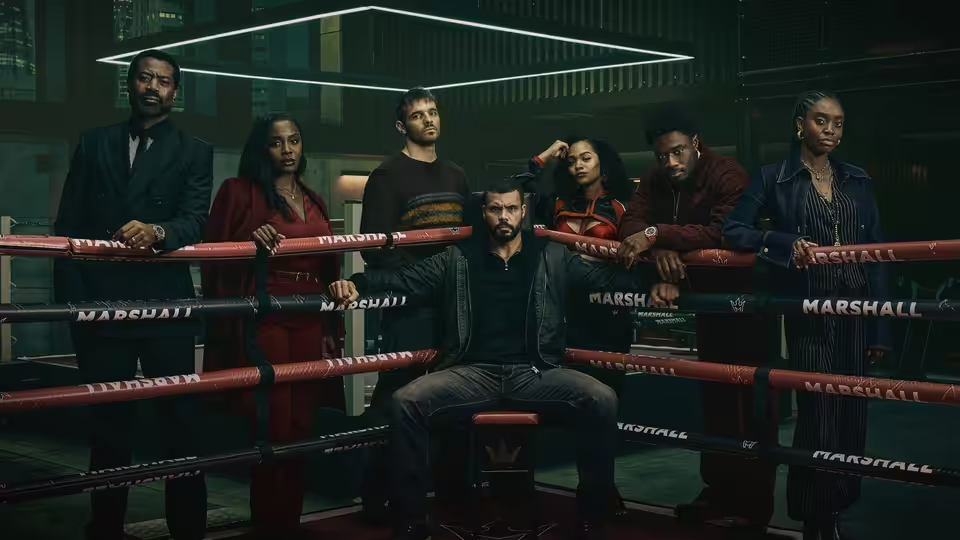
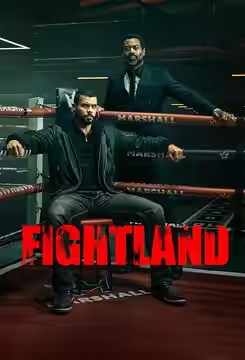
Fightland has a promising boxing premise and worthwhile work from Howard Charles and Anita-Joy Uwajeh. But muddled motives and perfunctory fights leave its crime story struggling to justify an eight-episode commitment.
Fightland has a promising boxing premise and too little interest in making the boxing count. Daniel Fajemisin-Duncan and Marlon Smith combine the sport with crime and soap-opera complications, giving their series several possible ways to hold our attention. The trouble is that the gangsters are insufficiently interesting to justify pushing the sporting story aside, and the characters’ motives are often unclear. There are performances worth noticing across this eight-episode first season, but they cannot make it an evening’s recommendation.
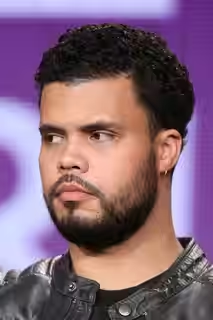
Howard Charles provides a firm centre as Maduka ‘Duke’ Kilroy, with a presence that makes the lead worth following even when the drama around him is weak. He gives the series someone who can hold our attention without much assistance. The writing leaves his presence with too much of the work to do. His physical authority is useful to a programme this slow, though it cannot keep compensating for the uncertainty about why people act as they do.
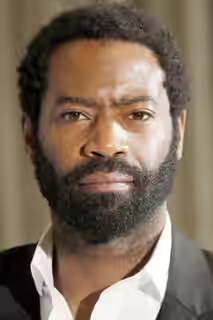
Anita-Joy Uwajeh is the stronger reason to persevere, giving Cebella ‘Cece’ Marshall some complexity in a drama that can otherwise feel blunt. She gives the part more than the required toughness, and the series needs that extra care. Nicholas Pinnock brings an unnerving edge to Kingsley Marshall and makes a more convincing impression than the routine gangster material. Those are substantial virtues, though neither performer can solve the wider problem of characters whose behaviour the writing has not made persuasive.
The boxing is where the direction most needs to be precise, and where it disappoints. Otto Bathurst and Colm McCarthy give us fights with too little sense of tactics or the decisions that distinguish one contest from another. We find these bouts frustrating: without a clear sense of strategy, the punches become less interesting than they should be. A boxing drama needs to make us understand what a fighter is trying to do, how an opponent prevents it and why a change matters.
The storytelling does gather some momentum as the boxing, criminal business and soap-opera plots become more closely entangled. That improvement keeps the series from being uniformly inert, and suggests the combination could have worked with firmer character writing. Yet having several things happen together does not resolve our uncertainty about the people making them happen. The creators supply complications more readily than persuasive reasons for them, so increased activity brings less suspense than it ought to. We are still waiting for the characters to become interesting enough to carry the plot.
Against the demands of a boxing crime drama, this is a particular waste of a useful premise. The sport offers a straightforward way to make ambition, fear and dependence visible through what people do, provided the fights receive the attention they need. Fightland keeps reducing that advantage by giving so much attention to gangsters who cannot sustain the interest their screen time requires. Admirers of Howard Charles, Anita-Joy Uwajeh and Nicholas Pinnock will find reasons to be patient, but the performances remain more compelling than the surrounding story. We would leave this one to those coming for the cast.