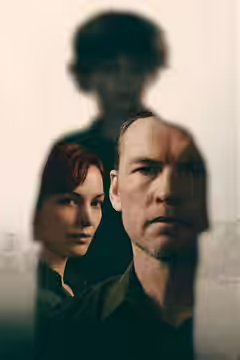
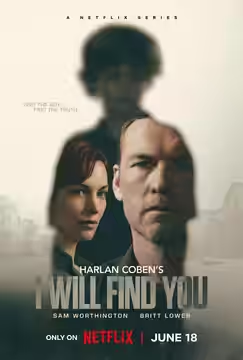
The latest Harlan Coben adaptation puts Sam Worthington over a prison wall in pursuit of a photograph, then piles twist on twist until the ground gives way. Brisk and watchable, with two good FBI agents, and it does not survive being thought about.
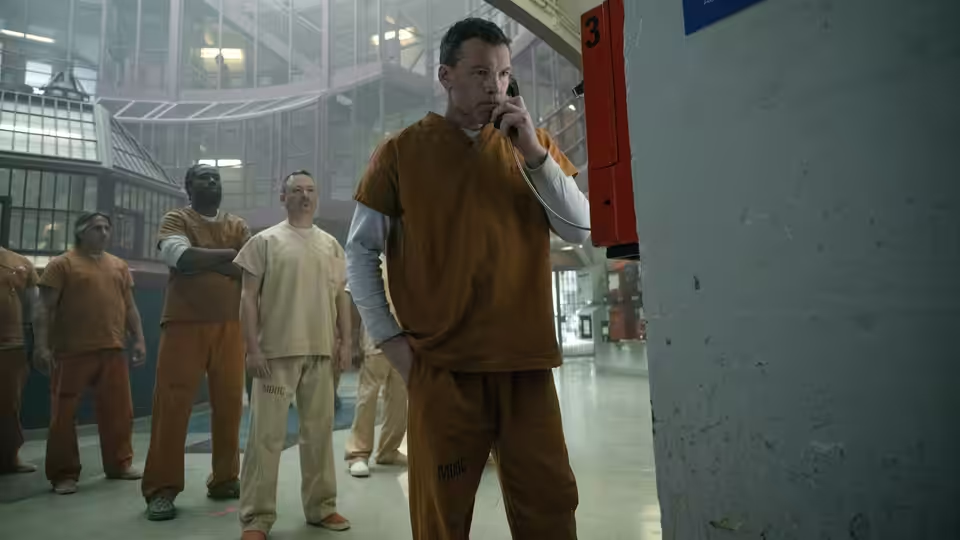
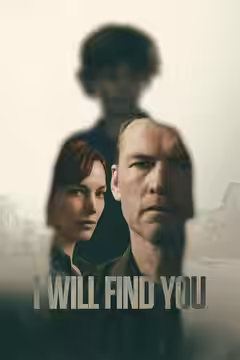
Harlan Coben’s novels now arrive on television at the rate of about one a year, and I Will Find You is the latest and one of the most breathless. Robert Hull’s eight-part adaptation puts Sam Worthington in a cell for a murder he says he did not do, hands him a photograph of a boy who might be the son he is supposed to have killed, and gets him over the wall before the first episode is out. From there it is a chase, a conspiracy and a rug-pull roughly every forty minutes. It is brisk, it is silly, and by the end it had stopped making sense in ways we could not forgive, even while we were still watching it.
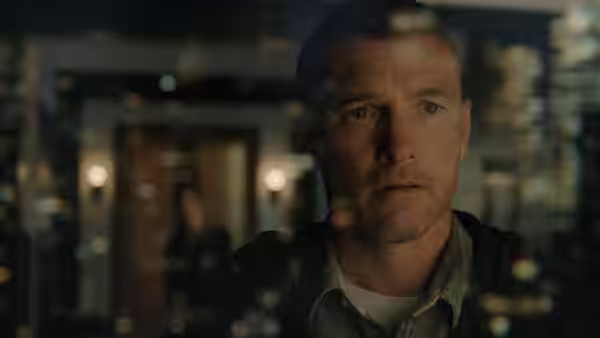
Worthington is the right man for it. He plays David Burroughs as a big, slow, damaged animal who has spent years deliberately not thinking, and the scene in the visiting room where Rachel Mills (Britt Lower) slides the photograph across the table is the best thing in the series. He looks, looks away, and then cannot stop looking. It got us. We were not expecting to be moved by a Coben adaptation, and for about two minutes we were. Lower plays Rachel dry and quick, a woman with her own reasons for wanting this story, and the two of them argue like people who used to be family.
The series is better still when it leaves them. Chi McBride and Logan Browning, as FBI agents Max Williams and Sarah Greer, are given the manhunt and a running argument about procedure, lunch and each other, and every scene they share is sharper and funnier than the one before. McBride does world-weariness without visible effort; Browning is the one who has read the file. Most critics have said the same and we agree. On this evidence they should have the series and Worthington should be the guest.
The trouble is the plot, which is to say the point. Coben’s method is to end every chapter with a door slamming, and Hull and his fellow writers Steven Lilien, Bryan Wynbrandt and Heather Mitchell keep faith with it. Each episode ends on a reveal and the next begins by explaining it, usually at length, usually to someone with no reason to be told. By the fourth episode we had stopped believing anyone and were still, to our slight irritation, pressing play on the fifth. By the seventh we were annoyed, because the series had made us care about the boy and then treated him as a piece to be moved round the board. There is a late twist we will not describe. We will say it made us laugh, and the series did not mean it to.
It is made in shifts. Four directors, Maggie Kiley, Adam Davidson, Maja Vrvilo and Brad Anderson, four editors and two cinematographers, Fraser Brown and Boris Mojsovski, share the eight episodes, and it shows. The prison hours are dim, green and handheld; the later ones are brightly lit and cut to the rhythm of the next reveal, and the join is visible. Mark Steel’s production design gives David’s cell and Cheryl’s new kitchen the same beige anonymity, which may be a point about grief or may be a schedule. Saunder Jurriaans and Danny Bensi supply the low string drone television thrillers now come with as standard, and it does the job of telling us something is wrong even when the scene is two people eating.
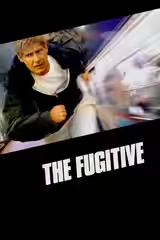
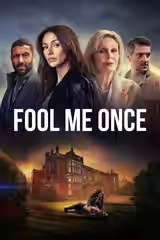
The Stranger (2020) was the good one: it had a mystery you could hold in your head and a cast that behaved like adults. Fool Me Once (2024) had Michelle Keegan and a straight face. I Will Find You has more plot than either and less patience, and it is the first of these that let us see the trick being done. Erin Richards, as David’s ex-wife Cheryl, has the hardest job, a woman who has grieved and rebuilt and is asked to do both again on camera, and she does more with her silences than the script does with its speeches. Milo Ventimiglia turns up in the second half and we will leave him there.
It carries a 15, mostly for the prison. Watch it with someone who enjoys guessing wrong, and over a few evenings rather than one, because the reveals land more softly with a night’s sleep between them and you will mind the explanations less if you have half forgotten what they are explaining. We finished it. We offer that as a fact rather than a recommendation.