Stephen Thompson’s British western has a setting television had not tried and a lead in Jessica Raine who deserves it. The first two episodes are brisk and busy; after that the mud stays tidy and the plotting goes round in circles.
Stephen Thompson’s Jericho takes the American western and sets it down in the Yorkshire Dales in the 1870s, on a hillside where a railway company is building a viaduct and a town of wooden shacks has sprung up under the piers to house the men doing it. It is a good idea. Britain had these places, and television has hardly looked at them. Over eight hour-long episodes the idea is handsomely dressed and busily plotted, and it is never as rough or as gripping as the setting deserves. It is a decent programme that runs out of breath halfway.
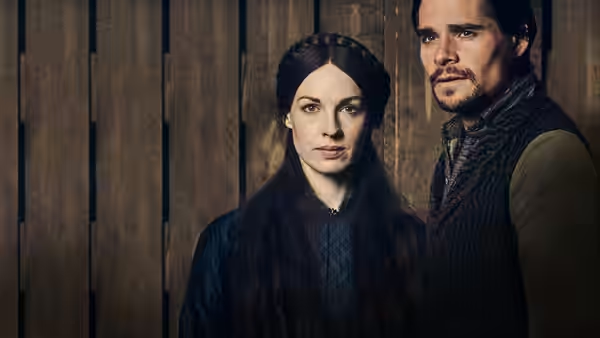
Jessica Raine is the reason to keep going. Annie Quaintain arrives with two children, a dead husband’s debts and a bearing that says she was not raised for this, and Raine plays her respectability as something held on to with both hands. She does not soften into the town and she does not turn hard for effect. When she is haggling for lodgers, or standing in a doorway deciding whether to let a man in, the programme is about someone. Samuel Bottomley and Amy James-Kelly, as her son and daughter, are given less to do than the setup promises.
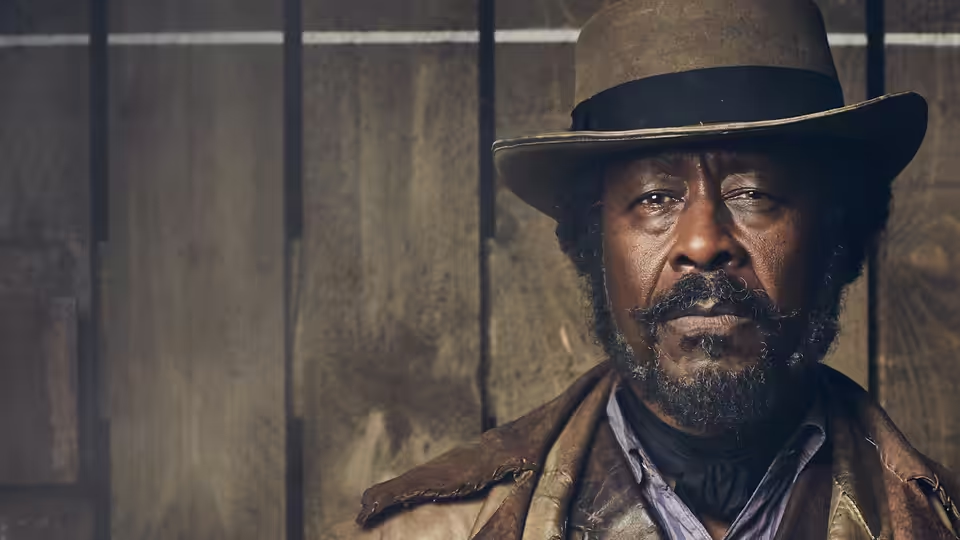
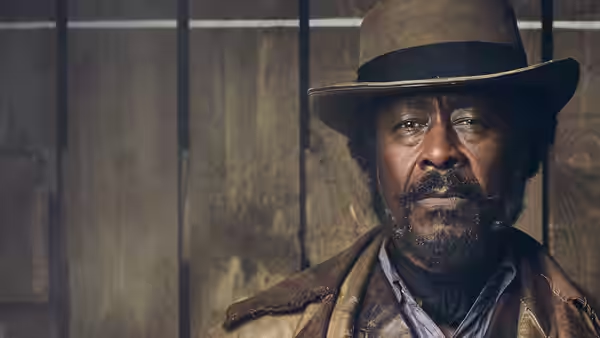
Around her the casting is stronger than the writing. Clarke Peters, as the company man Ralph Coates, brings the actual American west with him and lends the place some authority every time he walks through it. Lorraine Ashbourne’s Lace Polly runs the town’s other trade with a landlady’s patience and gets the best dry lines. Hans Matheson broods handsomely as Johnny Jackson, the navvy with a past, and the script keeps him brooding well beyond the point where we wanted him to say something.
The trouble is that Jericho is too clean. The shacks look newly built because they are. The mud lies where it has been put. Hair is done, teeth are white, and the navvies come off a shift of blasting rock looking as if they had been dusted rather than dirtied. Tim Phillips’s score, fiddles over swelling strings, keeps telling us this is a frontier when nothing on screen is cold, wet or dangerous enough to prove it. The three directors, Robert McKillop, David Moore and Paul Whittington, keep things moving, and that is part of the problem: no shot sits still long enough for the valley to feel like a place you might die in.
Here is what we felt. The first episode we enjoyed, plainly. It piles up debts, threats and arrivals at speed, and we were glad of a period drama that started with people in trouble rather than people in drawing rooms. By the fourth we were bored, and a little annoyed about it, because the writers, Thompson, Chris Dunlop and Caroline Henry, keep reaching for the same three tools: a secret, a letter, a stranger at the door. Each is pulled out on schedule and each is put back without changing anyone.
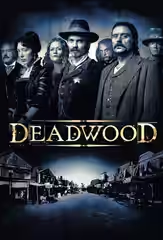
The programme also has a 15 certificate and barely uses it. Deadwood (2004) made its camp out of filth and language and a genuine chance that the wrong person would be shot on a Tuesday. Jericho has the shacks and the whisky and a rifle or two, and nobody in it feels at risk. The viaduct rises in the background, episode by episode, and it is the one element that looks as if it costs anyone anything.
Worth an evening, perhaps two, for Raine and Peters and the first pair of episodes. If after that you find yourself watching the viaduct rather than the people, you will not be alone.