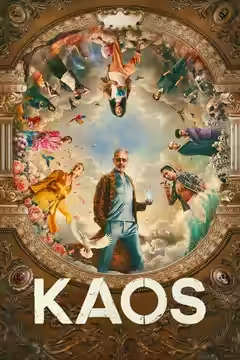
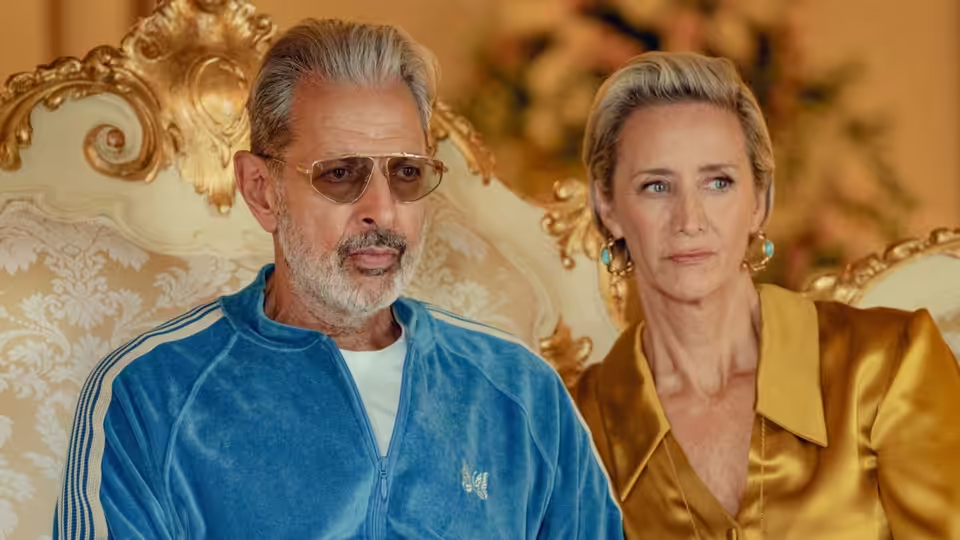
Zeus (Jeff Goldblum) and Hera (Janet McTeer) sit together on an ornate gilded throne
Series review

KAOS

2024 · Created by Charlie Covell · Series

In a sentenceJeff Goldblum runs the universe from a sun lounger and is undone by a wrinkle

On Olympus, which here is a white villa with a swimming pool, Zeus (Jeff Goldblum) wakes on Olympia Day to find a new line across his forehead. An old prophecy says a line will appear, order will wane and his family will fall, and for the first time he takes it seriously. Hera (Janet McTeer), his wife and sister, is unbothered. Dionysus (Nabhaan Rizwan), his youngest son, wants a proper job. Prometheus (Stephen Dillane), chained to his rock, tells us that three mortals in Krete will bring the gods down. Among them are Riddy (Aurora Perrineau), married to a famous musician she no longer loves, and Cassandra (Billie Piper), who sees the future and is believed by nobody. In the city, President Minos (Stanley Townsend) is dealing with a statue of Zeus that has just been defaced.

Plays from YouTube when you press play; nothing loads from them until then.

Fi1m review

Charlie Covell’s modern Greek myths begin with real swagger, and Jeff Goldblum’s vain, frightened Zeus is a pleasure to watch. Then eight episodes of plot arrive at once, and by the end the series is explaining its prophecy rather than enjoying it.

Charlie Covell has put the Greek gods in a world that looks like ours and left them with their old habits. Zeus (Jeff Goldblum) lives in a white villa on Olympus with a pool, a wife who is also his sister, and a prophecy he has spent centuries not reading. Below him is Krete, a modern city of billboards and traffic where the people celebrate Olympia Day under President Minos (Stanley Townsend). The idea is good and the first three episodes are better than good. Over eight hours the series slowly buries the thing it does well under the things it feels it ought to do.

Goldblum is the reason to start. He plays Zeus as a man who has never in his life been told no, which means that charm and cruelty come out of him in the same breath and he cannot tell them apart. The first episode hangs on a wrinkle: he finds a line on his forehead, and because the prophecy begins with a line, the most powerful being in creation spends the day in front of a mirror. We laughed properly at this, and more than once, because Goldblum plays the panic straight. Later, when the fear curdles into something that gets people killed, he does not change gear so much as show us the gear was there all along.

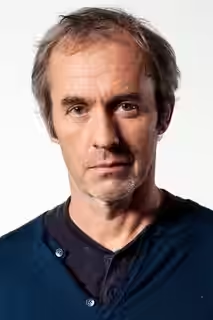
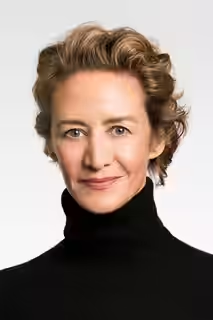
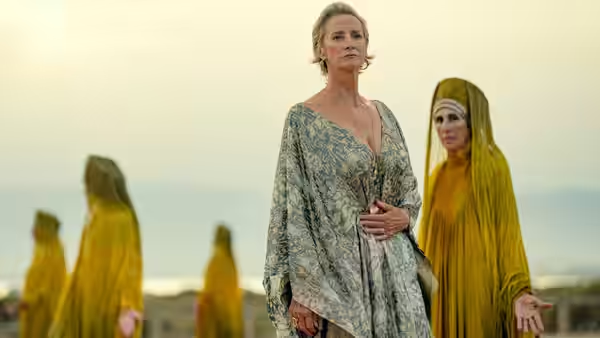
Stephen Dillane’s Prometheus narrates from his rock, dry as the stone, and his voice gives the series a shape it would otherwise lack. Janet McTeer’s Hera is the coldest thing on screen, a woman who has run this household for a long time and sees no reason to tell her husband anything. Nabhaan Rizwan plays Dionysus as the son nobody rings, puppyish and hurt, and he is good enough that we minded when the script forgot him for an episode at a time. Billie Piper’s Cassandra tells the truth in a voice that has long since stopped expecting an answer.

Georgi Banks-Davies and Runyararo Mapfumo share the directing, and between them they build three distinct places. Olympus is sun, white stone and gold fittings, a hotel nobody else is allowed into. Krete is a real-looking city where the gods appear on advertising hoardings and the Trojans, a conquered people, do the low-paid work. The Underworld is drained of colour, a place of queues and forms where the dead wait to be processed, and it is the best-designed thing in the series. Isabella Summers’s music keeps a low electronic pulse under the Olympus scenes and lets the mortal ones breathe with less.

The mortals are where the trouble starts. Riddy (Aurora Perrineau) is married to a famous musician and has stopped loving him, and anyone who knows the myth of Eurydice knows where she is headed; the first episode gets her there. Perrineau is watchful and sad and carries the only story with ordinary human stakes. But hers is one of three mortal threads, each with its own prophecy to fulfil, and Covell cross-cuts between them so evenly that each one stops to let the others catch up. By the fifth hour the prophecy had been recited to us so many times that we could have said it along with the characters.

We were bored, in the sixth episode, and we noticed because the first three had not let us be. Scenes exist to move a piece from one board to another. Characters explain to each other what we watched them do an hour earlier. There are twists, and we will not describe them, but several arrive as announcements rather than discoveries, and a twist you are told about is just information. The comedy thins as the plot thickens, which is the wrong way round.

Covell’s The End of the F*ing World ran at half this length and knew exactly when to stop. KAOS has that script’s ear for how awful people talk to each other and none of its discipline. Most critics have been kinder than we are, and we can see why; the opening is so confident that it buys a great deal of patience, and some reviewers evidently had more of it left by episode seven than we did.

Watch the first three episodes with company and a drink. They are funny, handsome and sharp about what power does to the people who hold it. If the prophecy has its hooks in you by then, stay for the rest and accept that the series will tell you everything twice. If it has not, you have already had the best of it.

Critical consensus AI synthesised

66
Positive
8
Mixed
0
Negative
3

Most critics like Kaos, and the praise clusters on two things: Charlie Covell’s writing and Jeff Goldblum’s Zeus. The reviews describe the series as funny, inventive and confident, and several say the modern reworking of the Greek myths keeps the appeal of the originals rather than flattening it. Goldblum is named again and again, for turning Zeus’s charm into something volatile and dangerous. The ensemble and the production design, particularly the Underworld, also come in for approval.

The spread is wide. Three reviews are firmly negative, and they share a complaint: the ideas are promising but the plotting does not follow through. The Hollywood Reporter and Variety find it meandering and frustrating; Paste says the retellings lack purpose and lean too hard on twists. Even some admirers concede the stories turn saccharine as they converge, and that some characters are not given room to breathe. Nobody sits in the middle; the reviews are either warm or cold.

The AV Club
29 August 2024 · A- · Christina Izzo
90

The review finds the series a sharp, confident satire that turns increasingly human and leaves room for more. It praises Jeff Goldblum’s performance, especially how he shifts Zeus’s charm into dangerous volatility.

Read the full review →
The Guardian
29 August 2024 · Lucy Mangan
90*

Mangan calls the series an intelligent, funny, moving triumph. She especially praises Charlie Covell’s confident, intricately plotted script and its deft blend of comedy and tragedy.

Read the full review →
Evening Standard
29 August 2024 · ★★★★ · Vicky Jessop
80

The review finds Kaos a wildly entertaining, creative reimagining that is overambitious but ultimately holds together. It praises the performances and especially Jeff Goldblum’s camp, high-energy portrayal of Zeus.

Read the full review →
Radio Times
29 August 2024 · Louise Griffin
80*

The review presents the series as a captivating, irreverent winner. It singles out Jeff Goldblum’s Zeus for providing glorious chaos.

Read the full review →
Empire
4 September 2024 · Tariq Ra'ouf
70*

The review finds the series chaotically good fun, praising its lively modern reimagining of Greek myths. It singles out Jeff Goldblum’s delightful performance as Zeus, while noting that some characters lack room to breathe.

Read the full review →
The i Paper
29 August 2024 · Emily Baker
70*

Baker finds the series a fun, flashy romp, though it becomes saccharine and clichéd as its stories converge. She especially praises the early episodes and the inventive comic treatment of the myths.

Read the full review →

Straight answers AI written, from our review

Is KAOS worth watching?
KAOS is worth watching for its first three episodes, and we scored it 67. Jeff Goldblum's vain, frightened Zeus and the drained, bureaucratic Underworld are the pleasures; after that the three mortal plots crowd each other out and the prophecy is explained more often than it is enjoyed. Start with company and a drink, and stop if it has not hooked you by episode three.
Where can I watch KAOS in Slovenia?
KAOS is streaming on Netflix in Slovenia. Availability is checked daily; the links above go straight to each service.
How violent or frightening is KAOS, and is it suitable for children?
KAOS carries a UK 15 certificate and a US TV-MA rating, and it is not for children. Zeus's panic turns into fear that gets people killed, the dead queue to be processed in the Underworld, and the gods talk to each other with the cruelty Charlie Covell's scripts are known for. Older teenagers who can take dark comedy about awful people will be fine; the squeamish should expect violence rather than horror.
How does KAOS compare to The End of the F***ing World?
KAOS shares a writer, Charlie Covell, with *The End of the F***ing World*, and the same ear for how awful people speak to each other, but the earlier series is the better of the two. It ran at half the length and knew when to stop, where KAOS tells you everything twice. Choose KAOS for Goldblum and the design; choose the earlier series for discipline.
What should I watch after KAOS?
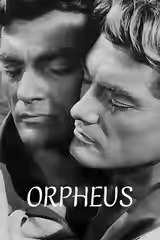
After KAOS, try *The End of the F***ing World* (2017, Fi1m 80): Covell’s earlier series: the same cruel wit, half the length, every episode necessary. Then Orphée (1950, Fi1m 82): Cocteau’s Orpheus in post-war Paris, with mirrors for doors and death in a Rolls-Royce; and The Good Place (2016, Fi1m 84): An afterlife run as a bureaucracy, with the jokes and the moral argument in balance.

Cast

If you liked this, try…

  1. The End of the F***ing World (2017, Fi1m 80)Covell’s earlier series: the same cruel wit, half the length, every episode necessary.

  2. Orphée (1950, Fi1m 82)Cocteau’s Orpheus in post-war Paris, with mirrors for doors and death in a Rolls-Royce.

  3. The Good Place (2016, Fi1m 84)An afterlife run as a bureaucracy, with the jokes and the moral argument in balance.

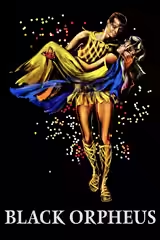
  4. Black Orpheus (1959, Fi1m 78)The Eurydice myth set in Rio at carnival, all colour and drums and grief.

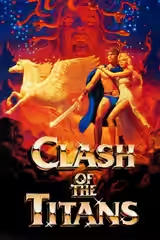
  5. Clash of the Titans (1981) · not on Fi1m yetThe gods on Olympus moving mortals about a chessboard, with Harryhausen’s monsters doing the rest.