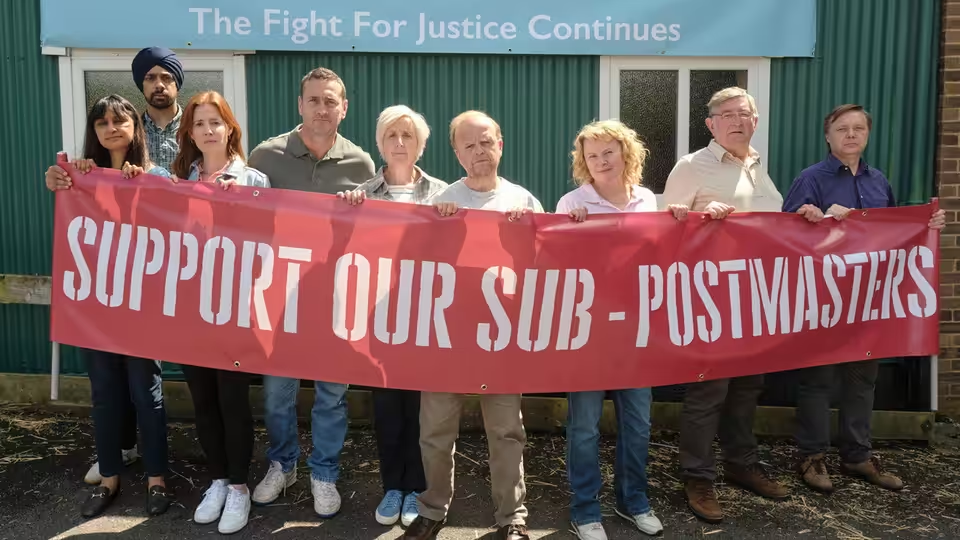
Gwyneth Hughes’s four-part account of the Post Office scandal is plain, angry television that trusts its story and its cast, and it is right to. The executives are sketched where the postmasters are drawn, but Toby Jones and Monica Dolan carry it.
Gwyneth Hughes’s four-part drama, directed by James Strong and first shown on 1 January 2024, tells the story of the Post Office scandal from behind the counter. Hundreds of sub-postmasters were accused of theft on the evidence of a computer system called Horizon, and many were prosecuted, bankrupted or sent to prison. Hughes does not begin with the numbers. She begins with a man in Llandudno who will not sign for money he has not lost, and she stays with people like him for four hours. It is plain, angry television and it is right to be, and we recommend it with one caveat we will come to.
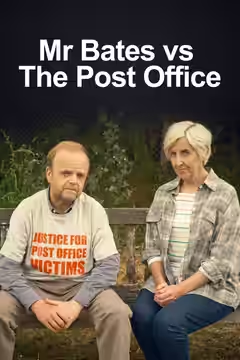
Toby Jones plays Alan Bates as a man whose weapon is a filing cabinet. He does not shout. He keeps copies. When the Post Office writes to him he writes back, and when it stops writing he keeps writing anyway, and Jones makes the stubbornness look like a kind of tiredness rather than heroism, which is the right call. Julie Hesmondhalgh, as his partner Suzanne Sercombe, is given the job of living with this, and she does it with a raised eyebrow and a kettle. Their spare room, dressed by production designer Antonia Lowe with box files climbing the walls, tells you more about years of campaigning than any speech could.
The scene that made us angry comes early and belongs to Monica Dolan. Jo Hamilton, who runs the post office in South Warnborough, Hampshire, rings the helpline about a shortfall she cannot explain. The voice at the other end tells her to press a key. She presses it and the figure on her screen doubles. Dolan plays it without tears, just a woman looking at a number and understanding that nobody is going to help her, and we sat with our jaw set for the rest of the hour. We knew roughly how this story went, and the drama still got under us, because Hughes shows the mechanism at the scale of one kitchen and one screen.
Will Mellor and Amy Nuttall, as Lee and Lisa Castleton in Bridlington, carry the strand about what happens when you decide to fight, and Mellor’s decency is the series’ quietest asset. Shaun Dooley, as Michael Rudkin, is given the one thread that plays like a thriller. Ian Hart’s Bob Rutherford, a forensic accountant, arrives partly to explain the technology to the postmasters and mostly to explain it to us, and Hart is good enough that we forgave the function.
Matt Gray shoots the branches as they are: cramped, over-lit, a queue for stamps and a screen that will not add up. The Post Office’s own offices are glass, pale wood and long tables, and the cutting between the two places does the arguing. Nobody has been clever with the camera, and we do not think anybody should have been. This is television that wants you to hear what is said and see who said it.
The caveat is the other side of the counter. Lia Williams plays Paula Vennells, the chief executive, and is given a smile, a lanyard and little else to do with them. Katherine Kelly’s Angela van den Bogerd is smooth in meetings, and that is the whole of her. Hughes has drawn her postmasters in three dimensions and her executives in one, and while history may have done the same, drama has more room than history. There is also a habit of ending scenes on the line that tells you what you have just felt, and Alex Jennings’s James Arbuthnot, the MP who takes up the cause, is allowed to be decent without ever being interesting.
Set beside the campaigning dramas it descends from, Cathy Come Home in 1966 or Hillsborough in 1996, it is less inventive than either, and it works. It does the old thing well: it puts a face to a name in a newspaper and makes you sit with it. How the story ends is a matter of public record and we will not rehearse it here.
Watch it in two sittings rather than four. The anger builds better without a night’s sleep between episodes, and there are people in it you will want to check on.