Jeff Pope’s five-part account of the Great Train Robbery from the kitchen rather than the trackside is well acted and well made, and Sheridan Smith is the reason to stay. It is also at least an episode longer than it needs to be.
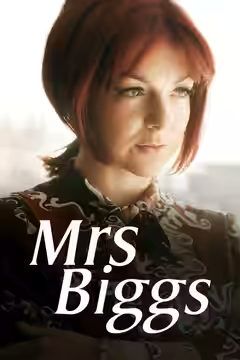
The Great Train Robbery of 8 August 1963 has been filmed before, and nearly always from the trackside: the gang, the signal, the mailbags. Jeff Pope, who created and wrote Mrs Biggs, starts six years earlier and stays indoors. His subject is Charmian Powell, the Surrey headmaster’s daughter who married Ronald Biggs, and his five episodes are about what it is to be married to a man who is cheerful, affectionate and not to be relied on for anything. It is good television, carefully made and well acted, and it is about an episode too long.
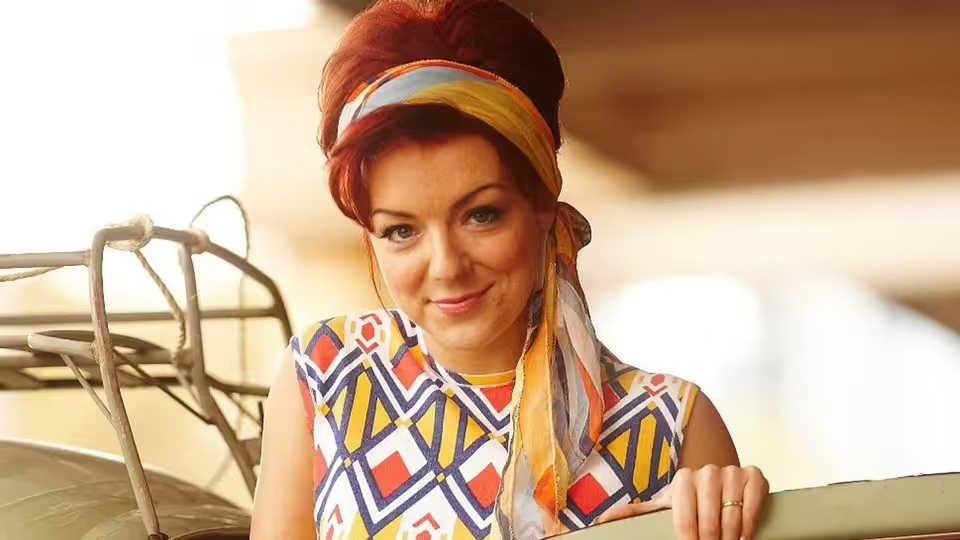
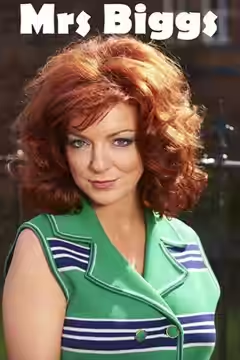
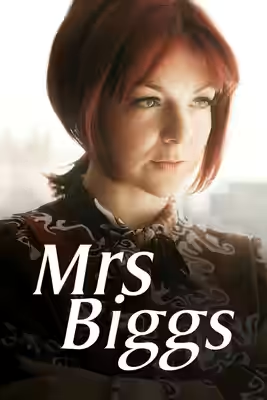
Sheridan Smith is on screen for nearly all of it and she is the reason to stay. She plays Charmian first as a schoolgirl who has worked out that the quickest way out of her father’s house is a man her father will hate, then as a young wife and mother, and she does the ageing without tricks, mostly by how she stands and how long she waits before answering. Daniel Mays plays Biggs as a man who agrees with whoever spoke last. He is funny, he is tender with the children, and he cannot look Charmian in the eye when he has been out all night. Mays never asks us to forgive him, which is why we almost do.
The performance we have not been able to shake belongs to Adrian Scarborough. Bernard Powell is a small man in a cardigan who never raises his voice, and we were more frightened of him across a dinner table than of anyone in the gang. Scarborough does it with pauses. He asks Charmian a question, lets her answer, and then says nothing for a second longer than is bearable, and the whole house goes still. Caroline Goodall’s Muriel spends those silences looking at her plate. Paul Whittington, who directs all five episodes, holds the camera on the table and lets it happen.
Fabian Wagner shoots the Powell house in brown and bottle green with the curtains half drawn, and saves daylight for the scenes where Charmian is out of it: the train, the street, the first flat. It is a plain scheme and it works. Every time she goes back through her parents’ front door the light drops, and we felt our shoulders go up with hers. Bryony Marks’s score is piano and a few strings and knows when to stop; the period songs are placed sparingly rather than for nostalgia. Ben Lester and Mark Atkin, the editors, keep the robbery, when it comes, brisk and mostly unseen. Their more interesting decision is to keep cutting back to Charmian in a kitchen, not knowing, which is where the serial’s loyalties lie.
Those loyalties are also its problem. Pope is so firmly on Charmian’s side that Biggs is let off more lightly than he deserves, and what happened on the track that night is dealt with in a line or two. Jay Simpson’s Bruce Reynolds arrives with the gang and departs with it, and the people around the marriage, played by Tom Brooke, Jack Lowden and Claire Rushbrook among others, are drawn briskly but never deeply. The 15 certificate is for language and a few hard moments, not for anything the series dwells on.
The second half separates the couple, as the record says it must, and we will leave it at that except to say the pace slows. Charmian’s waiting, which grips over two episodes, is harder to sustain over four, and one later episode circles a single decision for its full forty minutes when twenty would have done. The reviews so far have been warm and we are warm too, with that reservation.
Watch the first two episodes in one sitting. After that, take them one a night, which is how it was built and how it best survives its own length.