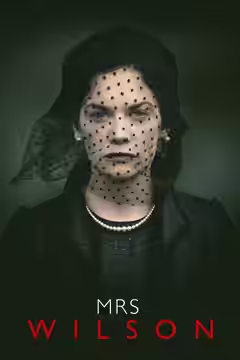
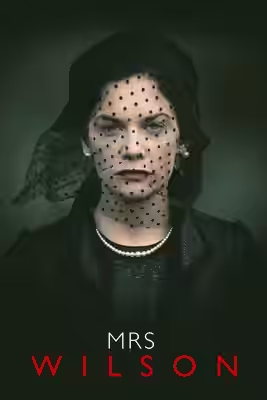
Mrs Wilson is a compelling family mystery carried by Ruth Wilson’s precise, painful performance. The secrecy can be overworked and the pacing too deliberate, but Alison’s struggle to understand her marriage keeps us involved.
Anna Symon’s Mrs Wilson is good at the part of a mystery that usually gets hurried through: what it costs to ask the next question. Alison Wilson is trying to understand Alec Wilson, and each doubt has consequences for how she sees their marriage. Richard Laxton keeps that discomfort close to the centre of the drama. We recommend it for Ruth Wilson’s performance, with a warning that the telling can be more deliberate than the story needs. Across three episodes, waiting for information occasionally becomes a frustration of its own.
Ruth Wilson makes the younger Alison’s hope and the widow’s guardedness feel like parts of the same person. She gives us enough continuity to recognise how much has been lost between them. We were more upset by that change than we expected. Seeing the hopeful young secretary alongside the woman struggling with Alec’s deceptions makes the damage personal, even when the plotting is busy drawing attention to the next secret. Her restraint occasionally holds us at a distance, but it also gives Alison a dignity that a more demonstrative performance might have disturbed.
Iain Glen gives Alec enough appeal to make Alison’s attachment credible, which matters once the questions begin. The series would have much less to work with if he seemed merely an obvious mistake she had made. Fiona Shaw as Coleman and Anupam Kher as Shahbaz Karim strengthen the supporting cast without shifting our attention away from Alison for long. Ruth Wilson remains the person we want to watch when another piece of information arrives.
Richard Laxton’s reserve is useful until it starts to make the whole programme feel mannered. Hubert Taczanowski’s cinematography and Susie Cullen’s production design favour an orderly presentation that suits Alison’s self-control. We could have done with more disruption: there are passages when the careful finish makes her distress harder to reach. Neither the photography nor the settings should have to supply the emotion, but their formality sometimes reinforces the distance already created by the performance.
Stephen Haren’s editing makes the movement between youth and widowhood clear, and the contrast gives Ruth Wilson room to do her most affecting work. It does not solve the slower stretches, when the series has established Alison’s uncertainty and then keeps us waiting inside it. Anne Nikitin’s music helps maintain unease, though the performance needs little assistance in making grief felt. Some of those stretches could have been shorter without losing anything important about Alison’s predicament.
Anna Symon’s writing also insists too heavily on Alec’s mysteriousness. Once we have begun to doubt him, further reminders add little; Alison’s attempts to keep believing are more interesting. The programme is persuasive about the difficulty of admitting that love has left us open to deception. It becomes less persuasive whenever a reference to Alec’s hidden life sounds as though it has been included principally to keep the investigation moving.
As a domestic mystery, Mrs Wilson earns its place by taking the person asking the questions seriously. Anyone expecting each discovery to produce a sharp new burst of suspense may find the pauses trying. There is pleasure here in watching a performance that allows affection and suspicion to remain awkwardly close. Choose it for that uneasy company, and allow for a few stretches when the storytelling could do with getting on.