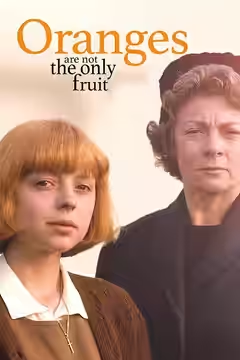
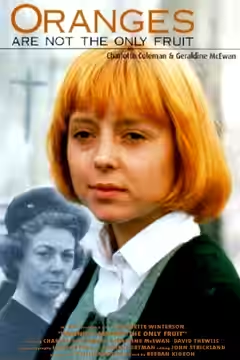
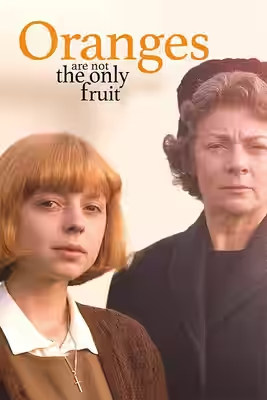
Jeanette Winterson’s adaptation of her own novel, directed by Beeban Kidron, is funny, cruel and over in under three hours. Geraldine McEwan and Charlotte Coleman are as good a mother and daughter as British television has put on screen; the production around them is plainer than they are.
Jeanette Winterson adapted her own novel for this three-part series, first broadcast on 10 January 1990, and the first thing to say is that she did not soften it. Jess is adopted by a woman who wants a child of God and gets a child. Mother reads the Bible aloud, keeps a list of enemies, buys oranges because they are the only fruit, and waits for the Lord to make use of her daughter. Our verdict is that this is one of the best things British television made about growing up, and that it has lasted because it is funny before it is sad and never stops being either.
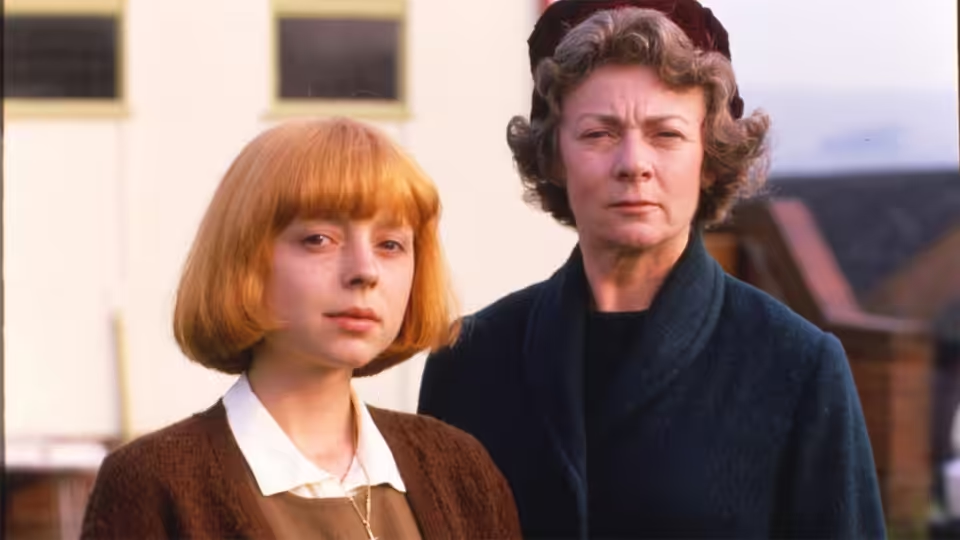
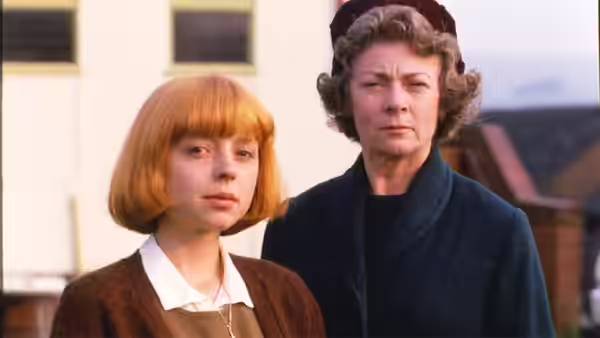
Geraldine McEwan plays Mother at a constant pitch of busy certainty. She does not rant. She clips her sentences, moves from sink to hymn book to window without pausing, and treats every setback as a test she intends to pass. McEwan makes her ridiculous and then refuses to let us relax, because the ridiculous woman has total power over a child. It is a performance built on small decisions: how she hands over an orange, how she says the word “Next Door”.
Charlotte Coleman’s Jess is the reason the series does not become a cartoon of fundamentalism. Coleman plays her as a girl who believes all of it, preaches it with pleasure, and is bewildered rather than rebellious when belief and feeling part company. She has a half-smile that looks like insolence and is actually attention. Emily Aston, as the younger Jess, is solemn and watchful and already a little too clever for the house she lives in.
We were angrier than we expected, and it was the chapel that did it rather than Mother. Kidron shoots the congregation praising God over the head of a child in the same flat brown light she uses for the kitchen, so that worship and washing up look like the same activity, and nobody in the frame thinks to ask the child anything. Miss Jewsbury, played by Celia Imrie with a nervous decency the series does not reward, is the one adult who treats Jess as a person rather than a project. David Thewlis turns up as a doctor, and it is a relief to meet someone who asks a question.
The chapel is well cast: Elizabeth Spriggs’s May, Barbara Hicks’s Cissy, Freda Dowie’s Mrs Green and Pam Ferris’s Mrs Arkwright make a chorus of hats and opinions, and Margery Withers gives Elsie, the one old woman who is kind to Jess for no reason, a warmth the series badly needs. Kenneth Cranham’s Pastor Finch arrives smooth and damp and preaches with the confidence of a salesman. There is a father, who barely speaks and is barely there. John Strickland’s cutting sets hymn-singing against housework and lets the hymns run on longer than is comfortable, which is the right length. Rachel Portman’s score is small and stays out of the way; the congregation provides most of the music, and it is louder.
It is a 1990 television production and looks like one. Interiors are cramped, the exteriors are few, and nothing in the frame is beautiful unless a face is. Some of the chapel women are played broadly, and the comic chorus occasionally tips into panto when the material does not need the help. Winterson has stripped out the fairy-tale interludes of the novel, and readers who loved them will miss them. The third episode has a great deal to get through in 55 minutes and gets through it faster than we wanted.
What happens when Jess’s feeling for Melanie becomes known is the matter of the later episodes, and we will not describe it, except to say that the series does not blink and that Coleman and McEwan play it as a fight between two people who love each other, which is worse than the alternative. Produced by Phillippa Giles, it runs three episodes of about 55 minutes each.
Watch all three in one sitting, with the lights on, and if you were raised in any kind of church you may find yourself laughing at things you had forgotten were funny and then going quiet for a bit.