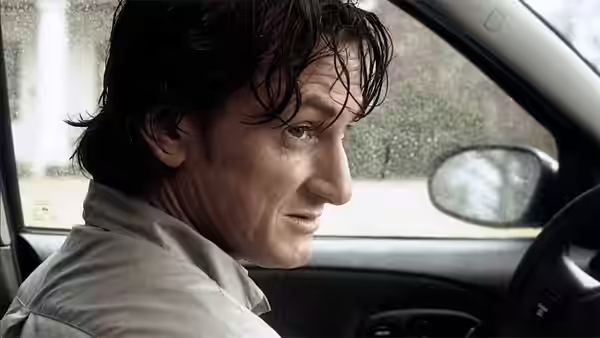
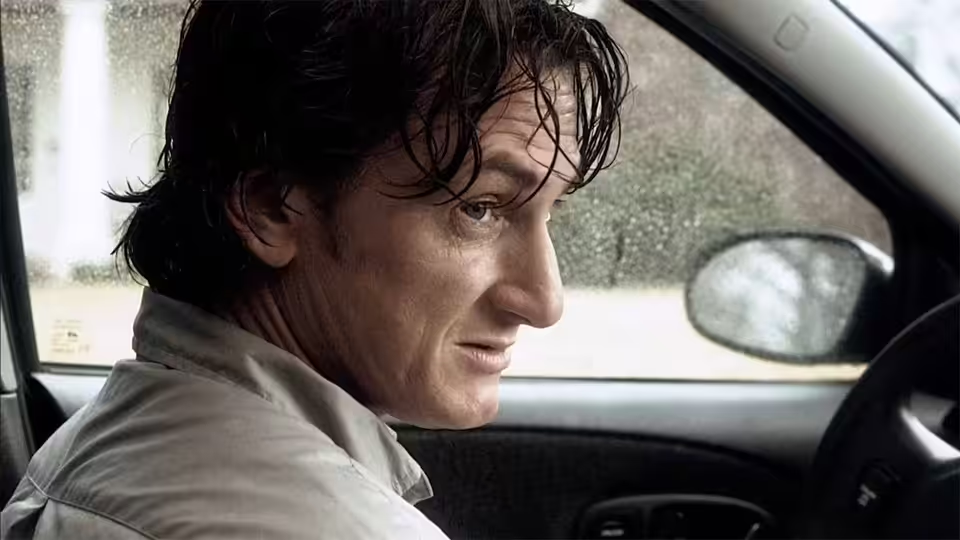
Paul Rivers (Sean Penn) behind the wheel of a car
Film review

21 Grams

2003 · Directed by Alejandro González Iñárritu · 2h 04m · PISF 16

In a sentenceThree fine actors, several terrible days, and a calendar that needs putting back together

Paul Rivers (Sean Penn) loses his temper at the doctor’s. Elsewhere, news of a hit-and-run reaches two separate parties. The accident connects Paul with Cristina Peck (Naomi Watts) and Jack Jordan (Benicio del Toro), though the film does not present their lives in order. Scenes from before and after the collision sit beside one another as each person struggles with its consequences. They try to carry on, but grief, guilt and questions of faith interfere with the choices they make. Their relationships become clearer as the fragments accumulate.

Fi1m review

The fractured storytelling in 21 Grams can feel needlessly elaborate, but Sean Penn, Naomi Watts and Benicio del Toro make its suffering difficult to dismiss. A demanding drama, worth enduring for the people in it.

21 Grams is worth seeing for its actors, even when its broken chronology makes their work harder to follow. Alejandro González Iñárritu directs a drama about three lives connected by a traffic accident, with grief, guilt and faith all demanding attention. Guillermo Arriaga’s screenplay gives us the consequences in pieces, making us reconsider people as more of their circumstances become clear. That can be absorbing, but there are stretches when we are busy placing a scene instead of feeling what happens in it.

Stephen Mirrione’s editing makes the jumps forceful enough to hold our attention, and the early uncertainty encourages us to look closely at everyone. A face in distress arrives before a full explanation, so an actor must establish something the chronology has not yet supplied. We were upset by Paul’s anger at the doctor’s because Sean Penn makes the loss of composure feel so exposing. For that scene, working out where we were in the story mattered less than watching a man struggle to stay in control.

Naomi Watts gives Cristina Peck’s distress an immediacy that makes the film’s rearranging seem briefly unnecessary. We do not need another clue to take her seriously, and the performance holds our attention even when the writing pushes hard for anguish. Benicio del Toro gives Jack Jordan a troubled conviction that keeps the questions about guilt and faith attached to somebody we can care about. Neither performance lets the suffering become merely a subject for discussion, though the script occasionally seems determined to conduct one.

Rodrigo Prieto’s gritty cinematography makes these performances uncomfortable to watch, with little visual relief from the distress. Yet the insistence on roughness becomes wearing; we do not need quite so much encouragement to feel that these lives are difficult. Brigitte Broch’s production design is particularly effective around the doctor’s scene, where the surroundings do little to soften Paul’s anger. Our attention stays on the confrontation, which is quite enough to make the scene hurt.

Gustavo Santaolalla’s music reinforces the mournfulness, sometimes more firmly than the performances require. The religious themes have a similar problem: there is plenty to consider, but the film keeps pressing us to appreciate the importance of what it is considering. The voice-over also explains too much, leaving little space for us to decide what we think. These are frustrating choices in a drama whose actors communicate complicated feelings without needing everything put into words.

The problem with the chronology becomes clearer as the connections emerge. With less left to discover, the rearrangement starts to feel like extra work imposed on a fairly direct account of damaged lives. A crime drama can use our curiosity to make us look harder at its characters, but here we sometimes end up checking our understanding of the sequence instead. The cast gives us plenty to think about without that distraction, and the scenes retain their force when the puzzle has ceased to be interesting.

Still, there is enough here to justify the effort if difficult, performance-led drama is what the evening calls for. The cast makes the grief particular, and the film is considerably more affecting when it trusts them to do that without further explanation. Give it your attention, but do not choose it for an undemanding night together.

Critical consensus AI synthesised

65
Positive
10
Mixed
4
Negative
2

Most critics respond positively to 21 Grams, with the strongest agreement centred on the performances by Penn, Watts and Del Toro. Even several sceptical reviews credit the actors with giving the film emotional force. Praise also gathers around its treatment of grief, guilt and faith, with supporters finding intimacy and moral complexity in the interconnected lives. The fragmented storytelling earns admiration for its ambition and, for some, makes the characters’ distress more affecting.

That structure also produces the sharpest disagreement, and the spread of opinion is wide. Empire regards the editing and direction as central to the film’s success; Slant Magazine finds the puzzle-like construction a substitute for emotional depth. More moderate reservations concern accumulating melodrama, strained spiritual symbolism and a story that becomes overwrought. The New Yorker rejects the fractured approach more decisively, finding that neither the sincerity nor the strong acting makes the story work.

Empire
Superb · Rob Fraser
90*

The critic praises the film's fragmented narrative structure and emotional power, hailing it as a quantum leap from Amores Perros that weaves fate, guilt, revenge and redemption into a riveting experience. Standout performances from Penn, Del Toro and Watts, along with flawless editing and direction, make it astonishing and essential viewing.

Read the full review →
The New York Times
18 October 2003 · NYT Critic’s Pick · Elvis Mitchell
90*

The film is a ruminative look at life after devastating loss, with the three stars achieving virtuosity in depicting people wasting away. It plumbs depths of intimacy rarely touched by filmmakers.

Read the full review →
Radio Times
★★★★
80

The film aspires to understand the human soul through a non-linear mosaic narrative linking three lives after a tragic accident. Fine performances from the leads deliver an astonishing account of faith and redemption.

Read the full review →
The AV Club
18 November 2003 · Nathan Rabin
80*

The review praises the raw emotional power and mournful atmosphere as the film explores how a fatal accident ricochets through interconnected lives, positioning it as an actor's showcase. The three leads' complex, intense performances are highlighted as matching the film's thematic ambition.

Read the full review →
The Guardian
5 March 2004 · ★★★★ · Peter Bradshaw
80

The non-linear structure and three outstanding lead performances create an arresting, accomplished film that grips the viewer's attention through its exploration of shattered lives after a tragedy.

Read the full review →
Evening Standard
10 April 2012 · Neil Norman
70*

Iñárritu evolves a unique stylistic identity in this English-language follow-up, controlling a complex, multitiered screenplay about characters united by trauma, though it accumulates melodrama and relies too heavily on a concluding voice-over. Less feral than Amores Perros but with a firm grasp on human strengths and frailties.

Read the full review →

Straight answers AI written, from our review

Is 21 Grams worth watching?
21 Grams is worth watching for its three central performances, and we score it 72 out of 100. We recommend it for those who enjoy demanding, performance-led drama, though the fractured chronology can make following the sequence distract from feeling the grief; this is not an undemanding evening.
How long is 21 Grams, and what is it rated?
21 Grams runs 2h 04m and is rated 16 by the PISF in Poland. It is a drama and crime film.
Where can I watch 21 Grams in Poland?
21 Grams is available to rent from Apple TV from zł 9.99. Availability is checked daily; the links above go straight to each service.
How violent or frightening is 21 Grams, and is it suitable for children?
21 Grams carries a UK 15 certificate and is not suitable for children under 15. We find its grief, guilt and exposed distress upsetting, with gritty images and little emotional relief; the certificate is the clearest guide to age suitability, rather than a precise indication of how graphic its violence is.
How does 21 Grams compare to Amores Perros?
21 Grams is the more qualified recommendation beside Amores Perros: both connect lives through a collision, but the latter allows more room for unruly behaviour. We recommend Amores Perros more warmly for its gripping drama, with a firm warning about graphic cruelty to dogs; 21 Grams earns its place chiefly through its actors, despite the distracting chronology.

Cast

Awards

Academy Awards, 2004

Nominated
Best Actress
Nominated
Best Supporting Actor

European Film Award for Best Non-European Film, 2003

Nominated
European Film Award for Best Non-European Film

If you liked this, try…

21 Grams (2003) review: Fine acting survives the fractured story (Poland) | Fi1m