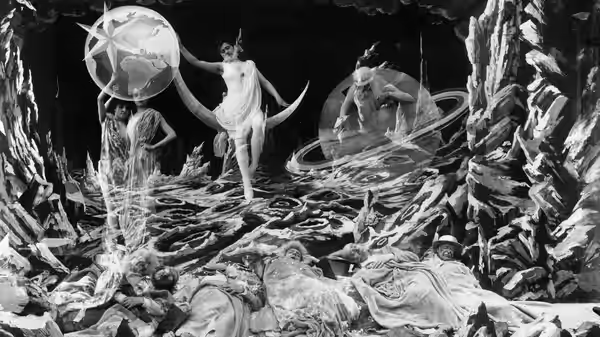
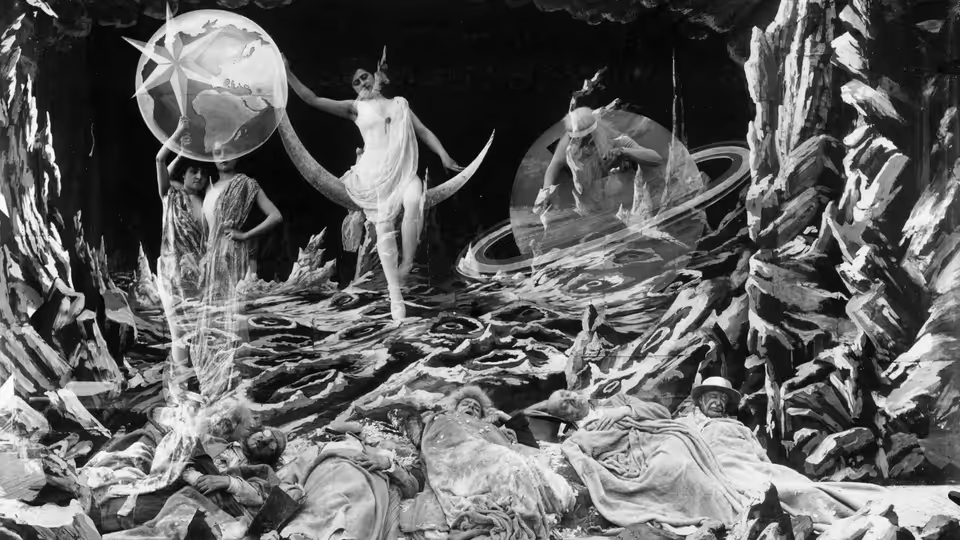
Astronomers and a woman stand among rocky lunar craters beneath a starry sky
Film review

A Trip to the Moon

1902 · Directed by Georges Méliès · 15m

In a sentenceSix old men in wizard hats fire themselves out of a cannon and the Moon takes it in the eye

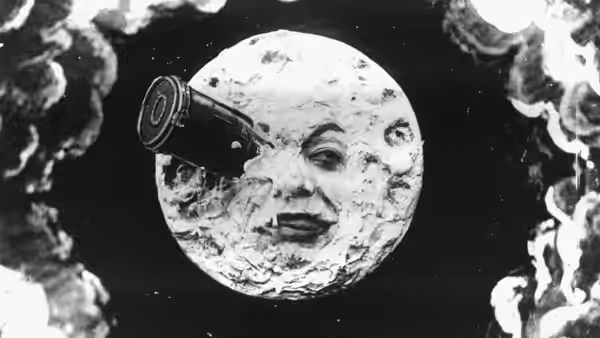
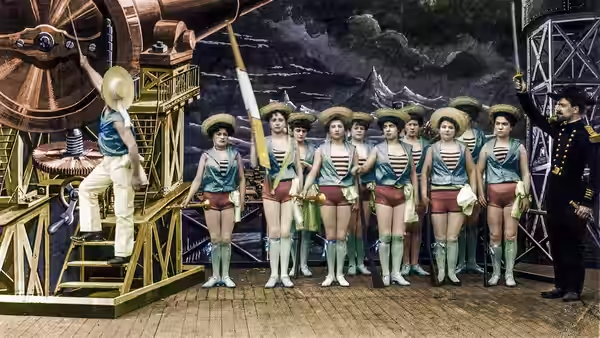
Paris, around the turn of the century. Professor Barbenfouillis (Georges Méliès) stands before a congress of astronomers in pointed hats and long gowns and proposes firing a shell at the Moon from an enormous cannon. There is a row, a book is thrown, and five colleagues (Victor André, Brunnet, Depierre, Farjaut and Kelm) agree to go with him. The shell is built in a workshop above the rooftops, the cannon is loaded by a line of young women in sailor suits, and a marine officer (François Lallement) gives the order to fire. The shell strikes the Moon squarely in its eye. The travellers climb out, watch the Earth rise, and settle down to sleep beneath stars with faces, while Phoebe, goddess of the Moon (Bleuette Bernon), looks on from her crescent. The Moon, it turns out, is not empty.

Plays from YouTube when you press play; nothing loads from them until then.

Fi1m review

Méliès’s fifteen-minute lunar excursion is a stage magician’s show pointed at a camera, and it is still funny, still handsome and still full of ideas nobody had had before. It is also a row of painted backdrops filmed from the stalls, and it never pretends otherwise.

Georges Méliès was a stage magician before he was a film-maker, and A Trip to the Moon is a magic show that happens to have been photographed. It runs fifteen minutes. It takes a handful of ideas from Jules Verne, a scientific congress and a cannon large enough to reach the Moon, and treats them as an excuse for costumes, trapdoors and painted scenery. Our verdict is plain enough: it is still worth your quarter of an hour, and not only as a curiosity. It is a comedy, and it still gets its laughs.

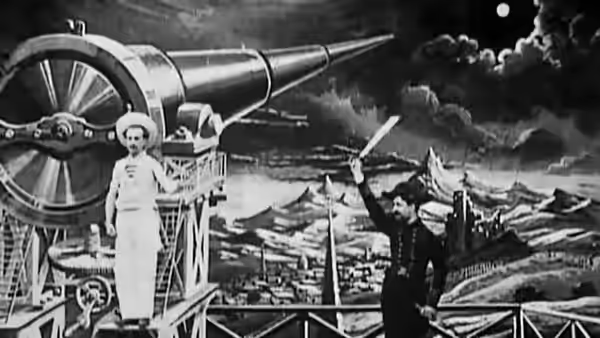
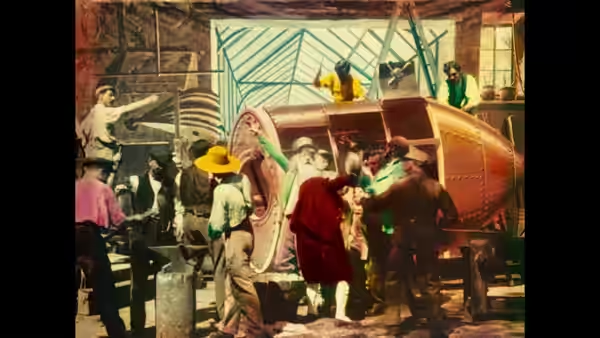
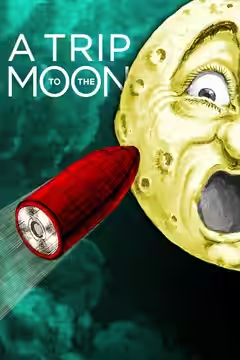
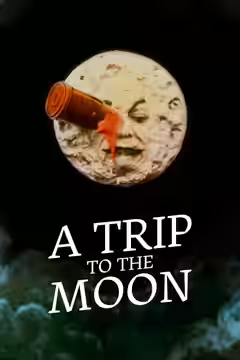
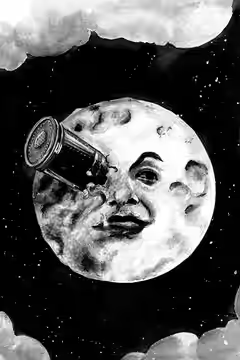
Méliès wrote it, directed it, produced it, cut it, designed it and plays the lead, so there is nobody else to credit for the look of the thing and nobody else to blame. The design is the reason it survives. The astronomers’ hall has a telescope painted on the wall and a blackboard nobody uses. The shell is built on a rooftop above a Paris of smoking chimneys, and the cannon is so long the barrel runs off the edge of the set. The Moon itself is a face, and the face is Méliès’s own, and when the shell arrives it lands in his eye with cream running out of it. There is a hand-coloured version, painted frame by frame and restored in recent years, in which the astronomers’ gowns are green and red and the Moon’s surface is a sickly yellow, and it is the one to see.

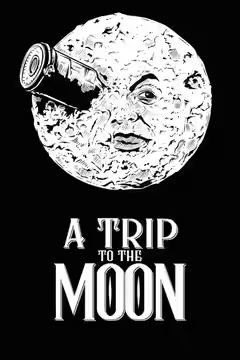
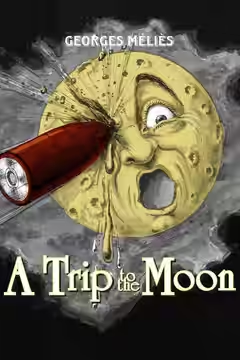
Lucien Tainguy and Théophile Michault’s camera does not move. Every scene is a single wide shot, taken from roughly the seat you would have bought in the middle of the stalls, and the actors face front and wave their arms so the back row can follow. The one exception is the approach to the Moon, where the face swells toward us and the picture cuts to the shell stuck in its eye. We laughed out loud at that, after a hundred and twenty years and heaven knows how many reproductions, and we can say exactly why: the timing is right. Méliès holds the face just long enough for us to see the eye blink before he hits it.

His editing is a magician’s editing. He stops the camera, changes something on the stage, and starts again, so that between one frame and the next a thing becomes another thing or is simply gone. That is the whole of his method, and he uses it for surprises rather than for storytelling. There is no cutting between places, no close-up, no shot of anyone’s face nearer than the far end of a room. Barbenfouillis is a beard and a hat, and the other five astronomers are five more beards and hats. The congress scene runs on past its joke, and the launch, with its line of sailor-suited women pushing the shell into the breech, is staged as a parade because Méliès liked parades.

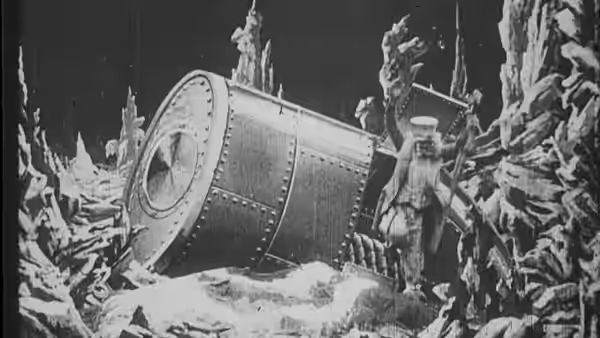
Once the travellers are on the Moon, we will describe very little. Phoebe (Bleuette Bernon) sits on a crescent, the stars have women’s faces (Jehanne d’Alcy is among them), and the Earth rises over the horizon in a painted flat that is prettier than it has any right to be. The Moon has residents, and the astronomers conduct themselves abroad about as well as Frenchmen of 1902 could be expected to, with umbrellas. The second half is a chase, and it is the part of the film that has been copied most and dated least.

The tagline calls it the first science fiction film, and we are not inclined to argue. What is more striking is how much of the genre’s furniture is already here: the committee that will not listen, the launch as public spectacle, the landing, the locals who are not pleased to see us. Later films would find better ways to shoot these things. Very few would find a funnier way to arrive.

It is a U certificate. Watch the colour version if you can find it, with a child if you have one to hand, and turn off the modern score by the band Air that some prints carry; a piano or silence suits the pointed hats better. Do not explain anything until it is over. They will have worked out the cannon before you have.

Critical consensus AI synthesised

80
Positive
3
Mixed
1
Negative
0
Radio Times
★★★★★ · David Parkinson
100

Parkinson treats the film as a cornerstone of narrative cinema and an early science-fiction treasure. He praises its beautiful design and highlights the iconic rocket landing in the Man in the Moon’s eye.

Read the full review →
Empire
3 July 2006 · David Parkinson
70*

Parkinson regards the film as an astonishingly ambitious and sophisticated early work, while noting that its construction remains rudimentary. He singles out Méliès’s imaginative visual effects and their contribution to cinema’s emerging fictional storytelling.

Read the full review →
Time Out
· CC
64*

The page identifies this as a review, but the article text is unavailable, so its verdict cannot be established. The available metadata does not reveal what the critic praises or criticizes.

Read the full review →
Digital Spy
18 May 2011 · festival review · Mayer Nissim
90*

The critic is strongly positive, calling the film still incredible and full of joy and wonder. They especially praise Air’s euphoric new soundtrack and the beautifully restored colour version.

Read the full review →

Straight answers AI written, from our review

Is A Trip to the Moon worth watching?
A Trip to the Moon is worth your quarter of an hour, and we scored it 82. It is a stage magician's show pointed at a camera, a row of painted backdrops filmed from the stalls, and it still gets its laughs, particularly when the shell lands in the Moon's eye. Watch the hand-coloured version if you can find it, ideally with a child.
How long is A Trip to the Moon, and what is it rated?
A Trip to the Moon runs 15m. It is an adventure and science fiction film.
Where can I watch A Trip to the Moon in Australia?
A Trip to the Moon is not on any streaming or rental service in Australia at the moment. It is available in 9 other countries; change your country at the top of the page to see where. Availability is checked daily.
How does A Trip to the Moon compare to Sherlock Jr.?
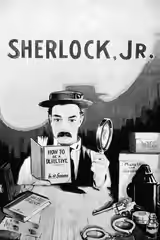
A Trip to the Moon is the more historically startling of the two, but Sherlock Jr. is the better film. Méliès's camera never moves and his tricks are a magician's stop-and-swap; Keaton's trick cutting, which walks him into a cinema screen, is still baffling, and his smallest movement earns a laugh. Choose Méliès for fifteen minutes of novelty, Keaton for the sustained comedy.
Is A Trip to the Moon based on a true story or a book?
A Trip to the Moon is loosely based on a novel by Jules Verne, and is not a true story. Méliès takes only a handful of ideas from the book, a scientific congress and a cannon large enough to reach the Moon, and treats them as an excuse for costumes, trapdoors and painted scenery. You need know nothing of Verne to follow it.
What should I watch after A Trip to the Moon?
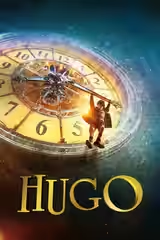
After A Trip to the Moon, try Sherlock Jr. (1924, Fi1m 91): Keaton walks into a cinema screen and the trick cutting is still baffling. Then Hugo (2011, Fi1m 76): Scorsese’s children’s film about Méliès himself, and a decent introduction to the man.

Cast

If you liked this, try…

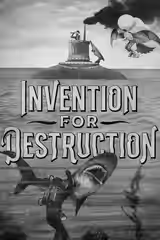
  1. Invention for Destruction (1958) · not on Fi1m yetKarel Zeman films Verne as a moving engraving; the closest anyone has come to Méliès since.

  2. Sherlock Jr. (1924, Fi1m 91)Keaton walks into a cinema screen and the trick cutting is still baffling.

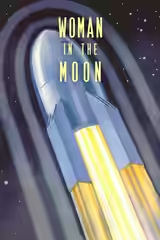
  3. Woman in the Moon (1929) · not on Fi1m yetFritz Lang’s launch invented the countdown; slow, serious and worth the wait.

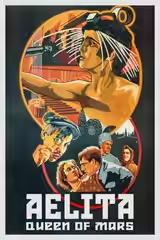
  4. Aelita: Queen of Mars (1924) · not on Fi1m yetSoviet Mars with angular sets and a revolution; strange and rather beautiful.

  5. Hugo (2011, Fi1m 76)Scorsese’s children’s film about Méliès himself, and a decent introduction to the man.