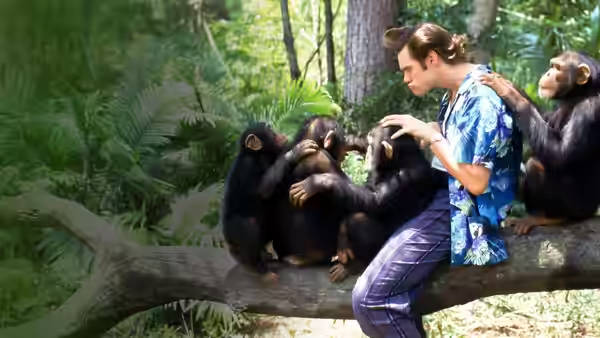
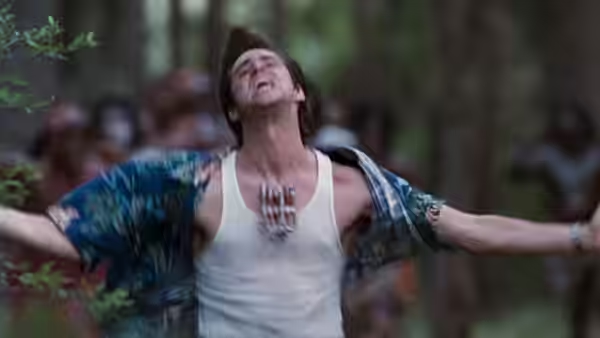
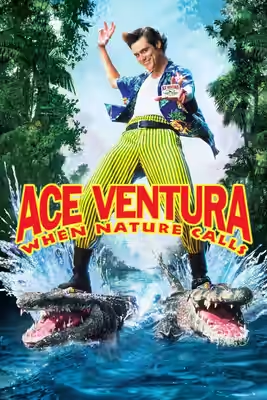
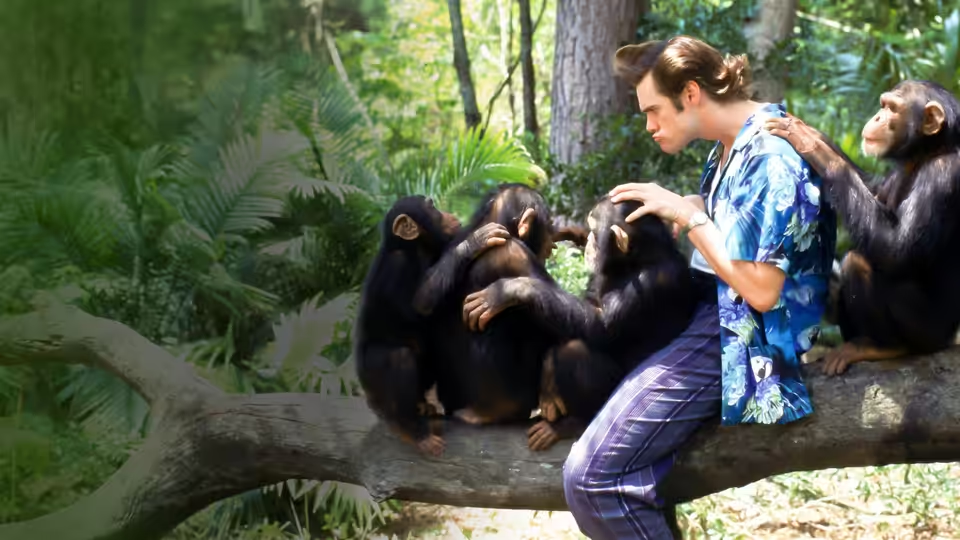
Ace Ventura (Jim Carrey) sits on a jungle branch among chimpanzees
Film review

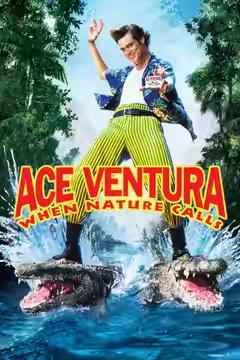
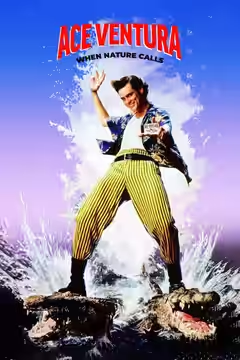
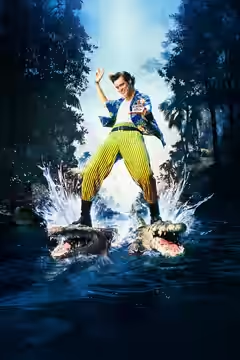
Ace Ventura: When Nature Calls

1995 · Directed by Steve Oedekerk · 1h 30m · RO 15

In a sentenceThe best scene involves a grown man being born from a mechanical rhinoceros, and nothing else in the film can compete

Ace Ventura (Jim Carrey), pet detective, botches a mountain rescue, loses the raccoon he was sent to save, and retreats to a monastery in Tibet to recover his nerve. Fulton Greenwall (Ian McNeice), a flustered official from a British consulate in Africa, climbs the mountain to hire him. The Wachati tribe’s sacred white bat, Shikaka, has been stolen, and without it the wedding between the Wachati Princess (Sophie Okonedo) and the son of the neighbouring Wachootoo will not go ahead and the two tribes will go to war. Ace, who cannot stand bats, flies out anyway. He meets the consul Vincent Cadby (Simon Callow), is given a guide, Ouda (Maynard Eziashi), who translates him loyally and wrongly, and starts poking around a safari park run by Burton Quinn (Bob Gunton).

Plays from YouTube when you press play; nothing loads from them until then.

Fi1m review

Steve Oedekerk’s sequel takes the pet detective to Africa, makes him louder, and gives him two or three of the best gags of Jim Carrey’s career. Between them it has nothing to do but wait, and the tribes it invents to wait among have not aged well.

Steve Oedekerk, who writes and directs, has one idea for the sequel to Ace Ventura: Pet Detective (1994), and it is a sound one for about twenty minutes: take the same man, send him somewhere bigger, and let him do everything twice as loud. Jim Carrey arrives at this film off a run of three hits in a single year, and he plays it as a man who knows the audience is on his side before he has opened his mouth. He is right. The trouble is that Oedekerk knows it too, and builds a 90-minute film on the assumption that Carrey will fill it. He fills roughly half.

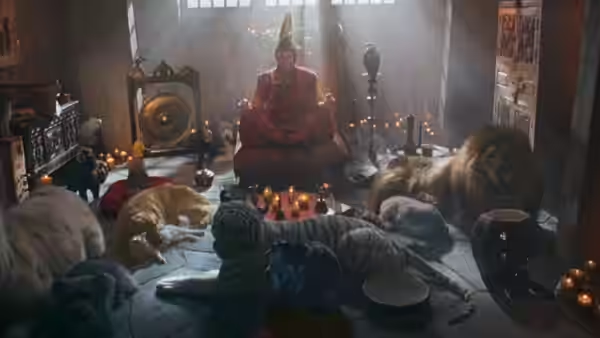
The opening is the good half in miniature. Ace dangles from a cliff face in a parody of Cliffhanger, straining to save a raccoon, and the sequence is shot and cut with a straight face, which is why it works. The raccoon does not make it. Ace takes himself off to a monastery in Tibet and is eventually asked to leave by monks who can barely hide their relief. We laughed hard at the monks. This stretch has a shape, a joke that builds and pays off, and the film does not find another shape like it until it reaches a rhinoceros.

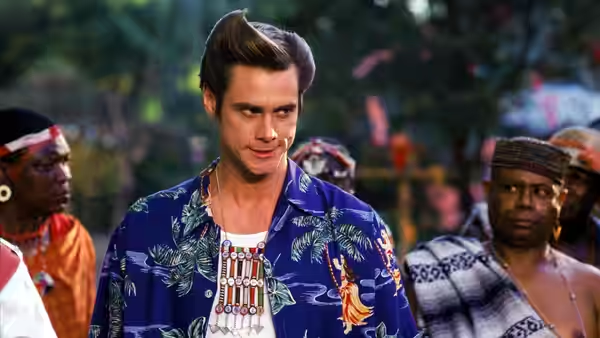
Donald E. Thorin shoots the plains in wide, warm, golden frames, as if for a wildlife documentary, and Robert Folk writes a big brass score in the manner of a 1950s safari picture. Both are doing the same job, which is to make the film look more expensive than its jokes. Stephen J. Lineweaver’s Wachati village is thatch and firelight, and his consulate is colonial white with ceiling fans. Elsa Zamparelli keeps the Hawaiian shirt and the hair and puts the two tribes in beads and paint from no country in particular, which is the film’s problem in a single costume rack.

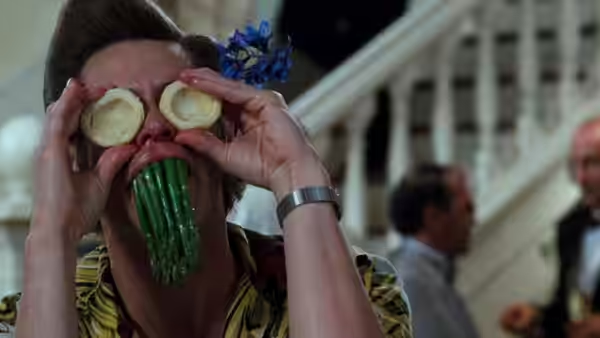
When the gags land they land properly. The rhino scene, in which Ace hides inside a mechanical animal, overheats, and escapes through the only available exit in front of a jeep full of tourists, is as well-built a piece of physical comedy as Carrey has done, and Malcolm Campbell cuts it with patience, letting the horror on the tourists’ faces do the work. A briefing in a darkened room becomes a shadow-puppet show, bunnies first, then worse. These are the moments most critics point to and they are right to.

The rest is the Wachati and the Wachootoo. Oedekerk has invented two African peoples so that Ace can insult one and be threatened by the other, and the film never looks at either of them except through him. The Wachati exist to be grateful; the Wachootoo exist to be frightening; the Princess, played by Sophie Okonedo in an early role, exists to want Ace. Maynard Eziashi gets the only African character with a joke of his own, the guide Ouda, who repeats Ace’s abuse to the chiefs with an innocent smile, and he is good. Tommy Davidson’s Tiny Warrior turns up for a fight that goes on for some time.

Here is what we felt. We laughed at the rhino until we had to wipe our eyes, loudly and without dignity, and we were glad to be in a room full of people doing the same. About a quarter of an hour later we were watching Carrey mug at a circle of painted extras and found we were embarrassed, for him and for them, and that nothing in the scene was asking us to be anything else. The mystery, meanwhile, is not one. Ian McNeice is sweetly flustered as Greenwall, Simon Callow does suave and bored as Cadby, and Bob Gunton glowers in a safari hat, and none of them is given a scene that a reader of the synopsis could not predict.

The first film was small and odd and seemed slightly surprised by its own star. This one is sure of itself from the first frame and has nothing underneath the certainty except the next set piece. It is for children on a wet afternoon, for anyone who wants the rhino, and for people who will forgive a great deal for a man who commits to a joke the way Carrey does. The tagline promises new animals, new adventures, same hair. Two of the three are true, and the hair is not the problem.

Critical consensus AI synthesised

58
Positive
1
Mixed
3
Negative
2

Most critics meet the sequel with a shrug, and the score sits in the middle. Where there is praise, it goes to Jim Carrey’s physical comedy and to individual set-pieces rather than the film as a whole. The opening sequence, a parody of Cliffhanger in which the pet detective fails to save a raccoon, is picked out more than once. Empire likes the rhino birth and the bunny-shapes gag. Variety is the lone admirer, calling it fresh and brash and crediting Steve Oedekerk’s comic timing.

The reservations cluster around what sits between the set-pieces. Radio Times finds the juvenile slapstick wearing and the direction short of the original’s surreal invention; the Los Angeles Times finds the humour inconsistent and much of the film flat, while admitting Carrey’s body does its work. The spread is wide, which for a comedy usually means the jokes land for you or they do not. Two of the six reviews are only partly readable.

Variety
9 November 1995 · Leonard Klady
85*

Klady finds the sequel fresh, brash, and outrageous, with strong commercial appeal. He especially praises Jim Carrey’s performance and Steve Oedekerk’s feel for comic timing.

Read the full review →
Empire
1 January 2000 · Caroline Westbrook
65*

Westbrook finds the sequel an uneven but entertaining showcase for Jim Carrey’s lowbrow comedy. She singles out the absurd set-pieces, especially the rhino birth and the bunny-shapes gag, as its funniest moments.

Read the full review →
The New York Times
10 November 1995
64*

The URL identifies this as a New York Times film review, but the article text is inaccessible. Its verdict and any specific praise or complaint cannot be determined from the available page.

Read the full review →
Time Out
· GA
64*

The available standfirst suggests the sequel starts on a high note, but the full verdict is unavailable. It singles out the pet detective’s retreat to a Tibetan mountain after failing to save a raccoon.

Read the full review →
Radio Times
★★ · John Ferguson
40

The review finds the sequel irritating rather than charming. It criticizes the relentless juvenile slapstick and says the direction lacks the original’s surreal inspiration.

Read the full review →
Los Angeles Times
10 November 1995 · Kenneth Turan
30*

Turan finds the film mostly flat and its humor inconsistent, despite Carrey’s physical comedy. He praises the opening sequence as a clever parody of Cliffhanger.

Read the full review →

Straight answers AI written, from our review

Is Ace Ventura: When Nature Calls worth watching?
Ace Ventura: When Nature Calls is worth watching for the rhinoceros scene and two or three other gags, and not for much else; we scored it 54. Jim Carrey fills about half of the 90 minutes, and the invented African tribes he spends the other half among have aged badly. It suits children on a wet afternoon and anyone who will forgive a lot for a man who commits to a joke.
How long is Ace Ventura: When Nature Calls, and what is it rated?
Ace Ventura: When Nature Calls runs 1h 30m and is rated 15 by the RO in Romania. It is a crime and comedy film.
Where can I watch Ace Ventura: When Nature Calls in Romania?
Ace Ventura: When Nature Calls is not on any streaming or rental service in Romania at the moment. It is available in 22 other countries; change your country at the top of the page to see where. Availability is checked daily.
How does Ace Ventura: When Nature Calls compare to Ace Ventura: Pet Detective?
Ace Ventura: When Nature Calls is louder, bigger and more sure of itself than Ace Ventura: Pet Detective, and the original is the stranger and more interesting of the two. The sequel has the better individual gags, the rhino above all, but nothing holding them together; the first film is one long Carrey performance with a plot draped over it, and its ending turns nasty. Newcomers should start with the original.
What should I watch after Ace Ventura: When Nature Calls?
After Ace Ventura: When Nature Calls, try Ace Ventura: Pet Detective (1994, Fi1m 44): The smaller, stranger original, before anyone knew it would work. Then The Mask (1994, Fi1m 71): Carrey’s face as special effect, with a script that keeps up; and Hot Shots! Part Deux (1993, Fi1m 67): Parody as carpet-bombing, with a far higher rate of hits than misses.

Cast

Awards

Kids' Choice Award for Favorite Movie, 1996

Won
Kids' Choice Award for Favorite Movie

If you liked this, try…

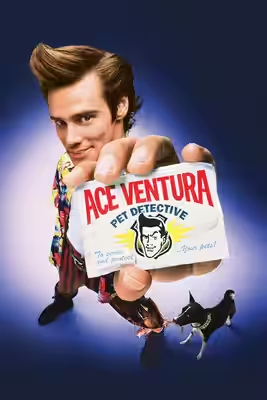
  1. Ace Ventura: Pet Detective (1994, Fi1m 44)The smaller, stranger original, before anyone knew it would work.

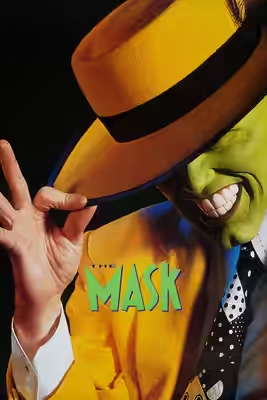
  2. The Mask (1994, Fi1m 71)Carrey’s face as special effect, with a script that keeps up.

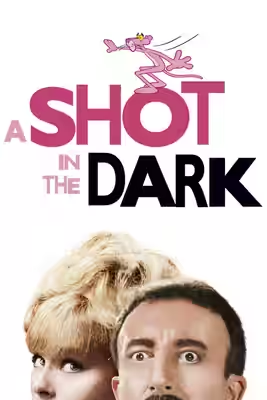
  3. A Shot in the Dark (1964) · not reviewed yetSellers’s Clouseau: the same idiot detective, with timing instead of volume.

  4. Hot Shots! Part Deux (1993, Fi1m 67)Parody as carpet-bombing, with a far higher rate of hits than misses.

  5. Monsieur Hulot's Holiday (1953, Fi1m 86)Physical comedy built from patience and silence, the exact opposite of this.

Free account

Know what to watch tonight

Two lists that know where things are streaming, collections you can share, your own score beside ours, and Discover that remembers what you have seen.

  • Want to see, sorted by what is streaming now
  • Seen, with your score out of ten
  • No adverts, ever