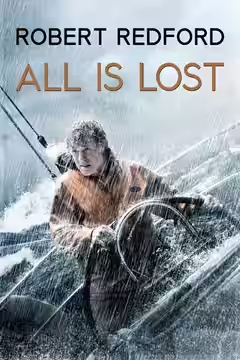
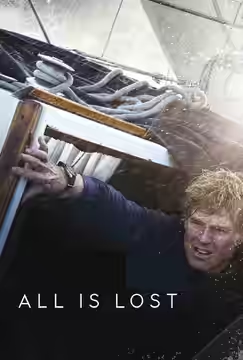
Robert Redford makes this spare survival drama gripping through the effort of staying composed. J.C. Chandor trusts physical action for most of its running time; the score is less willing to leave us alone.
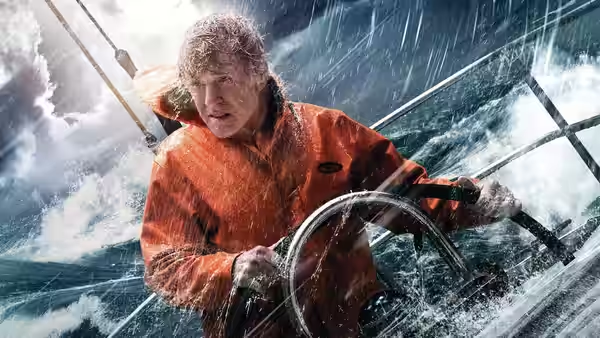
All Is Lost is a gripping survival film, with a little more music than it needs. J.C. Chandor puts Robert Redford alone at sea and gives him almost no dialogue, leaving us to watch a man work out how to remain alive. We do not need a family history to understand the wish. We need to believe in the effort, and the actor makes each demand on his ageing body matter.
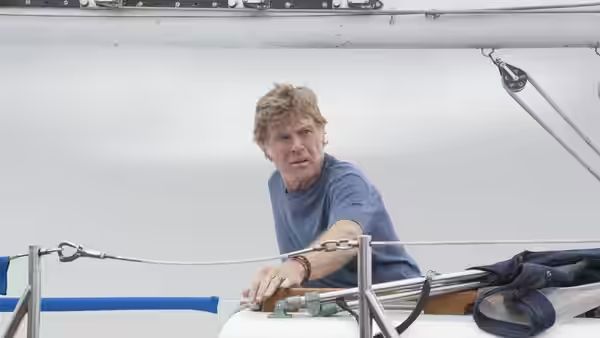
The performance is persuasive because he never seems eager to demonstrate courage. His stillness suggests someone accustomed to managing a problem before admitting how bad it is. We were frightened for him when the strain of the physical work showed through that calm. He makes it possible to watch a man concentrating for long stretches without wishing he would explain himself. The occasional uncertainty is crucial: he can seem resourceful without making us assume that he has everything under control.
Frankie DeMarco’s cinematography gives the surrounding water enough attention to make it absorbing in its own right. It can hold the eye even when little appears to be happening, which helps the film sustain its quiet passages. John P. Goldsmith’s production design is suitably unobtrusive, keeping our attention on the practical business of staying alive. The sea sequences retain a convincing sense of physical danger even when the water invites us to sit and stare.
Pete Beaudreau’s editing gives the physical action enough time to make sense. We can follow the effort instead of merely receiving a succession of emergencies, which matters in a film with so little speech. At 106 minutes, the film occasionally makes us feel the repetition in its sequence of difficulties. Still, the patience generally works: we have time to understand why the next effort matters, without another character having to explain it for our benefit.
The sound is often more useful than the music. The ocean’s noise makes the man’s silence unsettling, and it supplies enough warning and uncertainty without further assistance. Alex Ebert’s score can be affecting, but its more insistent passages tell us how much to feel when the image has already done the work. It is a modest complaint, though an audible one in a film so sparing elsewhere. We wanted more confidence in the water and in the actor.
As screenwriter as well as director, J.C. Chandor resists giving the man a convenient past to explain his behaviour. That is a useful departure from survival dramas which make us wait through memories before letting us attend to the danger in front of us. The lack of explanation can keep us at a slight distance from him, but it also stops his persistence being reduced to one tidy motive. We can recognise the wish to carry on without needing to know whom he hopes to see again.
This is a film to watch without dividing your attention. A glance away loses something when so much rests on a face, a physical effort or a small change in composure. Those who need conversation and a fully explained character may find its restraint frustrating. Give it a quiet evening, and let the man get on with the work.