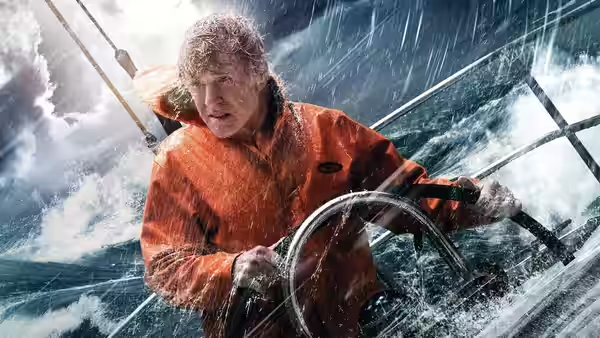
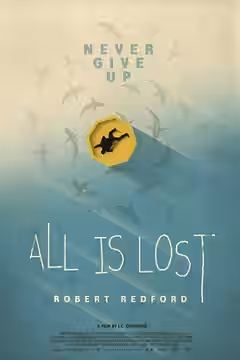
Our Man (Robert Redford) steers his sailboat across calm open water
Film review

All Is Lost

2013 · Directed by J.C. Chandor · 1h 46m · ΓΓΤΕ Κ

In a sentenceWe would not last five minutes at sea, but Robert Redford briefly makes us think we might

In J.C. Chandor’s All Is Lost, photographed by Frankie DeMarco, Our Man (Robert Redford) is alone at sea, trying to stay alive with only his own strength and judgement to rely on. He meets each demand with practical effort, saying little as he works. The strain tests his ageing body, and there is no companion to share the work or help him make decisions. Little is explained about the life he has left behind. His attention stays on the danger in front of him and on getting through the next difficulty without losing control of himself.

Plays from YouTube when you press play; nothing loads from them until then.

Fi1m review

Robert Redford makes this spare survival drama gripping through the effort of staying composed. J.C. Chandor trusts physical action for most of its running time; the score is less willing to leave us alone.

All Is Lost is a gripping survival film, with a little more music than it needs. J.C. Chandor puts Robert Redford alone at sea and gives him almost no dialogue, leaving us to watch a man work out how to remain alive. We do not need a family history to understand the wish. We need to believe in the effort, and the actor makes each demand on his ageing body matter.

The performance is persuasive because he never seems eager to demonstrate courage. His stillness suggests someone accustomed to managing a problem before admitting how bad it is. We were frightened for him when the strain of the physical work showed through that calm. He makes it possible to watch a man concentrating for long stretches without wishing he would explain himself. The occasional uncertainty is crucial: he can seem resourceful without making us assume that he has everything under control.

Frankie DeMarco’s cinematography gives the surrounding water enough attention to make it absorbing in its own right. It can hold the eye even when little appears to be happening, which helps the film sustain its quiet passages. John P. Goldsmith’s production design is suitably unobtrusive, keeping our attention on the practical business of staying alive. The sea sequences retain a convincing sense of physical danger even when the water invites us to sit and stare.

Pete Beaudreau’s editing gives the physical action enough time to make sense. We can follow the effort instead of merely receiving a succession of emergencies, which matters in a film with so little speech. At 106 minutes, the film occasionally makes us feel the repetition in its sequence of difficulties. Still, the patience generally works: we have time to understand why the next effort matters, without another character having to explain it for our benefit.

The sound is often more useful than the music. The ocean’s noise makes the man’s silence unsettling, and it supplies enough warning and uncertainty without further assistance. Alex Ebert’s score can be affecting, but its more insistent passages tell us how much to feel when the image has already done the work. It is a modest complaint, though an audible one in a film so sparing elsewhere. We wanted more confidence in the water and in the actor.

As screenwriter as well as director, J.C. Chandor resists giving the man a convenient past to explain his behaviour. That is a useful departure from survival dramas which make us wait through memories before letting us attend to the danger in front of us. The lack of explanation can keep us at a slight distance from him, but it also stops his persistence being reduced to one tidy motive. We can recognise the wish to carry on without needing to know whom he hopes to see again.

This is a film to watch without dividing your attention. A glance away loses something when so much rests on a face, a physical effort or a small change in composure. Those who need conversation and a fully explained character may find its restraint frustrating. Give it a quiet evening, and let the man get on with the work.


Critical consensus AI synthesised

79
Positive
21
Mixed
6
Negative
0

Most critics find All Is Lost a gripping survival drama, with praise centred on Robert Redford’s restrained, physically expressive performance. The reviews repeatedly credit him with conveying vulnerability, age and determination with little dialogue. Chandor’s visual storytelling also draws broad approval: the methodical action, sea imagery and detailed sound make exposition seem unnecessary to many reviewers. For its strongest supporters, that spareness makes the struggle both tense and moving.

The spread runs from enthusiastic praise to mixed responses, with no outright negative verdicts. Reservations centre on emotional distance, repetition and whether the restraint can sustain the running time. The Guardian admires Redford but finds the character difficult to reach; Little White Lies goes further, questioning his performance’s realism and finding the pace too sedate. The score divides opinion too, while several otherwise enthusiastic reviews express doubts about the ending’s handling.

Time Out
17 December 2013 · ★★★★★ · Joshua Rothkopf
100

The review is strongly positive about the film. It singles out Robert Redford’s tough, manly screen presence for praise.

Read the full review →
Empire
3 December 2013 · Chris Hewitt
90*

Hewitt considers the film a triumph of pure cinema, driven by Redford’s sublime performance. He singles out Chandor’s assured direction and the visual storytelling for praise.

Read the full review →
IndieWire
15 October 2013 · A- · Eric Kohn
90

Kohn finds the film an impressive, minimalist work, with Robert Redford’s performance carrying its themes of mortality. He praises Redford’s expressive physical acting, while noting that the patient pacing and occasional score can overstate the material.

Read the full review →
Sight and Sound
29 December 2013 · Michael Koresky
90*

Koresky admires the film’s elemental, tightly sustained approach and finds it an operatic experience. He especially praises Robert Redford’s physically demanding performance and the empathy it earns for the solitary character.

Read the full review →
The AV Club
17 October 2013 · A- · Mike D'Angelo
90

D’Angelo calls the film a triumph of dramatic minimalism, while noting that Redford’s performance is too single-minded to reach greatness. He praises its unsparing realism and the way it makes backstory and exposition feel unnecessary.

Read the full review →
Variety
22 May 2013 · festival review · Justin Chang
90*

Chang praises the film as an emotionally resonant, eloquent survival drama and calls Redford’s performance superb. He especially singles out the resourceful, nearly wordless storytelling and the deeply moving ending, while noting that the final scene risks overcalculation.

Read the full review →

Straight answers AI written, from our review

Is All Is Lost worth watching?
All Is Lost is worth watching for its gripping, nearly wordless survival drama, and we score it 82 out of 100. Robert Redford makes the practical effort of staying alive absorbing, though the music sometimes presses too hard and the difficulties occasionally feel repetitive. We recommend it for a quiet evening with undivided attention.
How long is All Is Lost, and what is it rated?
All Is Lost runs 1h 46m and is rated Κ by the ΓΓΤΕ in Greece. It is an action and adventure film.
Where can I watch All Is Lost in Greece?
All Is Lost is not on any streaming or rental service in Greece at the moment. It is available in 38 other countries; change your country at the top of the page to see where. Availability is checked daily.
How violent or frightening is All Is Lost, and is it suitable for children?
All Is Lost carries a UK 12 certificate, and its convincing physical danger makes it a tense choice rather than an easy children’s adventure. We find the strain on Redford’s ageing body frightening as he works alone to survive at sea. It is better suited to teenagers comfortable with sustained peril and long, quiet passages than to younger children.
How does All Is Lost compare to A Man Escaped?
All Is Lost shares A Man Escaped’s ability to turn careful practical work into sustained suspense, but exchanges prison preparation for solitary survival at sea. We favour A Man Escaped for viewers seeking greater restraint, with sound carrying much of its danger where All Is Lost sometimes pushes its music too hard. Redford’s physical performance gives the sea drama its own strong appeal.
What should I watch after All Is Lost?
After All Is Lost, try A Man Escaped (1956, Fi1m 90): Careful hands and close attention turn practical work into sustained suspense. Then The Straight Story (1999, Fi1m 88): An ageing man’s determination receives the same patient attention, with more conversation; and The Wages of Fear (1953, Fi1m 90): Working through one physical hazard after another becomes an exacting test of nerve.

Cast

Awards

Academy Awards, 2014

Nominated
Best Sound Editing

If you liked this, try…

  1. Arctic (2018) · not on Fi1m yetAnother solitary survivor whose practical decisions make the danger painfully easy to grasp.

  2. The Naked Island (1960) · not on Fi1m yetPatient physical work and scarce dialogue make an ordinary struggle absorbing.

  3. A Man Escaped (1956, Fi1m 90)Careful hands and close attention turn practical work into sustained suspense.

  4. The Straight Story (1999, Fi1m 88)An ageing man’s determination receives the same patient attention, with more conversation.

  5. The Wages of Fear (1953, Fi1m 90)Working through one physical hazard after another becomes an exacting test of nerve.