Film review

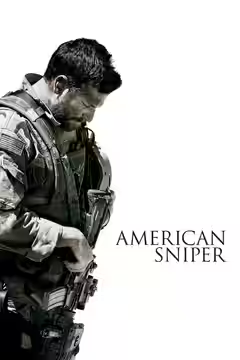
American Sniper

2014 · Directed by Clint Eastwood · 2h 13m · MPA R

In a sentenceTwo hours looking down a rifle at people the film has no intention of introducing

WarAction

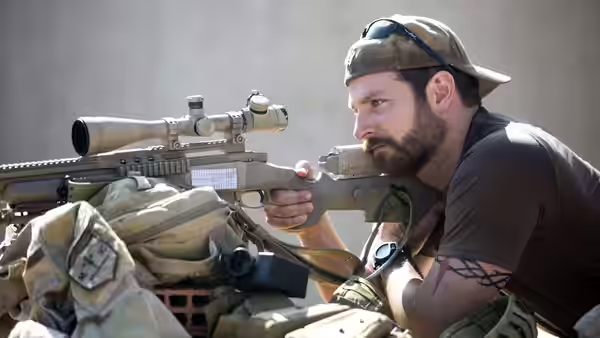
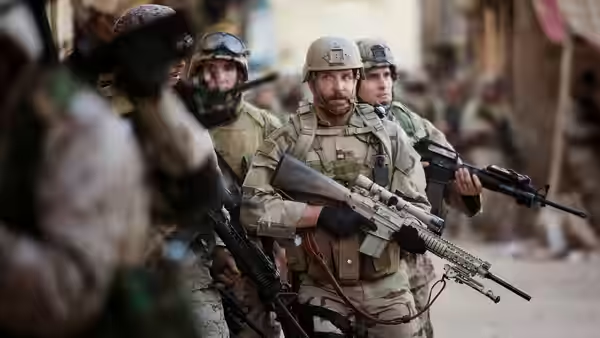
Fallujah, Iraq. Navy SEAL Chris Kyle (Bradley Cooper) lies on a rooftop with a marine convoy approaching and a woman and a boy stepping into the street below. The film then goes back to Texas: a boy (Cole Konis) taught by his father Wayne Kyle (Ben Reed) that people are sheep, wolves or sheepdogs; a rodeo rider who sees the 1998 embassy bombings on television and joins the SEALs; a bar where he meets Taya (Sienna Miller), who tells him she wants nothing to do with SEALs. After 11 September 2001 he is deployed alongside Goat-Winston (Kyle Gallner) and Dauber (Kevin Lacz), and finds himself back on that rooftop, with seconds to decide whether the boy is carrying a grenade.

Plays from YouTube when you press play; nothing loads from them until then.

Fi1m review

Clint Eastwood’s film about the Navy SEAL Chris Kyle is tense whenever Bradley Cooper is on a rooftop, and Sienna Miller does more than the script gives her. It never once asks who is on the other end of the shot.

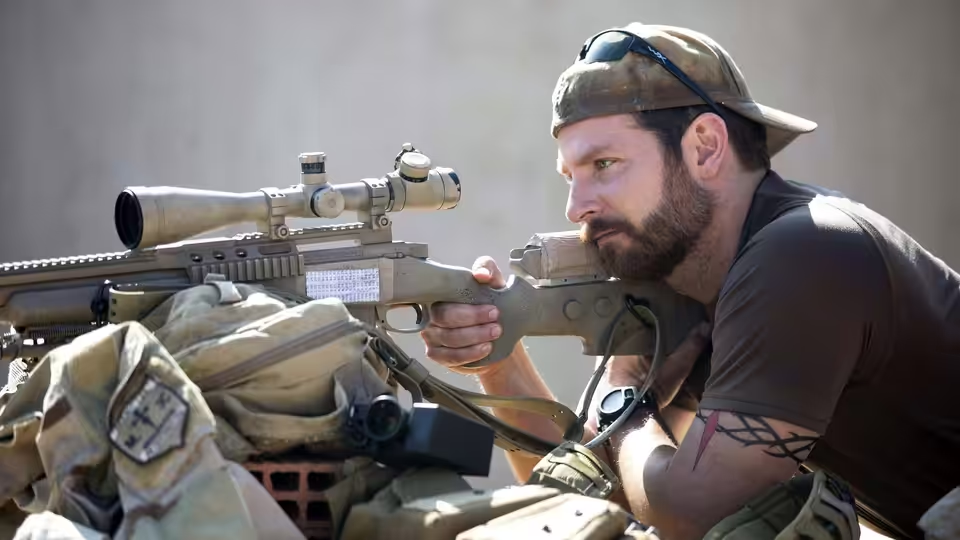
Clint Eastwood’s film about Chris Kyle, adapted by Jason Hall from Kyle’s own memoir, is built the way Kyle’s job was: one man, one rifle, one narrow view of a street. The tagline calls him the most lethal sniper in U.S. history, and the film takes the phrase at face value. Four tours in Iraq, a wife and children in Texas, a count that keeps rising. It is tense and cleanly made, Bradley Cooper is good in it, and we cannot recommend it, because for 133 minutes it looks only where Kyle looks and never once turns round.

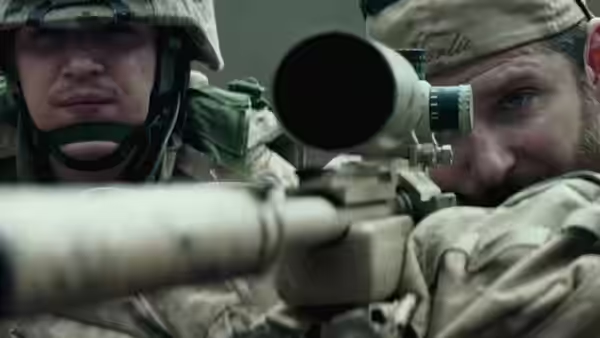
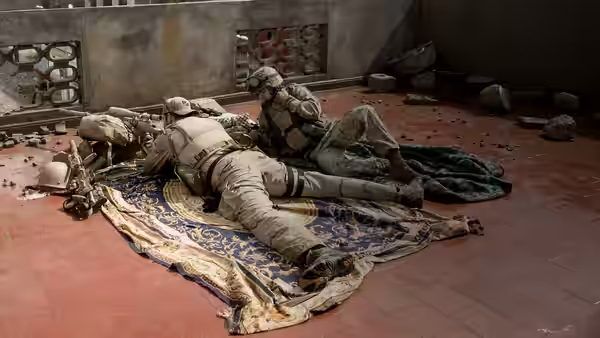
The opening is the film at its best. Kyle lies on a rooftop over a Fallujah street, a marine convoy is coming, and a woman steps out with a boy and hands him something. Joel Cox and Gary D. Roach cut between the scope, Cooper’s eye, the street and the radio in his ear, and they hold each shot a beat longer than is comfortable. Eastwood keeps music almost entirely off the soundtrack, so there is only wind, the radio and breathing. We were tight in our seats and glad of it. Then we noticed the film had not the slightest interest in the woman, and the feeling curdled, and it never quite came back.

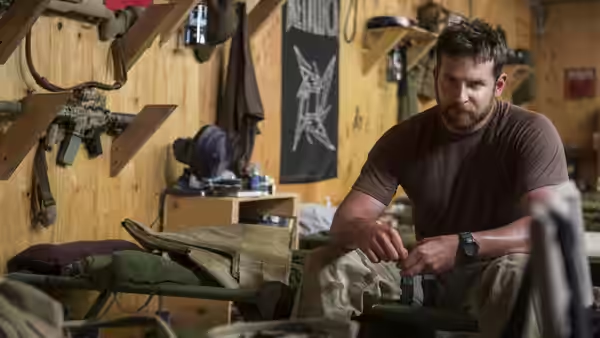
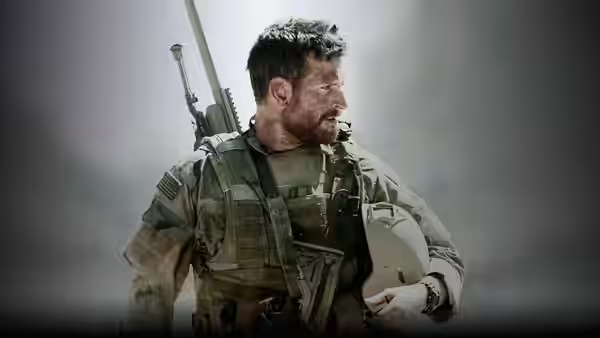
Cooper plays Kyle as a man with no doubt in him, and puts the damage in his body instead. He is heavy, slow-blinking, quiet, and he spends the home stretches sitting in front of a television that is not switched on. Tom Stern shoots the Texas suburbs in flat, grey, overcast light, so the house Kyle comes back to looks colder than the war he leaves, and Deborah Hopper keeps him in the same hunting jacket and ball cap at home, as if he has never fully changed out of uniform. It is careful, physical acting, and Cooper makes a man who barely speaks worth watching for two hours.

Sienna Miller has the harder job. Taya gets one scene per tour, and each is the same scene: he is going back, she says he is not there even when he is here, he says he is protecting people. Miller finds something different to do with her face each time, which is more than Hall’s script has bothered to. The scene in which Kyle takes her call from a rooftop while a firefight starts around him is the one time the film puts the two halves of his life in one frame, and it is a proper scene.

The war itself is a matter of targets. James J. Murakami and Charisse Cardenas build Iraqi streets of rubble and rooftops, all the colour of the dust, and Stern bleaches them to a hot ochre, so that anyone moving stands out against a wall. That is how a sniper sees, and it is also how the film sees. There is an enforcer called the Butcher, whose methods we will not describe, and a rival sniper called Mustafa, dressed in black and given no lines. Every other Iraqi is a body in a doorway, a shape on a roof or a man who may or may not be reaching for something. Nobody in the film asks what they want, and nobody on screen appears to wonder.

Eastwood has done this differently. In 2006 he made Flags of Our Fathers and Letters from Iwo Jima, two films about one battle, one from each side, because he thought both sides had a story. Here he makes one film and points it one way. A sandstorm sequence late on, in which the fighting disappears into a wall of brown and the film with it, is the nearest he comes to saying the whole business made no sense, and it is over in minutes. The ending is abrupt in a way we will not describe, except to say that it hands the largest questions to a title card.

See it for the rooftops, for Cooper, and for Miller doing a great deal with a little, and see it on a big screen, where the scope has room to work. Do not go looking for the war. It is not here. Only the man on the roof, and what he can see down a tube.

Critical consensus AI synthesised

64
Positive
15
Mixed
3
Negative
5

Most critics come down in favour, though without much heat. The praise clusters on Bradley Cooper’s performance, which even the harshest reviewers single out, and on Eastwood’s handling of the sniper sequences, which several find as tense as anything in The Hurt Locker. A good number read the film as a study of what killing does to a committed soldier rather than a straightforward salute, and credit it with an undertow of sadness.

The spread is wide, from raves to outright dismissals. The reservations gather around politics and the home front: Iraqis reduced to shadows, the war’s context left unexamined, repetitive domestic scenes and a rushed ending. The Guardian calls it an incurious salute that prints the legend, Collider finds it hollow and passionless, and Den of Geek judges it Eastwood’s worst. Even some who admire it, Little White Lies among them, call it ideologically muddled. Cooper is the one point on which nearly everyone agrees.

Empire
4 June 2014 · festival review · Ian Nathan
90*

Eastwood's film is a muscular, thrilling Iraq war story that honours heroism while ruminating on its costs to the man. Cooper gives a complex, nomination-worthy performance as the conflicted sniper.

Read the full review →
Radio Times
★★★★ · Alan Jones
80

Eastwood's matter-of-fact biopic centers on Cooper's confident performance as the lethal sniper, delivering heart-stopping suspense and insights into the psychological effects of warfare.

Read the full review →
Time Out
23 December 2014 · ★★★★ · Joshua Rothkopf
80

Eastwood delivers a superbly subtle critique of the Iraq War veteran experience, saluting soldiers while highlighting personal tragedy and family dysfunction at home; Cooper is at his best.

Read the full review →
Film Comment
70*

The review praises Eastwood's efficient direction and complex action set pieces, noting Cooper's strong portrayal of Kyle as a modest protector; it highlights the film's respectful yet probing take on war's moral costs while acknowledging production constraints and public debate around the subject.

Read the full review →
Los Angeles Times
24 December 2014 · Kenneth Turan
70*

The film goes beyond standard war-hero biopics by examining the soul-destroying consequences of violence on even a committed patriot like Kyle. Eastwood crafts impeccable action sequences that immerse viewers in combat's relentlessness.

Read the full review →
Slant Magazine
5 December 2014 · Chuck Bowen
70*

Eastwood explores the myth of the hero through Kyle as a man relentlessly alone and unfulfilled, gripping viewers with hypnotic silence and visceral battle scenes tied to the character's tormented psyche. The film balances art and action while highlighting the alienating sadness of heroism.

Read the full review →

Cast

Awards

Academy Awards, 2015

Nominated
Best Actor
Nominated
Best Film Editing
Nominated
Best Picture
Nominated
Best Sound
Nominated
Best Writing, Adapted Screenplay
Won
Best Sound Editing

If you liked this, try…

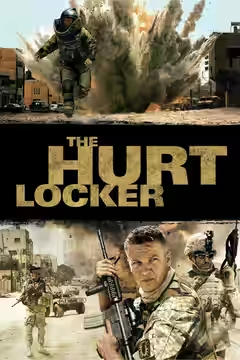
The Hurt Locker poster86

The Hurt Locker

2008 · Bigelow’s bomb-disposal film, tighter, stranger and far more curious about the men it watches.

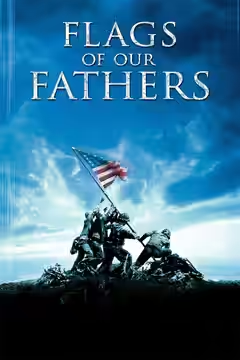
Flags of Our Fathers poster

Flags of Our Fathers

2006 · Eastwood on a war-hero myth, this time willing to ask who built it.

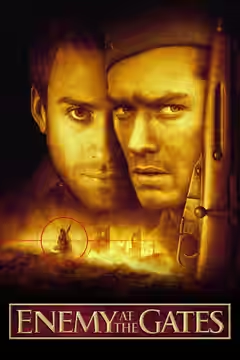
Enemy at the Gates poster

Enemy at the Gates

2001 · Two snipers stalk each other through Stalingrad; the duel this film only gestures at.

Waltz with Bashir poster83

Waltz with Bashir

2008 · An animated Israeli veteran tries to remember a war his mind has filed away.

Restrepo poster

Restrepo

2010 · A year with one platoon in Afghanistan, no script, no rooftop, no comfort.