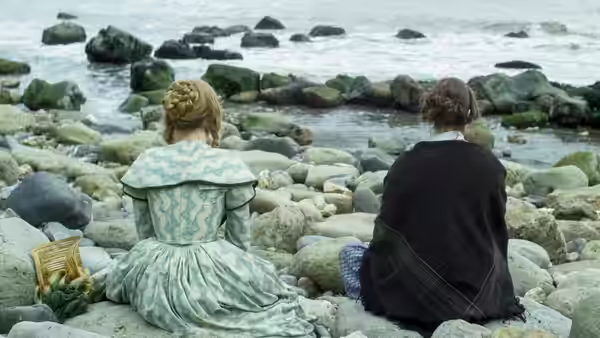
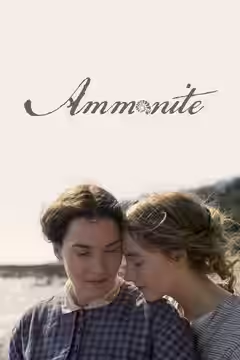
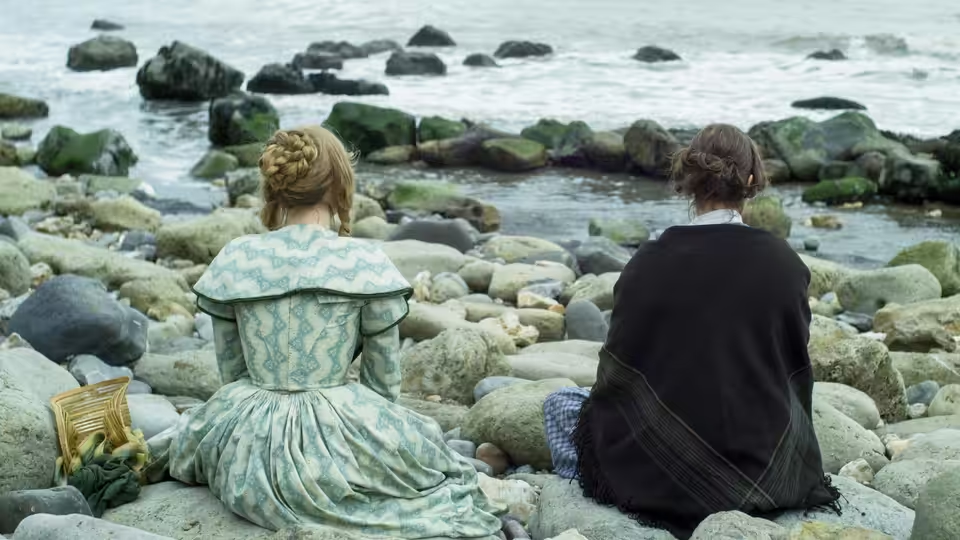
Charlotte Murchison (Saoirse Ronan) and Mary Anning (Kate Winslet) sit among rocks beside the sea
Film review

Ammonite

2020 · Directed by Francis Lee · 1h 58m

In a sentenceKate Winslet digging up fossils proves more absorbing than anyone falling in love

In a Victorian coastal community, Mary Anning (Kate Winslet) searches among the rocks for fossils. Her days revolve around solitary work, and she has little inclination to make room for company. Charlotte Murchison (Saoirse Ronan) asks to accompany her, putting that guarded routine under pressure. Mary wants to get on with her work; Charlotte wants to join her in it. Spending time together opens up the possibility of romance, against the restrictions surrounding their lives. Molly Anning (Gemma Jones) and Elizabeth Philpot (Fiona Shaw) share this small coastal world.

Plays from YouTube when you press play; nothing loads from them until then.

Fi1m review

Kate Winslet’s physically convincing performance gives Francis Lee’s coastal romance its strongest reason to watch. The care is evident in the images and sound, but Charlotte remains too thinly written for the relationship to convince.

Francis Lee’s Ammonite is most convincing when Mary Anning has work to do. Kate Winslet makes the labour of searching among rocks absorb us without requiring much explanation or conversation. The romance with Charlotte Murchison, played by Saoirse Ronan, is harder to believe, despite the care both actors bring to it. There is enough here to reward an interest in restrained period drama, but the writing around Mary is frustratingly thin.

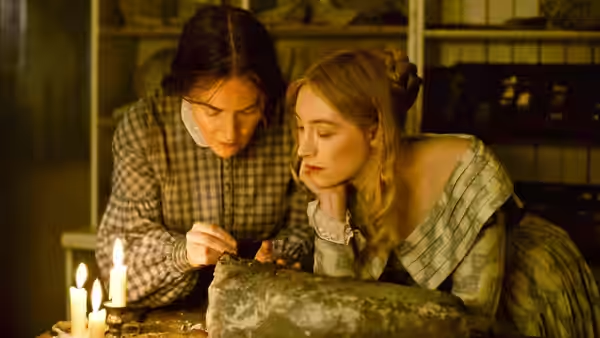
Mary’s solitude gives Winslet something substantial to play, and she resists making it merely picturesque. Her physical concentration during the fossil work suggests a person accustomed to relying on herself, while the sparse dialogue lets small changes in her bearing carry weight. We felt unexpectedly close to Mary as she worked among the rocks. Winslet makes that effort so persuasive that we wanted more time with the work itself, including the knowledge needed to do it.

Stéphane Fontaine photographs the coastal rocks with enough attention to their rough surfaces that Mary’s labour feels physically demanding. Sarah Finlay’s production design belongs to the same sober period world, keeping the surroundings from competing with the actors. The attention to material detail works because it helps us understand how Mary occupies her days. There is pleasure in watching a period romance take the physical effort of working seriously, rather than treating it as something to establish before the important business begins.

The difficulty is that Charlotte never becomes comparably distinct. Ronan can suggest feeling without spelling it out, but Lee’s screenplay leaves too little for that restraint to communicate. Her presence matters to Mary; her own wants deserve more attention than the writing gives them. The scenes between the women contain moments of tenderness, and the actors prevent the relationship from seeming merely dutiful. Yet we too often have to supply the reasons these particular people would want each other’s company.

The attention to everyday sound is more rewarding. Coastal noise and the insistence of clocks make the women’s surroundings audible, giving the quiet passages something to hold our attention beyond the faces. The music by Hauschka and Dustin O’Halloran cannot make the feelings much clearer when the writing has left them vague. Chris Wyatt’s unhurried editing gives Winslet room to work, but it also leaves stretches in which we are waiting for another detail of character.

A restrained romance need not explain every attraction, and Lee is right to allow physical desire its place without apologising for it. The frankness is welcome, and the actors bring conviction to the physical intimacy. But the film’s speculative use of historical lives makes us want characters who seem capable of existing beyond this relationship. The scientific work is compelling enough to make its limited place in the story a real frustration.

Lee’s seriousness is never in doubt, and the care taken over the performances and surroundings deserves respect. The solemn pace nevertheless makes the underwritten passages feel longer, particularly when Charlotte needs something more substantial to express. Anyone seeking a convincing love story may find themselves doing too much of the work. Watch it for Winslet, with some patience for the pauses.

Critical consensus AI synthesised

66
Positive
14
Mixed
8
Negative
7

The reviews lean towards qualified approval, with the strongest agreement around Kate Winslet’s performance: critics repeatedly praise the emotional detail in her physical work and sparse dialogue. Saoirse Ronan also receives substantial praise, while the coastal imagery, tactile photography and attention to everyday sounds earn approval across otherwise differing verdicts. Admirers find the restraint moving and the intimacy persuasive, often responding to the film as a portrait of solitude rather than a conventional romance.

The spread is wide, however, and the central relationship divides critics sharply. The Hollywood Reporter finds the leads emotionally transparent and their intimacy profoundly affecting; Collider finds little chemistry between them and the romance flat. Reservations elsewhere centre on slow pacing, thin characterisation and symbolism that makes the women feel remote. Even several sympathetic reviews find the story slight or the final stretch short of dramatic force, while detractors often retain admiration for Winslet.

Evening Standard
25 March 2021 · ★★★★★ · Charlotte O'Sullivan
100

O'Sullivan calls the film superb and says it contains multitudes. She praises its tactile cinematography and the performances of Kate Winslet and Saoirse Ronan.

Read the full review →
The Hollywood Reporter
12 September 2020 · festival review · David Rooney
98*

Rooney offers an ecstatic verdict, calling the film profoundly affecting and saying it floored him. He singles out Kate Winslet and Saoirse Ronan’s emotionally transparent performances and the film’s naturalistic intimacy for praise.

Read the full review →
Empire
22 March 2021 · Beth Webb
85*

Webb finds the film a tender, finely crafted triumph, though its story is slight. She especially praises Winslet’s assured physical performance and the film’s grounded visual craftsmanship.

Read the full review →
Los Angeles Times
12 November 2020 · Justin Chang
85*

Chang praises the film as a wrenching, passionate portrait of solitude rather than a sweeping forbidden romance. He singles out Kate Winslet’s extraordinary performance, calling it her finest screen acting since “Mildred Pierce.”

Read the full review →
Little White Lies
24 March 2021 · 3/4/4 · Jourdain Searles
80

Searles finds the film atmospheric and emotionally complete, while noting it is not a conventional love story. The review praises the meticulous attention to everyday sounds and gestures, and the poetic refusal of the ending to provide the expected resolution.

Read the full review →
Radio Times
★★★★ · Josh Winning
80

The critic gives the film a strongly positive verdict. They single out Kate Winslet’s achingly vulnerable performance for praise.

Read the full review →

Straight answers AI written, from our review

Is Ammonite worth watching?
Ammonite is worth considering for Kate Winslet’s physically convincing performance and its sober coastal setting; we score it 64 out of 100. We find Mary’s fossil work more absorbing than the romance, so it suits patient admirers of restrained period drama better than anyone seeking a persuasive love story.
How long is Ammonite, and what is it rated?
Ammonite runs 1h 58m. It is a romance and drama film.
Where can I watch Ammonite in Singapore?
Ammonite is not on any streaming or rental service in Singapore at the moment. It is available in 45 other countries; change your country at the top of the page to see where. Availability is checked daily.
How violent or frightening is Ammonite, and is it suitable for children?
Ammonite carries a UK 15 certificate and is not suitable for children under 15, with frank physical intimacy the adult content we highlight. We would caution on that basis rather than offer reassurance about violence or frightening material: our review does not assess those elements specifically.
How does Ammonite compare to Portrait of a Lady on Fire?
Ammonite is our weaker choice for a coastal romance beside Portrait of a Lady on Fire, which gives more attention to how attraction develops. We recommend the latter for its earned tenderness, despite some over-managed restraint; Ammonite is more rewarding when Winslet is absorbed in Mary’s fossil work than when it asks us to believe in the relationship.
What should I watch after Ammonite?
After Ammonite, try Portrait of a Lady on Fire (2019, Fi1m 89): For another coastal romance, with more attention to how attraction develops. Then The Piano (1993, Fi1m 88): Physical work, difficult silences and desire given a more forceful dramatic shape; and The Lunchbox (2013, Fi1m 75): Everyday routines allow lonely people to approach each other without grand declarations.

Cast

Awards

European Film Award for Best Costume Designer, 2021

Won
European Film Award for Best Costume Designer

If you liked this, try…

  1. Portrait of a Lady on Fire (2019, Fi1m 89)For another coastal romance, with more attention to how attraction develops.

  2. The Piano (1993, Fi1m 88)Physical work, difficult silences and desire given a more forceful dramatic shape.

  3. The Lunchbox (2013, Fi1m 75)Everyday routines allow lonely people to approach each other without grand declarations.

  4. Brief Encounter (1945, Fi1m 90)For restrained longing that makes each ordinary meeting feel difficult to abandon.

  5. Desert Hearts (1985) · not reviewed yetA warmer lesbian romance, attentive to the women on both sides of attraction.