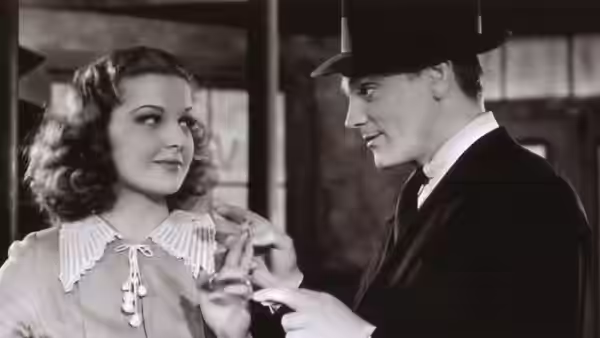
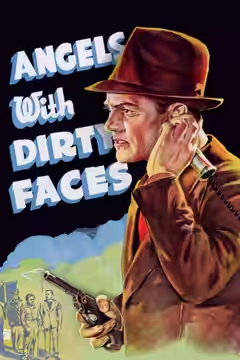
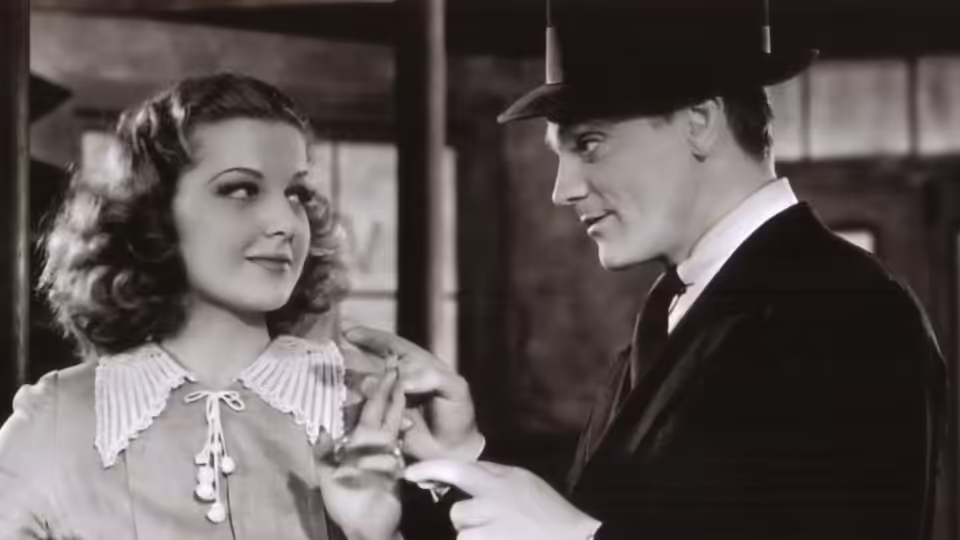
A suited man in a fedora reaches toward a woman’s collar indoors
Film review

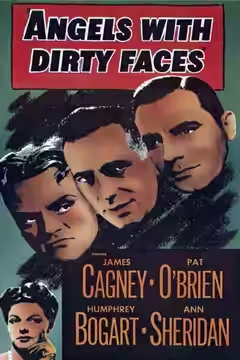
Angels with Dirty Faces

1938 · Directed by Michael Curtiz · 1h 37m

In a sentenceJames Cagney makes the case for bad company rather harder to dismiss

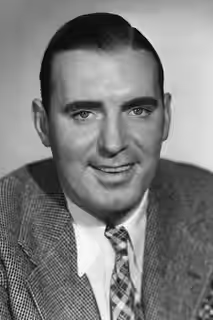
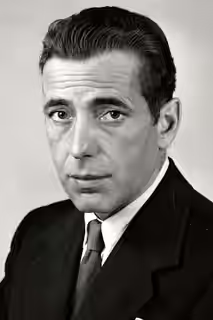
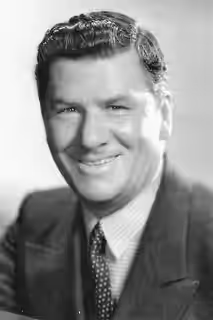
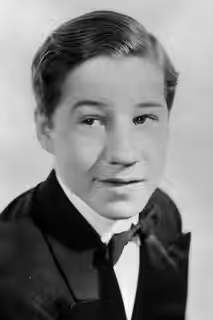
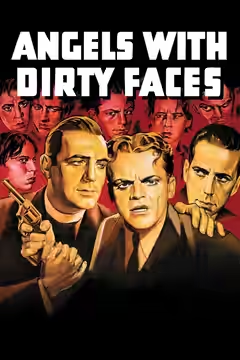
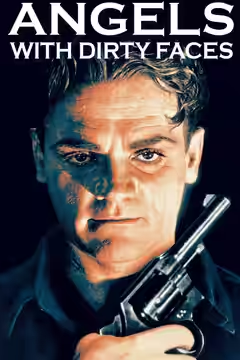
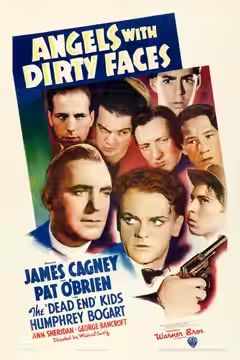
Rocky Sullivan (James Cagney) and Jerry Connolly (Pat O’Brien) are the central figures in a gangster story about criminality, responsibility and redemption. Around them are James Frazier (Humphrey Bogart), Laury Ferguson (Ann Sheridan) and a group of boys including Soapy (Billy Halop), Swing (Bobby Jordan) and Bim (Leo Gorcey). The adults offer contrasting examples to the youngsters, making the appeal of criminal life a concern beyond their own disagreements. Rocky’s force of personality complicates the moral questions, as the story follows the connections between gangsters, children and the adults whose behaviour they observe.

Fi1m review

James Cagney and Pat O’Brien give Michael Curtiz’s gangster drama a warmth that makes its moral questions matter. The dialogue can creak and the melodrama presses hard, but their performances make it well worth seeing.

Angels with Dirty Faces is worth seeing for the uneasy affection between James Cagney and Pat O’Brien. Michael Curtiz gives its questions about crime and responsibility enough urgency to survive some heavy moralising. Rocky Sullivan is immediately attractive company, and the film understands how much trouble that causes. We need to understand why anyone would listen to him, and James Cagney makes that easy. The difficulty comes when the screenplay wants to make its disapproval equally clear.

James Cagney gives Rocky a confidence that makes the heavier dialogue easier to accept. There is pleasure in watching someone so certain of his effect on other people, especially when the performance allows warmth into that certainty. We caught ourselves warming to Rocky against our better judgement. The ease between James Cagney and Pat O’Brien does it: their regard for each other makes the disagreement feel personal. A less companionable leading performance would have made the film considerably simpler and considerably less interesting.

Pat O’Brien deserves as much credit for that connection as his more forceful partner. Jerry Connolly could easily become someone whose chief function is to tell us what to think. The performance gives him enough feeling to make his position seem costly, and enough firmness to keep the scenes from belonging entirely to Rocky. We believe that these men matter to each other. That belief gives the film something to work with when the writing grows insistent.

The youngsters make the question of influence harder to put aside. Their presence gives the adults’ behaviour consequences beyond an argument between two men, though the film can press this point too firmly. Warren B. Duff and John Wexley’s screenplay is least persuasive when it seems anxious that we might misunderstand the lesson. Some of the dialogue has the stiff emphasis of words intended to be remembered. The actors are more convincing when they can make a response feel immediate.

Sol Polito’s cinematography gives the performances a welcome force, keeping our attention on the people carrying this dispute. The visual emphasis feels right for a film whose success depends so heavily on our response to its leading actors. Owen Marks’s editing supplies a briskness that helps the crime drama withstand the weight of the moral discussion; the 97-minute running time feels sufficient. Max Steiner’s music is less restrained, and its insistence sometimes makes the melodrama harder to accept. We would have trusted the actors with more of that emotional work.

As a gangster film, it takes the attraction of criminal confidence seriously enough to make condemnation uncomfortable. That is a worthwhile difficulty, and Curtiz handles it most persuasively through the central relationship. The social commentary becomes less convincing whenever the people begin to sound like examples in a lesson. Even then, the energy of the performances keeps the film from becoming merely dutiful. Its warmth survives the preaching.

There is a particular pleasure here for anyone who enjoys actors holding their own against emphatic material. James Cagney has the greater immediate appeal, but Pat O’Brien makes the partnership worth our time. Watch it for both of them, with a little patience for the moments when the dialogue starts handing down judgement.

Critical consensus AI synthesised

78
Positive
5
Mixed
1
Negative
0

Most critics respond warmly to Angels with Dirty Faces, praising its gangster thrills and its serious interest in criminality and redemption. Michael Curtiz’s assured direction and James Cagney’s performance draw the strongest praise, with several reviews finding the drama forceful despite its familiar material. The favourable responses also value the combination of brisk storytelling and social commentary, treating the moral questions as an important part of the film’s appeal.

The spread is nevertheless wide, running from wholehearted enthusiasm to a mixed assessment. Empire admires the film’s moral core but finds the melodrama heavy and the dialogue dated. Variety is the clearest dissenter: it praises the chemistry and contrasting performances of Cagney and Pat O’Brien, but considers the story familiar and the ending hokey. That reservation marks the sharpest divide, since some of the most enthusiastic reviews single out the closing scenes for praise.

Radio Times
★★★★★ · Tony Sloman
100

The critic calls it a definitive, unsurpassed Warner Bros gangster film. They praise Michael Curtiz’s direction and the especially effective execution-scene ending.

Read the full review →
Slant Magazine
2 February 2005 · ★★★★/4 · Jeremiah Kipp
100

Kipp praises the film as a gripping, conflicted gangster story that benefits from Curtiz’s assured direction. He especially singles out Cagney’s final prison scene for its powerful, ambiguous performance.

Read the full review →
Empire
25 August 2006 · Ian Nathan
75*

Nathan finds the film a classic with a serious moral core, despite its heavy melodrama and dated dialogue. He praises its examination of criminality and redemption, especially the tragic but inspiring final choice Rocky makes.

Read the full review →
The New York Times
26 November 1938 · Frank S. Nugent
70*

The review appears to give the film a favorable verdict. Its headline presents it as a lively gangster drama, but the inaccessible article text prevents confirming what the critic singled out for praise.

Read the full review →
Time Out
· GA
70*

The review presents the film as a gutsy, rousing success. It praises the brisk blend of gangster thrills and social commentary.

Read the full review →
Variety
31 December 1937 · Variety Staff
50*

The review finds the film a familiar Dead End kids story, elevated by its two leads but weakened by a hokey ending. It particularly praises the chemistry and contrasting performances of James Cagney and Pat O’Brien.

Read the full review →

Straight answers AI written, from our review

Is Angels with Dirty Faces worth watching?
Angels with Dirty Faces is well worth watching for James Cagney and Pat O’Brien’s warm, uneasy partnership, and we score it 82 out of 100. We recommend it especially to anyone who enjoys performance-led gangster dramas, with a little patience for stiff dialogue, heavy moralising and music that presses the emotion too hard.
How long is Angels with Dirty Faces, and what is it rated?
Angels with Dirty Faces runs 1h 37m. It is a crime and drama film.
Where can I watch Angels with Dirty Faces in Panama?
Angels with Dirty Faces is not on any streaming or rental service in Panama at the moment. It is available in 4 other countries; change your country at the top of the page to see where. Availability is checked daily.
How violent or frightening is Angels with Dirty Faces, and is it suitable for children?
Angels with Dirty Faces has no UK certificate supplied and is listed as NR in the US, so those labels offer no reliable age guidance for children. Its concerns include criminality and adults’ influence on youngsters, but we cannot give a firm warning about violence or frightening scenes from the available detail; unrated does not mean child-friendly.
How does Angels with Dirty Faces compare to The Public Enemy?
Angels with Dirty Faces offers a warmer Cagney-led gangster drama than The Public Enemy, with more emphasis on affection and moral responsibility. We find its central partnership especially rewarding, while The Public Enemy has sharper dialogue and a more frightening Cagney presence. Choose the former for the relationship with Pat O’Brien, the latter for criminal swagger made deeply unpleasant.
What should I watch after Angels with Dirty Faces?
After Angels with Dirty Faces, try The Public Enemy (1931, Fi1m 83): More Cagney, with criminal swagger made both attractive and deeply unpleasant. Then Los olvidados (1950, Fi1m 84): For a harsher account of children learning cruelty from the adults nearby; and A Prophet (2009, Fi1m 86): Prison becomes a school for crime, with little room for comforting sermons.

Cast

Awards

Academy Awards, 1939

Nominated
Best Actor
Nominated
Best Director
Nominated
Best Story

If you liked this, try…

  1. The Public Enemy (1931, Fi1m 83)More Cagney, with criminal swagger made both attractive and deeply unpleasant.

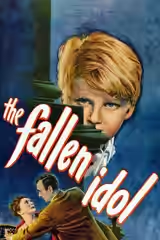
  2. The Fallen Idol (1948) · not on Fi1m yetA child’s admiration for an adult becomes a source of painful suspense.

  3. Los olvidados (1950, Fi1m 84)For a harsher account of children learning cruelty from the adults nearby.

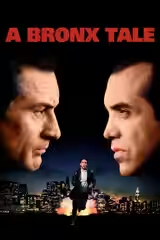
  4. A Bronx Tale (1993) · not on Fi1m yetAnother neighbourhood where a gangster’s appeal complicates a boy’s moral education.

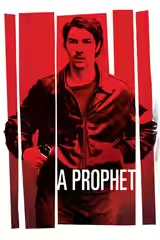
  5. A Prophet (2009, Fi1m 86)Prison becomes a school for crime, with little room for comforting sermons.

Angels with Dirty Faces (1938) review: Fine leads in a stern tale (Panama) | Fi1m