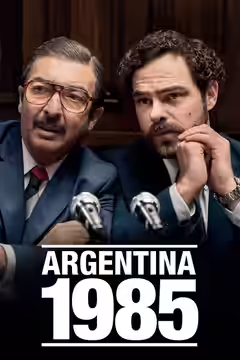
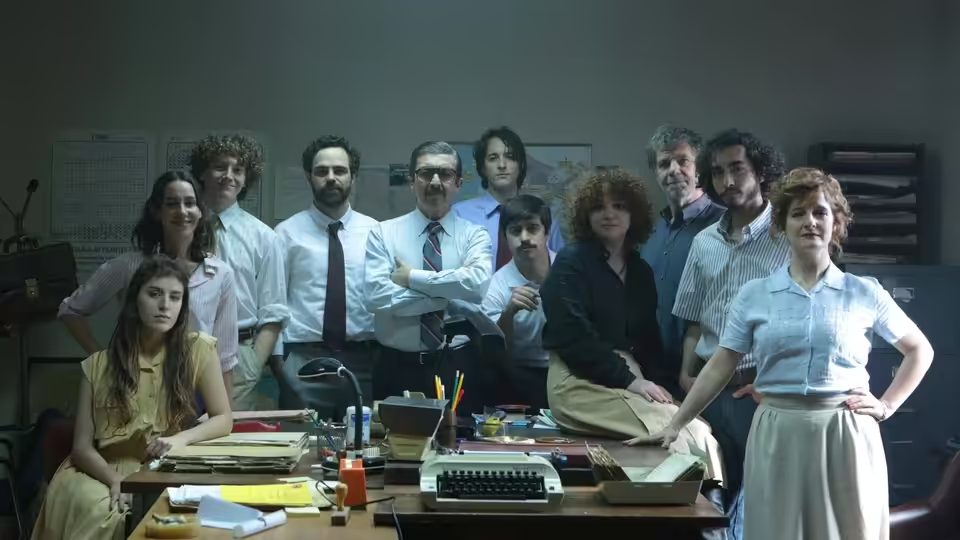
Julio Strassera (Ricardo Darín) and his colleagues gather around desks in a crowded office
Film review

Argentina 1985

2022 · Directed by Santiago Mitre · 2h 21m

In a sentenceA war-crimes prosecutor with the good sense to be less solemn than his job

In Argentina in 1985, prosecutor Julio Strassera (Ricardo Darín) takes on a war-crimes trial. The work reaches into his family life, where everyday concerns continue alongside the demands of preparing a prosecution. Luis Moreno Ocampo (Peter Lanzani) and Silvia (Alejandra Flechner) are among the people around Strassera as the story moves between legal proceedings and domestic exchanges. He wants the crimes heard in court, but the case also places demands on relationships outside it. The prosecution requires his attention while the people at home still have to live with him.

Plays from YouTube when you press play; nothing loads from them until then.

Fi1m review

Santiago Mitre makes an affecting courtroom drama, with Ricardo Darín giving the prosecution a tired, funny, recognisably human face. The historical background needs more space, but the testimony earns the film’s emotional force.

Argentina 1985 is a moving courtroom drama with a persuasive lead performance and some gaps in the history. Santiago Mitre makes a war-crimes prosecution understandable without requiring its prosecutor to be noble every time he opens his mouth. Julio Strassera, played by Ricardo Darín, has a family as well as a case, and the film takes both seriously. The familiar legal-drama approach works because the people involved remain recognisable beneath the weight of the subject.

Darín gives Strassera a weariness that can be funny without making his responsibilities seem small. He is convincing as someone capable of carrying out the work and equally capable of finding it exhausting. The domestic scenes make good use of that distinction: a prosecutor who can command our attention in court need not be quite so commanding at home. The family exchanges give the performance room for irritation and awkwardness, qualities that make his commitment to the prosecution more believable.

Mariano Llinás and Santiago Mitre’s screenplay gives the family scenes enough space to matter. The humour helps us settle into Strassera’s life, and makes the cost of the prosecution easier to grasp than another explanation of its importance would. Some of the procedural dialogue is flatter, with lines that seem chiefly interested in getting the necessary information across. The changes between family scenes and legal business do not always maintain the same easy pace, and a few exchanges feel dutiful.

When the witnesses speak, that ease disappears. We were horrified by the accounts of the crimes, which the film allows us to hear without turning the suffering into sensational entertainment. Javier Juliá’s cinematography keeps the courtroom exchanges clear, while Andrés Pepe Estrada’s editing gives the spoken evidence room to register. Those choices matter in a genre so often concerned with a lawyer’s ability to dominate a scene: here, listening to what has been done to people is harder than following the prosecution’s progress.

The period detail is convincing without becoming an excuse to inspect the furniture. Mónica Toschi’s costumes contribute to that sense of an ordinary working world, and the courtroom reconstruction gives the proceedings a credible setting. Pedro Osuna’s music is more insistent about the emotion than we need, given the force of what is being said. Mitre is most persuasive when he allows a speaker to hold our attention without additional encouragement.

The larger weakness is the historical background. Mitre gives us a clearer sense of the prosecution’s human demands than of the political circumstances surrounding it, leaving anyone unfamiliar with Argentina’s past with questions the film does not answer. A courtroom drama need not become a history lecture, but this one could explain more about the circumstances in which the prosecution takes place. That would also give the quieter procedural passages more purpose, rather than simply making them feel like necessary preparation.

At 141 minutes, the film asks for a proper evening and occasionally makes us aware of the time. Darín and the testimony are good reasons to give it one, provided a complete account of the history is not what we are after. Watch when there is time to listen, rather than merely follow a case.

Critical consensus AI synthesised

76
Positive
13
Mixed
4
Negative
0

Most critics find Argentina 1985 a stirring, humane courtroom drama, with praise centred on Ricardo Darín’s restrained, witty performance as prosecutor Julio Strassera. The reviews repeatedly credit the family scenes and everyday humour with making him a rounded character and giving the prosecution personal stakes. Witness testimony supplies much of the emotional force, while several critics admire the film’s ability to make familiar courtroom conventions feel compelling without sensationalising the crimes.

The disagreement concerns how well that conventional approach serves the history. Some find it well suited to the subject; others see limitations in the storytelling and pace. The Hollywood Reporter finds stretches of pacing and dialogue flat, while HeyUGuys argues that the film rushes towards its courtroom climax. There are also reservations about how much historical knowledge it assumes. The spread runs from enthusiastic to qualified rather than hostile: thirteen reviews are positive, four mixed, and none negative.

Variety
3 September 2022 · festival review · Guy Lodge
85*

Lodge finds the film a rousing, emotionally immediate courtroom drama that uses familiar genre conventions effectively. He particularly praises Ricardo Darín’s grounded, charismatic performance and the gripping final courtroom speech.

Read the full review →
IndieWire
3 September 2022 · B+ · Sophie Monks Kaufman
83

The review finds the film an entertaining, often amusing account that resists simplistic hero-making. It praises Ricardo Darín for bringing wit and nuance to the drama’s procedural, historical, and domestic elements.

Read the full review →
Los Angeles Times
28 September 2022 · Michael Ordoña
80*

The critic finds the film humane and compelling, balancing the gravity of the crimes with everyday humor. He especially praises its vivid portrayal of Strassera’s family and relationships, which grounds the story and raises the stakes.

Read the full review →
Radio Times
★★★★ · James Mottram
80

The critic describes the courtroom drama as a powerful account of Argentina’s war-crimes trial. They single out Ricardo Darín’s excellent performance as prosecutor Julio Strassera.

Read the full review →
The Guardian
3 September 2022 · Peter Bradshaw
80*

Bradshaw finds the courtroom drama emotionally heightened but handled with flair and heartfelt commitment. He singles out Ricardo Darín’s witty, careworn performance as especially compelling.

Read the full review →
The New Yorker
80*

The review finds the film suspenseful and ultimately rousing despite its known outcome. It praises the storytelling’s sturdy feel and the flashes of comedy that preserve lightness amid the serious drama.

Read the full review →

Straight answers AI written, from our review

Is Argentina 1985 worth watching?
Argentina 1985 is worth watching for its affecting courtroom testimony and Ricardo Darín’s tired, funny prosecutor; we score it 80 out of 100. We recommend it to anyone drawn to legal dramas with a convincing family life, though the 141-minute running time occasionally drags and the political background needs more explanation.
How long is Argentina 1985, and what is it rated?
Argentina 1985 runs 2h 21m. It is a drama and history film.
Where can I watch Argentina 1985 in Lithuania?
Argentina 1985 is streaming on Amazon Prime Video in Lithuania. Availability is checked daily; the links above go straight to each service.
How violent or frightening is Argentina 1985, and is it suitable for children?
Argentina 1985 has a US R certificate and contains harrowing spoken accounts of war crimes, making it unsuitable for children. We were horrified by the witnesses’ testimony, although the film avoids treating their suffering as sensational entertainment. For older teenagers and adults, the distressing accounts are the clearest reason for caution.
How does Argentina 1985 compare to The Secret in Their Eyes?
Argentina 1985 is our stronger choice for courtroom drama, while The Secret in Their Eyes better suits an evening built around crime and frustrated romance. Both Argentine dramas show the pursuit of justice reaching into private life, with performances that hold our attention. We find the testimony particularly affecting in the former; the latter gives its romance convincing emotional weight.
What should I watch after Argentina 1985?
After Argentina 1985, try The Secret in Their Eyes (2009, Fi1m 78): Another Argentine drama in which the pursuit of justice refuses to stay at work. Then Judgment at Nuremberg (1961, Fi1m 82): A courtroom drama that allows testimony time and makes responsibility difficult to evade; and The Official Story (1985, Fi1m 81): Family life becomes inseparable from Argentina’s history in this more intimate drama.

Cast

Awards

Golden Globes, 2023

Won
Best Non-English Language Film

Goya Award for Best Ibero-American Film, 2023

Won
Goya Award for Best Ibero-American Film

International Submission to the Academy Awards, 2023

Nominated
International Submission to the Academy Awards

Platino Award for Best Art Direction, 2023

Won
Platino Award for Best Art Direction

Platino Award for Best Ibero-American Film, 2023

Won
Platino Award for Best Ibero-American Film

Platino Award for Best Screenplay, 2023

Won
Platino Award for Best Screenplay

If you liked this, try…

  1. The Secret in Their Eyes (2009, Fi1m 78)Another Argentine drama in which the pursuit of justice refuses to stay at work.

  2. Judgment at Nuremberg (1961, Fi1m 82)A courtroom drama that allows testimony time and makes responsibility difficult to evade.

  3. The Official Story (1985, Fi1m 81)Family life becomes inseparable from Argentina’s history in this more intimate drama.

  4. Court (2014) · not reviewed yetAn Indian courtroom film that makes the routines of legal procedure quietly devastating.

  5. Saint Omer (2022) · not reviewed yetA French courtroom drama that asks us to listen before deciding.