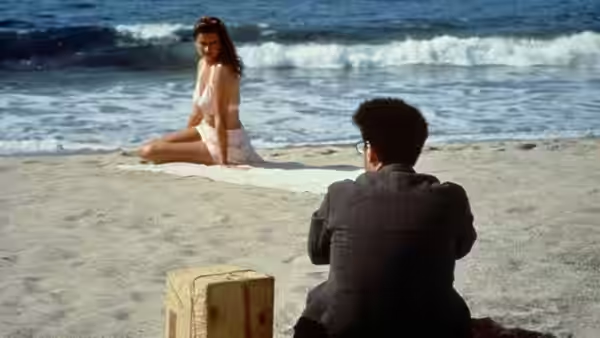
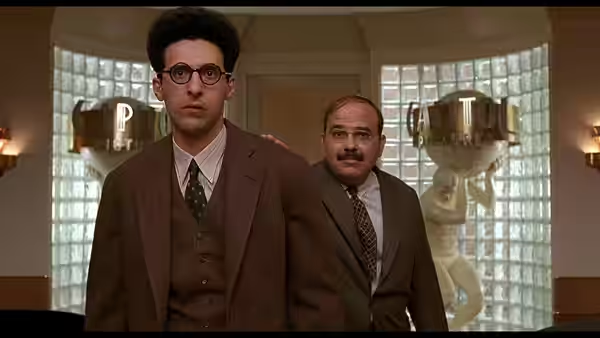
Barton Fink (John Turturro) gesturing with hand to head in crowded hall
Film review

Barton Fink

1991 · Directed by Joel Coen, Ethan Coen · 1h 57m

In a sentenceThe hotel is unpleasant, but having to listen to its resident playwright might be worse

Barton Fink (John Turturro) is a playwright trying to write a B-picture in 1940s Hollywood. He struggles with the work while staying in a hotel, where his neighbour is Charlie Meadows (John Goodman). His concern for ordinary people sits awkwardly with his difficulty engaging with them, and the demands of Hollywood offer further complications. Michael Lerner plays studio mogul Jack Lipnick, with Judy Davis as Audrey Taylor and John Mahoney as W.P. Mayhew. The story follows Barton’s frustration as his working life becomes increasingly tangled with the people around him.

Fi1m review

The Coens’ Hollywood comedy is funny, unnerving and sharply acted, with John Turturro and John Goodman especially good. Its treatment of the unhappy writer grows a little repetitive, but the uncomfortable laughs are worth an evening.

Joel and Ethan Coen put a playwright in Hollywood and decline to treat his creative difficulties as evidence of a superior soul. Barton Fink is a funny, disquieting comedy, particularly sharp about the vanity that can accompany a wish to speak for ordinary people. Its writer has a professional problem, but his difficulty taking an interest in anyone else is more revealing. The Coens let us recognise the humiliation of being unable to work without accepting Barton’s flattering account of himself.

John Turturro makes Barton earnest enough to be recognisable and self-absorbed enough to be hard company. John Goodman plays Charlie Meadows, Barton’s neighbour, with a friendliness that does not quite let us relax. We laughed at Barton’s high opinion of his concern for ordinary people, then felt embarrassed by his failure to attend to the man beside him. Goodman gives Charlie enough presence that we cannot simply share Barton’s lack of interest.

Michael Lerner’s Jack Lipnick supplies a different kind of difficult company: the studio mogul who has no reason to doubt his own judgement. Lerner plays the authority with such assurance that the absurdity needs little additional emphasis. The Coens’ screenplay is alert to the comic similarity between an employer who assumes he knows everything and a writer who believes his motives excuse him from listening. That makes the Hollywood scenes more interesting than a simple complaint about what commerce does to art.

Roger Deakins’s cinematography makes the hotel’s humid atmosphere unpleasantly tangible, especially around Turturro’s strained presence. Dennis Gassner’s production design keeps the place oppressive enough that returning to it feels like bad news. The hotel seems capable of making an ordinary task exhausting, which is apt for a film about a writer who cannot write. The setting does much of the work that a speech about creative frustration would otherwise have to do.

Joel and Ethan Coen also handle the editing, and their patience with the performances matters as much as their appetite for the bizarre. The comedy has time to become uncomfortable before the film asks us to be frightened. Carter Burwell’s music helps those changes feel part of the same experience, rather than separate instructions to laugh and worry. Even when the film becomes more extreme, the awkwardness of being in company remains recognisable.

The reservation is that the Coens sometimes seem too pleased to have placed Barton in this predicament. His vanity is clear early, and there are stretches when the film appears to be finding elaborate new ways to establish something we already know. The increasingly strange treatment of his troubles can make him seem like someone put there chiefly to be punished. A little more attention to his distress would help. That matters because Turturro has made him recognisable enough to deserve it.

As a Hollywood satire, Barton Fink is especially good at denying the writer an easy claim to moral superiority. The studio’s priorities are absurd, but that does not make his own priorities generous or even sensible. The 117 minutes ask for concentration, and the jokes do not always offer much relief. It is worth an evening, provided nobody needs every strange detail explained before bed.


Critical consensus AI synthesised

69
Positive
5
Mixed
2
Negative
1

Most critics respond warmly to Barton Fink, with praise clustering around the Coens’ visual control, literate writing and performances. John Turturro and John Goodman receive repeated attention, while Michael Lerner’s studio mogul is another source of approval. The favourable reviews find the mixture of Hollywood satire, psychological unease and absurd comedy assured, with several seeing a sharp attack on writers whose concern for ordinary people exceeds their willingness to listen to them.

The spread is wide, however, and the central disagreement concerns how much the film has to say beneath its elaborate style. The Guardian admires its imagination but questions its substance, while the Los Angeles Times finds it amusing without being convinced that it adds up. The New Yorker is more firmly opposed, treating the allusions and twists as empty display. Even some sympathetic reviews therefore share the sceptics’ reservations about what all that technique achieves.

Empire
1 January 1991 · Phil Thomas
85*

The critic lauds the performances from Turturro, Goodman and others along with the Coens' visual flair and literate screenplay. It singles out the film's subtle critique of arrogant, self-absorbed writers who fail to engage with the 'common man'.

Read the full review →
Time Out
3 May 2011 · GA
85*

The review describes the film as a bizarre blend of brooding psychodrama and screwball satire that shifts into outrageous Gothic fantasy. It praises the Coens' superb writing and assured direction along with a roster of marvellous performances that make everything cohere on multiple levels.

Read the full review →
Radio Times
★★★★ · Alan Jones
80

The critic calls it the most brilliantly observed Hollywood put-down since Day of the Locust and a vitriolic yet successful attack on the industry. It singles out the gorgeously designed paranoid parable packed with sharp detail, great in-jokes and Michael Lerner's Oscar-nominated turn as the studio mogul from hell.

Read the full review →
RogerEbert.com
23 August 1991 · Roger Ebert
75*

Ebert finds the film an assured piece of comic filmmaking that warns about the perils of talented filmmakers heading to Hollywood, but not one of the greatest ever made. He singles out the visual style and performances, particularly those evoking the rise of Nazism in its subtext.

Read the full review →
The Guardian
13 February 1992 · Derek Malcolm
65*

The critic finds Barton Fink the Coens' most accomplished film, praising its style, imagination, and cinematic illustration of the writer's dilemma, but notes it is heavy on movie references and uncertain content with little substance.

Read the full review →
Los Angeles Times
13 September 1991 · Kenneth Turan
50*

Turan finds the film an enormously amusing crackpot take on Hollywood but questions whether it adds up to anything substantial. He singles out its brazen assurance and the ambivalence it provokes in viewers as its core effect.

Read the full review →

Straight answers AI written, from our review

Is Barton Fink worth watching?
Barton Fink is worth an evening for anyone who enjoys comedy that turns uncomfortable, and we scored it 83. John Turturro and John Goodman are especially good, and the Coens are sharp about a writer whose concern for ordinary people does not extend to the man next door. The treatment of his misery grows repetitive, and the strangeness is not explained.
How long is Barton Fink, and what is it rated?
Barton Fink runs 1h 57m. It is a comedy and drama film.
Where can I watch Barton Fink in Serbia?
Barton Fink is not on any streaming or rental service in Serbia at the moment. It is available in 1 other country; change your country at the top of the page to see where. Availability is checked daily.
How violent or frightening is Barton Fink, and is it suitable for children?
Barton Fink is certified 15 in the UK and R in the US, and it is not a film for children. It begins as a comedy about a struggling writer in a 1940s hotel, then asks us to be frightened as the story becomes more extreme, and the atmosphere is oppressive throughout. Older teenagers who like unsettling comedy should be fine; the squeamish should be warned that it does turn dark.
How does Barton Fink compare to Sunset Boulevard?
Barton Fink and Sunset Boulevard are both Hollywood stories in which professional disappointment is the least of the trouble, but Wilder's film is the more direct and the more frightening about failure, while the Coens' is stranger and funnier. Both enjoy humiliating their lead a little too much. Choose Sunset Boulevard for a painfully human portrait of a faded star; choose Barton Fink if you can take odd, uncomfortable laughs without every detail explained.
What should I watch after Barton Fink?
After Barton Fink, try Sunset Boulevard (1950, Fi1m 91): Another Hollywood welcome that makes professional disappointment look comparatively manageable. Then 8½ (1963, Fi1m 91): A blocked filmmaker finds that escaping work means encountering himself everywhere; and Adaptation. (2002, Fi1m 83): Another writer’s crisis, with more anxious self-scrutiny and equally troublesome storytelling.

Cast

Awards

Academy Awards, 1992

Nominated
Best Costume Design
Nominated
Best Production Design
Nominated
Best Supporting Actor

Cannes Film Festival, 1991

Won
Palme d'Or

If you liked this, try…

  1. Sunset Boulevard (1950, Fi1m 91)Another Hollywood welcome that makes professional disappointment look comparatively manageable.

  2. 8½ (1963, Fi1m 91)A blocked filmmaker finds that escaping work means encountering himself everywhere.

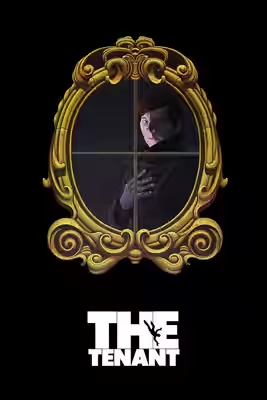
  3. The Tenant (1976) · not reviewed yetFor the oppressive lodgings and the growing difficulty of trusting anyone.

  4. Adaptation. (2002, Fi1m 83)Another writer’s crisis, with more anxious self-scrutiny and equally troublesome storytelling.

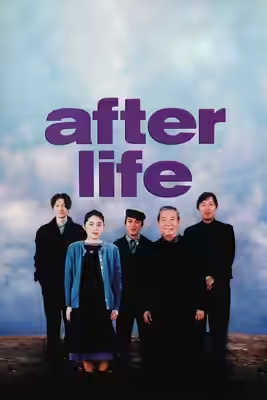
  5. After Life (1998, Fi1m 85)For a gentler, quietly strange look at turning lived experience into films.

Free account

Know what to watch tonight

Two lists that know where things are streaming, collections you can share, your own score beside ours, and Discover that remembers what you have seen.

  • Want to see, sorted by what is streaming now
  • Seen, with your score out of ten
  • No adverts, ever