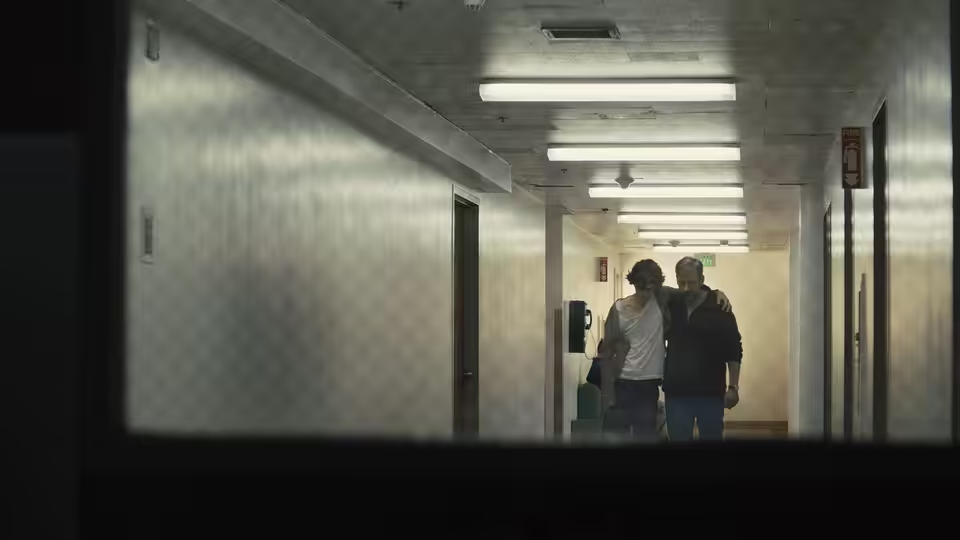
Steve Carell and Timothée Chalamet make Beautiful Boy an affecting family drama, despite a structure that gradually wears down its impact. Their performances deserve attention, though the repetition and insistent music require patience.
Felix van Groeningen approaches Beautiful Boy as a family drama about the limits of a father’s ability to help his son. It is affecting but frustrating, with two leading performances that keep us interested when the storytelling falters. Addiction tests the affection between David Sheff and Nic Sheff without making either man easy to dismiss. The difficulty is that the film keeps returning to that test without always finding enough that is new in it.
Timothée Chalamet gives Nic a volatility that makes trusting him difficult without making concern for him impossible. He lets us see the shame without presenting it as a guarantee of better behaviour. We were moved by the self-disgust in his performance, because it makes clear that Nic already feels the disappointment his father struggles to contain. The acting keeps him recognisable as a person even when the writing offers little beyond another painful turn through the same experience.
Steve Carell is persuasive because David’s love can become wearing, and the performance allows irritation to survive alongside concern. We understand why this father keeps trying, but also how difficult his persistence might be for his son. Their scenes together have a friction that prevents the tenderness from becoming entirely reassuring. Neither actor needs his character to be agreeable, and the film benefits whenever it allows their relationship to remain awkward without trying to explain the awkwardness away.
Nico Leunen’s editing moves between different periods while trying to preserve the exhausting repetition of addiction and recovery. The changes of period too often distract from the relationship we are trying to follow, while the recurring pattern gradually becomes easier to anticipate. A straightforward march towards improvement would hardly be convincing, but the repetition needs to deepen our understanding. Across 121 minutes, too much of it merely confirms what the actors have already made clear.
Ruben Impens’s polished cinematography can make the distress feel held at a safe distance, though its restraint suits the quieter exchanges. Ethan Tobman’s production design contributes to the impression of a comfortable family, whose circumstances deserve closer examination than the film gives them. Money need not protect these people from suffering for its presence to matter to their story. The soundtrack is less restrained, repeatedly underlining emotions already clear in the performances. When the music presses this firmly for sympathy, we become conscious of being prompted at precisely the moment the actors have earned our attention.
The screenplay by Luke Davies and Felix van Groeningen also leaves the women underdeveloped. Maura Tierney, as Karen Barbour, and Amy Ryan, as Vicki Sheff, belong to a family whose distress is too often treated as the business of its two men. Keeping David and Nic central is a reasonable choice, but fuller attention to the others would help us understand the family they are struggling within. There are people here whose feelings seem to count chiefly when they bear on the father and son.
The film deserves credit for resisting the reassuring shortcuts available to an addiction drama. It remains patient with people whose behaviour can be exhausting, and the connection between its leads gives that patience a reason beyond good intentions. That makes it worth considering for those drawn to intimate family stories, despite the music and the structural strain. If repetition is likely to wear out your sympathy, choose something else.