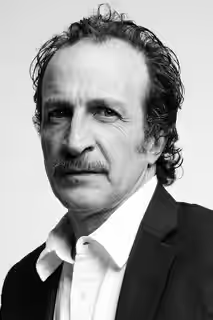
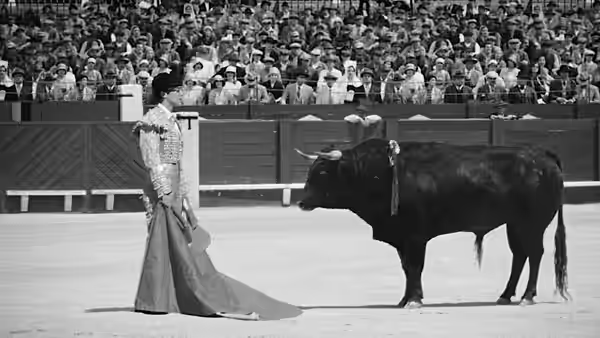
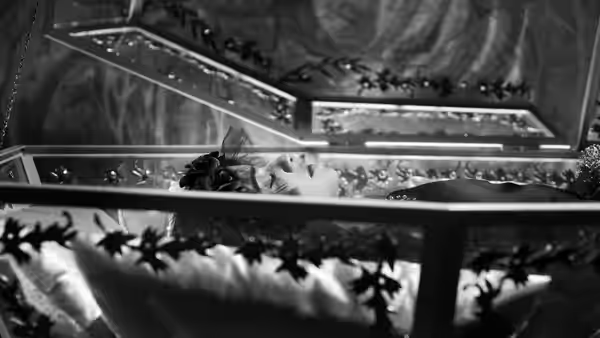
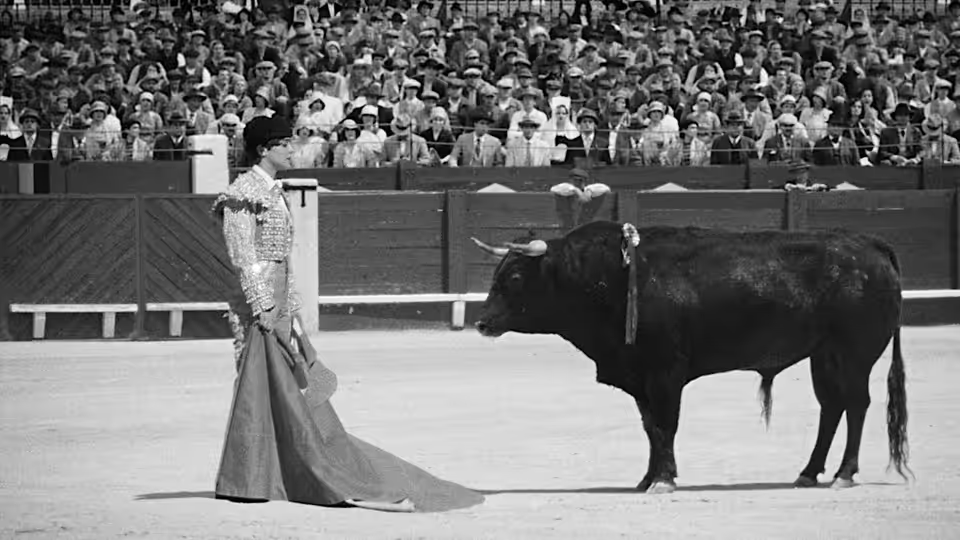
Antonio Villalta (Daniel Giménez Cacho) faces a bull in a crowded bullring
Film review

Blancanieves

2012 · Directed by Pablo Berger · 1h 44m · IFCO 12

In a sentenceA silent Snow White where the dwarfs fight bulls and the stepmother dresses for the occasion

Seville, in the 1920s. Antonio Villalta (Daniel Giménez Cacho) is gored in the ring while his pregnant wife, the flamenco singer Carmen de Triana (Inma Cuesta), watches from the stands. She goes into labour and dies giving birth to a daughter; he is left paralysed. His nurse, Encarna (Maribel Verdú), marries him and takes charge of his house and his money. The child, Carmencita (Sofía Oria), grows up with her grandmother Doña Concha (Ángela Molina) in Triana. When the grandmother dies, Carmencita is sent to Encarna’s estate, where she is put to work in the coal cellar and forbidden to climb the stairs to the rooms where her father is kept.

Plays from YouTube when you press play; nothing loads from them until then.

Fi1m review

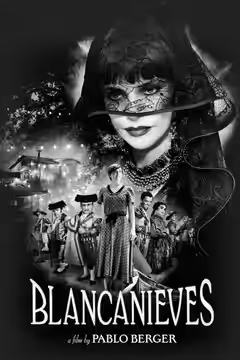
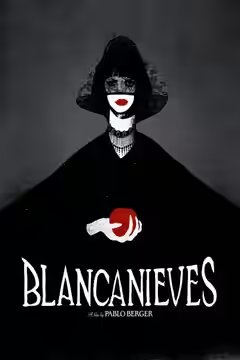
Pablo Berger’s silent, black-and-white Snow White, moved to the bullrings of 1920s Spain, is the most inventive version of the tale we have seen and, in its father-and-daughter scenes, a moving one. Maribel Verdú’s stepmother is drawn with a broad brush, and the middle hurries.

Pablo Berger’s idea is simple and slightly mad: tell Snow White as a silent film, in black and white, in Andalusia in the 1920s, with a matador for a father and a bullring where the fairy tale usually has a forest. It sounds like a stunt. It is not. Berger, who wrote and directed and is one of three credited producers, has plainly watched a great deal of silent cinema and understood that the close-up, the iris and the sparing intertitle are a way of telling a story, not a costume to dress one in. Blancanieves is the best Snow White we have seen, and we have sat through more of them than we wanted to.

The opening sets out how it will work. Antonio Villalta (Daniel Giménez Cacho) is in the ring at Seville, his wife Carmen de Triana (Inma Cuesta) in the stands, and Fernando Franco cuts the afternoon as a rising rhythm: hands, hooves, a photographer’s flash, the singer’s face, the bull arriving as an edit rather than a picture. We flinched, and there is not a drop of blood on screen. Ten minutes later the fairy tale is in place, a dead mother, a broken father, and a nurse (Maribel Verdú) whose eyes go to the house before they go to the patient.

Kiko de la Rica shoots it in a black and white with real black in it. The coal cellar where the child is put to work is a hole with one lamp; Encarna’s rooms upstairs are white walls and hard shadow. Alain Bainée’s estate is all staircases and locked doors, which is what a stepmother’s house should be. Paco Delgado dresses Verdú in gowns that look as if they arrived from Paris that morning and the child in a smock the colour of the cellar. Alfonso Vilallonga’s score does the talking. Guitar, handclaps and orchestra carry the plot, and the score also supplies the noises the film refuses to make, so a cockerel or a slap is a note rather than a sound. It is the most useful score we have heard in a long while.

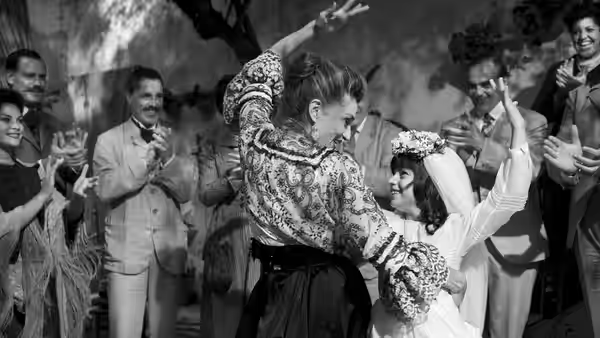
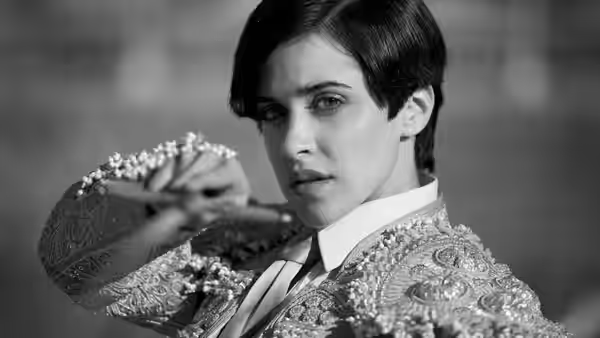
The film is at its best when it forgets the villain and stays with the father. Carmencita (Sofía Oria) creeps upstairs, finds the man in the wheelchair, and he teaches her the cape from his chair with a tablecloth. There is a scene in which she puts a record on and dances with him, swinging the chair in circles while the camera looks up at them, and it moved us far more than we expected a silent pastiche to manage. Oria is remarkable, stubborn and watchful, and when Macarena García takes over as the grown Carmen she keeps the same set of the chin. García does the bullring scenes herself, or appears to, and she carries them.

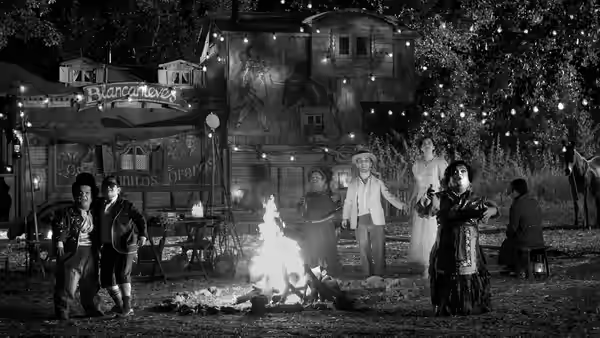
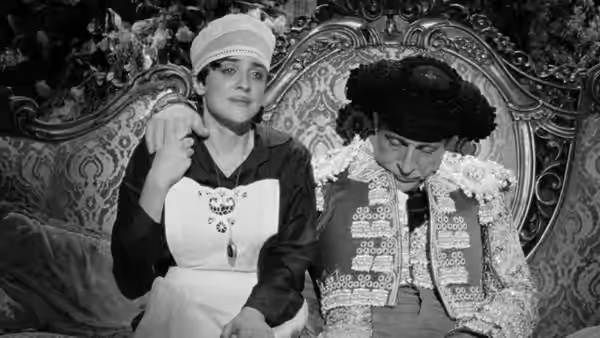
Verdú is having a wonderful time as Encarna, a woman who has got everything she schemed for and found it dull. She poses for magazine covers, keeps the chauffeur Genaro (Pere Ponce) on a lead, and treats the child as a problem in housekeeping. She is funny, and she is broad. Berger writes her as a series of set pieces rather than a person, and the fetish joke with the chauffeur is done once, then done again for anyone who missed it. The middle of the film, once Carmen leaves the house, goes by too quickly as well, as if Berger were impatient to get to the ring. We will not say how she gets there. We will say that the travelling troupe of bullfighting dwarfs she falls in with is the film’s warmest invention, and the stretch on the road with them is where it relaxes and lets its people be funny.

Comparisons with The Artist were inevitable and are not very useful. Berger is closer to Murnau and to Spanish gothic than to Hollywood, and his film is darker in every sense. The ending takes a turn we will not describe. It unsettled us, we are still not certain it is the right note, and we are glad Berger did not take the obvious one.

At 104 minutes it is over before the objection forms. If you have never sat through a silent film and suspect you could not, start here, with the sound up, because half of it is in the music.

Critical consensus AI synthesised

78
Positive
14
Mixed
4
Negative
0
Empire
5 July 2013 · David Parkinson
90*

The review finds the film irresistible, praising its elegant silent-film style. It singles out Macarena García and Maribel Verdú as sublime.

Read the full review →
IndieWire
29 March 2013 · Annette Insdorf
90*

Insdorf considers this the most thrilling of the Snow White adaptations and finds it both celebratory and emotionally charged. She singles out its evocative 1920s Spanish setting and its shift toward the growing bond between father and daughter.

Read the full review →
Sight and Sound
12 July 2013
90*

The review finds the film a fantastically entertaining, warm reworking of Spanish history and Snow White. It especially praises its visually ravishing imagery and layered play with film history.

Read the full review →
The Guardian
11 July 2013 · Peter Bradshaw
90*

Bradshaw calls the film extraordinarily enjoyable and a film to treasure. He praises the superb bullring scenes and the eerie, erotic ambiguity of its ending.

Read the full review →
Evening Standard
12 July 2013 · The Standard
85*

The critic finds Berger’s film truly enchanting and more than a mere comparison to The Artist. They praise the flamenco-fuelled mood and single out the wicked stepmother’s schemes for their pleasurable shivers.

Read the full review →
The AV Club
28 March 2013 · B+ · Noel Murray
83

Murray finds the silent Snow White riff stylish and emotionally engaging despite its gimmicky plot. He especially praises the beautifully staged image of the daughter helping her father dance in his wheelchair.

Read the full review →

Straight answers AI written, from our review

Is Blancanieves worth watching?
Blancanieves is worth watching for anyone willing to try a silent, black-and-white film, and we scored it 81. Pablo Berger moves Snow White to the bullrings of 1920s Spain and the father-and-daughter scenes moved us more than we expected. The stepmother is played broadly and the middle hurries, but at 104 minutes it is over before that matters.
How long is Blancanieves, and what is it rated?
Blancanieves runs 1h 44m and is rated 12 by the IFCO in Ireland. It is a drama and fantasy film.
Where can I watch Blancanieves in Ireland?
Blancanieves is not on any streaming or rental service in Ireland at the moment. It is available in 7 other countries; change your country at the top of the page to see where. Availability is checked daily.
How does Blancanieves compare to The Artist?
Blancanieves is the darker and more substantial of the two modern silent films, and The Artist is the sunnier and slighter one. Berger draws on Murnau and Spanish gothic where Hazanavicius draws on Hollywood, so one is a fairy tale with a coal cellar and the other a romance with a scene-stealing dog. Start with The Artist if you want ease; choose Blancanieves if you want to be got at.
What should I watch after Blancanieves?
After Blancanieves, try The Artist (2011, Fi1m 82): The other modern silent, sunnier and slighter, with a dog who steals it. Then Sunrise (1927, Fi1m 88): Murnau’s marriage melodrama, the film every silent pastiche is secretly trying to be; and Cría Cuervos (1976, Fi1m 83): Another Spanish child in a dark house, watching the adults and forgiving nothing.

Cast

Awards

European Film Award for Best Costume Designer, 2013

Won
European Film Award for Best Costume Designer

European Film Award for Best Director, 2013

Nominated
European Film Award for Best Director

European Film Award for Best Film, 2013

Nominated
European Film Award for Best Film

Gaudí Award for Best Film in Catalan Language, 2013

Won
Gaudí Award for Best Film in Catalan Language

Goya Award for Best Actress, 2013

Won
Goya Award for Best Actress

Goya Award for Best Art Direction, 2013

Won
Goya Award for Best Art Direction

Goya Award for Best Cinematography, 2013

Won
Goya Award for Best Cinematography

Goya Award for Best Costume Design, 2013

Won
Goya Award for Best Costume Design

Goya Award for Best Film, 2013

Won
Goya Award for Best Film

Goya Award for Best New Actress, 2013

Won
Goya Award for Best New Actress

Goya Award for Best Original Score, 2013

Won
Goya Award for Best Original Score

Goya Award for Best Original Screenplay, 2013

Won
Goya Award for Best Original Screenplay

Goya Award for Best Production Supervision, 2013

Nominated
Goya Award for Best Production Supervision

Goya Award for Best Special Effects, 2013

Nominated
Goya Award for Best Special Effects

International Submission to the Academy Awards, 2013

Nominated
International Submission to the Academy Awards

If you liked this, try…

  1. The Artist (2011, Fi1m 82)The other modern silent, sunnier and slighter, with a dog who steals it.

  2. Sunrise (1927, Fi1m 88)Murnau’s marriage melodrama, the film every silent pastiche is secretly trying to be.

  3. Cría Cuervos (1976, Fi1m 83)Another Spanish child in a dark house, watching the adults and forgiving nothing.

  4. Tabu (2012) · not on Fi1m yetMiguel Gomes goes half silent for a colonial love story told in black and white.

  5. Talk to Her (2002, Fi1m 84)Almodóvar on a gored bullfighter and the men who wait at her bedside.

Blancanieves (2012) review: Snow White, silent, in the bullring (Ireland) | Fi1m