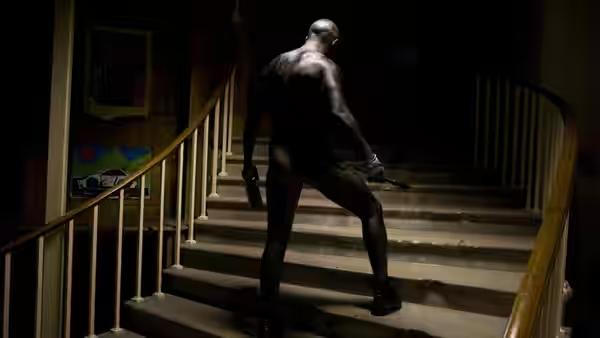
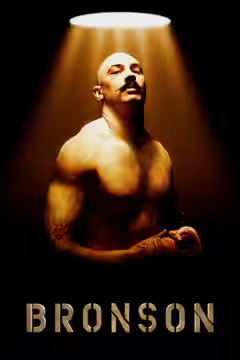
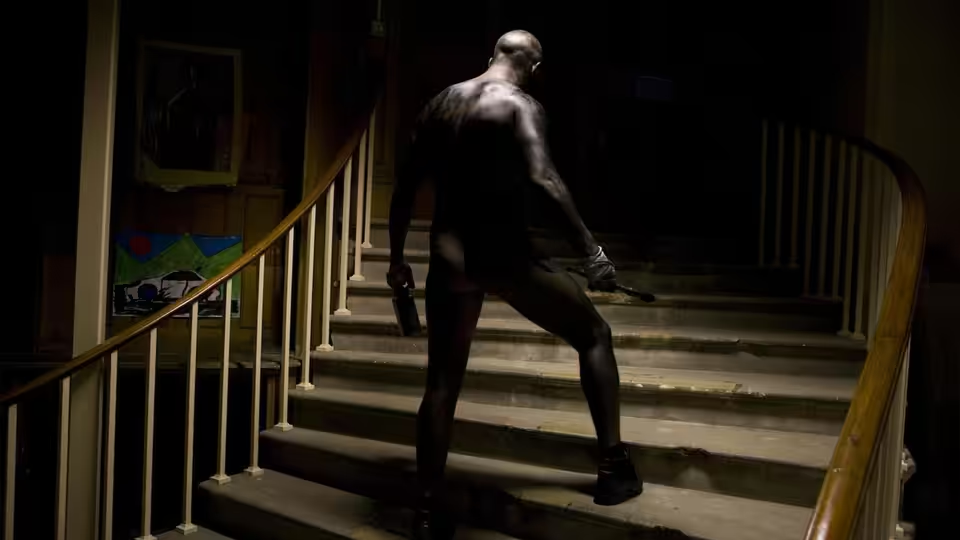
Charles Bronson (Tom Hardy) climbs a dimly lit staircase, seen from behind
Film review

Bronson

2009 · Directed by Nicolas Winding Refn · 1h 32m

In a sentenceTom Hardy is alarmingly funny for a man we would rather not sit beside

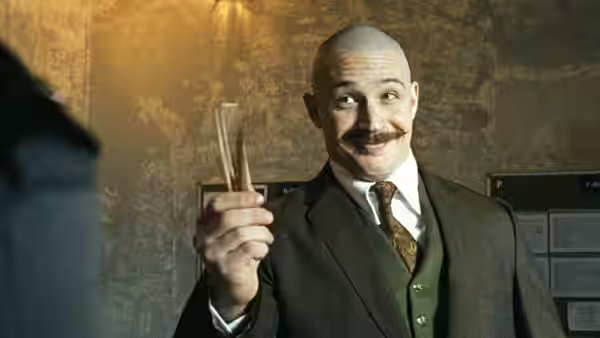
Michael Peterson / Charles Bronson (Tom Hardy) wants an audience, and violence gives him a way of demanding one. His mother (Amanda Burton) and father (Andrew Forbes) are part of the family life behind the name. He presents himself as somebody worth watching, making his aggression into a performance and insisting on his own importance. The account mixes crime, dark comedy and surreal self-presentation as he pursues recognition. At its centre is a man whose desire to be noticed keeps drawing attention back to the behaviour that makes him difficult company.

Plays from YouTube when you press play; nothing loads from them until then.

Fi1m review

Tom Hardy makes Bronson funny, threatening and worth the discomfort. Nicolas Winding Refn’s crime portrait is held together by that performance, though its fascination with a violent man’s hunger for attention starts to wear thin across 92 minutes.

Nicolas Winding Refn’s Bronson is worth seeing for Tom Hardy, with a firm warning about the company we will be keeping. The film turns a violent man’s craving for attention into abrasive, uneasy entertainment. It allows us to enjoy his self-importance, then makes that enjoyment uncomfortable. This is a useful way into a crime biography that might otherwise settle for explaining bad behaviour. The trouble is that the film finds the idea so satisfying that it keeps repeating it.

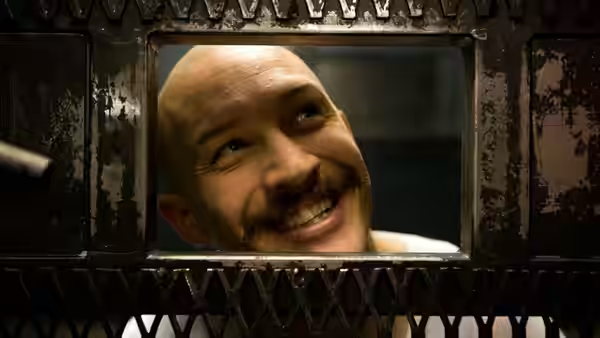
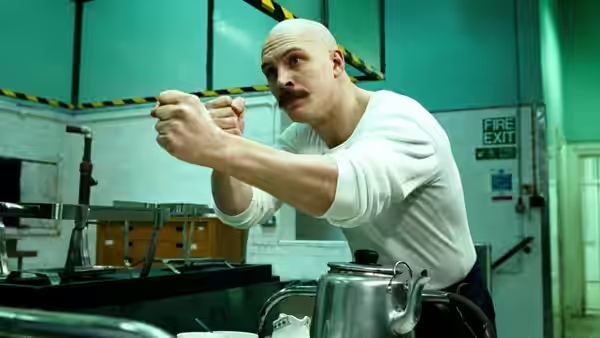
Tom Hardy plays Michael Peterson / Charles Bronson with enough humour to make the aggression unpredictable. The performance can be ridiculous without becoming reassuring, because the desire to impress never makes the threat disappear. We laughed, then felt uneasy about laughing: his exaggerated self-importance is funny, but the brutality gives that joke an unpleasant consequence. The comic and violent sides belong to the same person, and the actor does not tidy him up for our benefit.

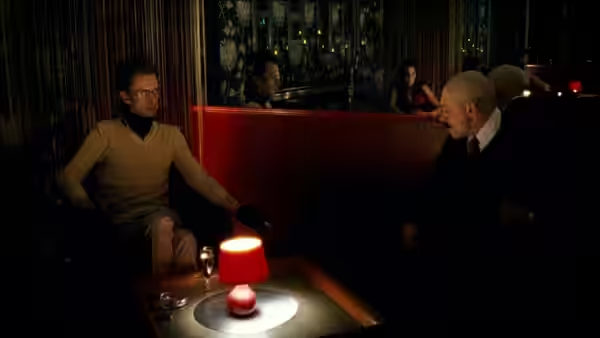
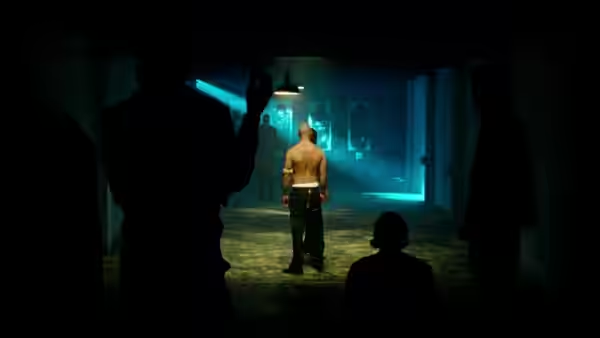
Larry Smith’s cinematography gives the film’s stillness a threatening weight. These pauses matter because the aggression would become monotonous if every image competed to be the most forceful. Adrian Smith’s production design suits the heightened performance, making its exaggerations feel at home rather than like an actor overwhelming his surroundings. The visual confidence helps keep us watching, although it also makes the director’s fascination with this man a little too easy to share.

Matthew Newman’s editing makes good use of the shifts between waiting and attack. The pace can be brisk without making the threat feel routine, and the more patient passages give us time to become anxious about what might happen next. Johnny Jewel’s music adds to the sense that somebody expects an occasion to be made of him. It is effective, though the combined insistence of music, images and performance sometimes makes the film feel unnecessarily emphatic.

The screenplay, by Brock Norman Brock and Nicolas Winding Refn, is less persuasive. Its interest in violence as self-promotion is clear early on, and revisiting it does not make it much richer. We do not need a neat explanation for every ugly impulse, but there should be more to discover after the central idea has been established. Too often another display of aggression has to do the work of developing the character. At 92 minutes, the film has little excuse for losing momentum.

Matt King, as Paul Daniels, offers a welcome change of company. His camp performance introduces a different comic manner, and suggests how much a supporting player can do when a film is so firmly organised around its lead. Against the familiar promises of a screen biography, this one is pleasingly unwilling to make its subject easy to understand. It is less willing to ask what we gain from spending so much time in his company.

The performance remains strong enough to justify the evening if abrasive crime drama is what we are after. There is wit here, and tension, and the central figure never becomes comfortably likeable. But the film runs short of fresh things to say about him. Go for Tom Hardy; do not expect the film to explain the man he plays.

Critical consensus AI synthesised

65
Positive
9
Mixed
2
Negative
3

Most critics respond favourably to Bronson, with praise centred on Tom Hardy’s intense, darkly comic performance. The reviews repeatedly describe a portrait of a man who turns violence into theatre, and Hardy’s ability to make that spectacle compelling is the clearest point of agreement. Supporters also value Refn’s tense direction, surreal storytelling and visual style, finding humour as well as menace in the brutality. Photography and editing earn approval even from some who dislike the film.

The spread is wide, however, and the central dispute concerns what all that force reveals. Some favourable reviews acknowledge borrowed stylistic ideas, pretension or a loss of momentum. The Guardian finds the portrait indulgent and short on insight, while The Hollywood Reporter argues that its critique of celebrity culture cannot justify the punishing violence. Hardy attracts broader approval than the film’s treatment of its subject.

Los Angeles Times
16 October 2009 · Gary Goldstein
90*

The critic finds the film wildly riveting and audacious. He singles out Tom Hardy’s ferocious, indelible lead performance for praise.

Read the full review →
Slant Magazine
5 October 2009 · ★★★½/4 · Nick Schager
88

Schager finds the film fast, ferocious, and wickedly funny, with Refn’s portrait of Bronson’s violence both compelling and darkly comic. He especially praises Tom Hardy’s whirlwind performance and the film’s Kubrick-indebted visual style.

Read the full review →
The AV Club
8 October 2009 · B+ · Noel Murray
83

Murray finds the film an entertaining, tense study of a man who turns brutality into performance, though it can feel derivative and pretentious. He singles out Tom Hardy’s boisterous performance and Refn’s dynamic use of stillness to build anxiety.

Read the full review →
Little White Lies
12 March 2009 · 3/4/4 · Anton Bitel
80

The review finds the film’s mix of brutal ultraviolence and art-house oddity arresting. It particularly praises Tom Hardy’s intense, serio-comic performance.

Read the full review →
Empire
25 February 2009 · Damon Wise
75*

Wise views the film as a darkly hilarious biopic whose unconventional approach makes it a likely cult item. He singles out its playful riff on A Clockwork Orange.

Read the full review →
Evening Standard
10 April 2012
75*

The critic finds the film a remarkably bold, cinematic portrait, while noting that its free-man sequences are less successful. Tom Hardy’s astonishing performance is singled out for praise, alongside the film’s tense direction and editing.

Read the full review →

Straight answers AI written, from our review

Is Bronson worth watching?
Bronson is worth watching for Tom Hardy’s funny, threatening performance, particularly if abrasive crime drama appeals; we score it 73 out of 100. We find its mixture of humour and brutality unsettling in a useful way, but its repeated displays of aggression offer diminishing insight into the man.
How long is Bronson, and what is it rated?
Bronson runs 1h 32m. It is a drama and action film.
Where can I watch Bronson in Poland?
Bronson is not on any streaming or rental service in Poland at the moment. It is available in 15 other countries; change your country at the top of the page to see where. Availability is checked daily.
How violent or frightening is Bronson, and is it suitable for children?
Bronson carries a UK 18 certificate and is not suitable for children: brutality, unpredictable aggression and sustained threat make it uncomfortable adult viewing. We find Hardy’s humour makes the violence more unsettling rather than reassuring, so the squeamish should be cautious even though the film also works as a dark comedy.
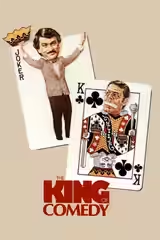
How does Bronson compare to The King of Comedy?
Bronson offers a more violently threatening portrait of attention-seeking than The King of Comedy, which we favour for painfully funny social discomfort. Hardy makes aggression and self-importance difficult to separate, while Robert De Niro and Jerry Lewis make unwanted attention excruciating; both films risk repetition, but we recommend the latter more readily for its comedy.
What should I watch after Bronson?
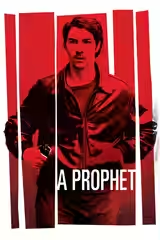
After Bronson, try The King of Comedy (1982, Fi1m 88): A craving for fame made funny, awkward and increasingly difficult to tolerate. Then A Prophet (2009, Fi1m 86): Prison violence becomes a means of advancement, with closer attention to consequences.

Cast

If you liked this, try…

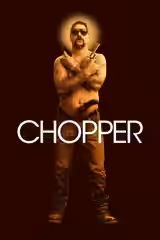
  1. Chopper (2000) · not on Fi1m yetAnother violent self-invention, with humour that makes the brutality harder to dismiss.

  2. The King of Comedy (1982, Fi1m 88)A craving for fame made funny, awkward and increasingly difficult to tolerate.

  3. A Prophet (2009, Fi1m 86)Prison violence becomes a means of advancement, with closer attention to consequences.

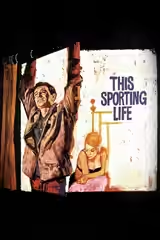
  4. This Sporting Life (1963) · not on Fi1m yetPhysical aggression and wounded pride give another difficult man a formidable presence.

  5. Pusher (1996) · not on Fi1m yetA harsher crime story where fear keeps puncturing the men’s confidence.