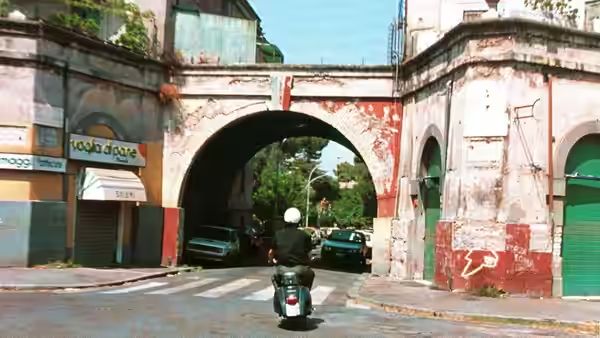
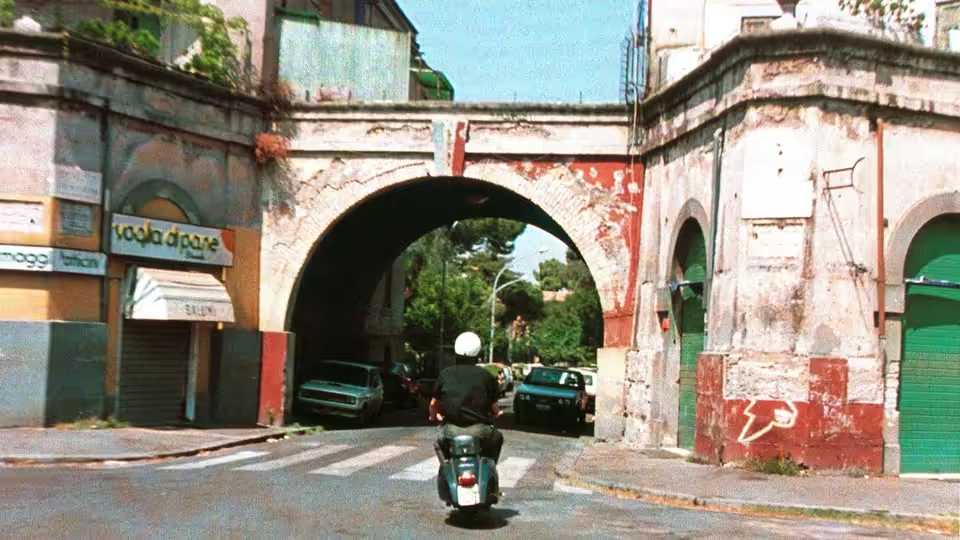
A scooter rider passes beneath an archway into a tree-lined street
Film review

Caro diario

1993 · Directed by Nanni Moretti · 1h 41m

In a sentenceWe would happily follow Nanni Moretti on his Vespa, provided he occasionally stopped talking

Nanni Moretti plays himself, riding a motor scooter and looking for inspiration. Reflections on the countryside give way to thoughts about the cinema, including an angry response to Henry: Portrait of a Serial Killer. His own uncertainty about what to make complicates the search, even as the wandering supplies material for a personal film. The cast includes Gerardo (Renato Carpentieri) and Sindaco di Stromboli (Antonio Neiwiller), as the director records a life in which watching films and trying to make them are difficult to separate.

Plays from YouTube when you press play; nothing loads from them until then.

Fi1m review

Nanni Moretti’s Caro diario makes absorbing company, though some of its complaints outstay their welcome. The scooter ride is the chief pleasure in a funny, uneven film that rewards a taste for digression.

Caro diario is good company, provided we are willing to give Nanni Moretti time to finish a thought. Playing himself, he makes the search for inspiration into a film, allowing irritation, curiosity and pleasure in the cinema to determine where it goes. The approach works because he can be funny about having a mind that will not leave things alone. It also creates the film’s main problem: some observations have to sustain our attention long after their interest has faded.

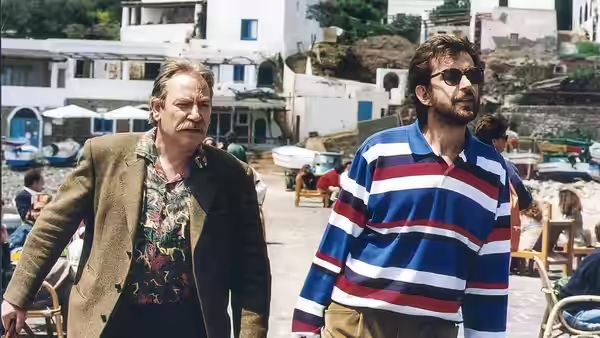
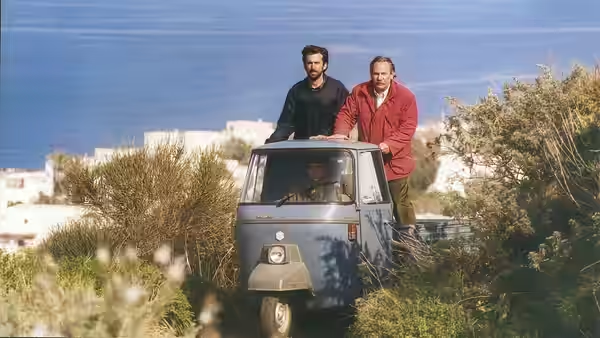
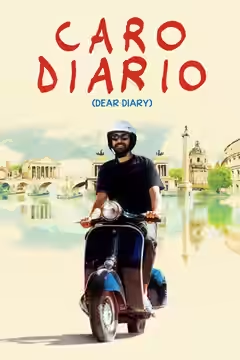
The scooter passage makes the strongest case for following him. Giuseppe Lanci’s cinematography makes the movement pleasurable in itself, without needing an incident to give the ride a purpose. We felt unexpectedly happy watching it, because the excursion gives us time to look around without waiting for a plot to announce itself. Mirco Garrone’s editing gives these reflections an easy pace, allowing the director’s thoughts to accompany the journey without overwhelming it. The pauses feel like part of the outing.

His irritation can be just as engaging, particularly when he turns on Henry: Portrait of a Serial Killer. The angry review has the comic advantage of being so personal: we are listening to someone who cannot simply leave an unpleasant screening behind. His confidence is funny even when his opinions are less persuasive, and the film lets that disproportion show. There is pleasure in watching a filmmaker admit how much another film can bother him, then take the trouble to record the complaint.

Nicola Piovani’s score has a warmth that helps when the director is being prickly. It keeps the film agreeable without asking us to endorse everything he says. Marta Maffucci’s production design is unobtrusive, giving the travelling filmmaker surroundings that do not compete with him for attention. That restraint suits the material, although the ride remains more memorable than the places visited. There is enough care in the presentation to let us settle into the film’s uncertain progress.

The later episodes do not sustain the scooter passage’s ease. The satire sometimes assumes that sharing the director’s impatience is all we need to do, and his political certainty can make the conversation feel closed. More damagingly, a complaint can continue after its point is clear, with too little fresh observation to justify another minute in its company. The editing cannot always give these passages the lightness of the earlier excursion. A little less insistence would have helped.

A diary film has to make us curious about another person’s day, even when little happens. A scooter ride and an argument about a film give this one enough to begin with, and its informality makes the occasional sharp observation feel like something discovered in conversation. We do not need every detour to explain the director or advance his search for something to make. We do need him to notice when he has exhausted a subject, and he is not always reliable about that. Choose it when a wandering conversation sounds like a good way to spend the evening.
Critical consensus AI synthesised

68
Positive
3
Mixed
2
Negative
1

The reviews lean favourable, with praise centred on Moretti’s personal, lightly comic storytelling and his willingness to make his own search for inspiration the subject. Admirers find the wandering structure inventive and vulnerable, bringing together satire, artistic uncertainty and a life shaped by cinema. The strongest responses see those personal reflections as carefully formed filmmaking rather than an unfinished notebook. Variety also praises the cinematography and editing, while finding the film consistently stimulating and amusing.

The spread is wide, and the main disagreement concerns when that wandering becomes tiresome. Variety finds that some passages drag and the politics can sound sanctimonious. The Los Angeles Times is more firmly opposed, judging the film self-indulgent and long-winded despite enjoying the Vespa episode and Nicola Piovani’s score. Two of the six reviews lack enough available text to establish their verdicts, so the reasons behind the middle scores remain partly unclear.

The New Yorker
3 February 2015 · Richard Brody
90*

Brody calls the film a masterwork and celebrates its inventive, self-reflexive portrait of a life intertwined with cinema. He particularly praises Moretti’s lively satire and his ability to make personal reflections feel like a finished cinematic notebook.

Read the full review →
Slant Magazine
12 May 2020 · ★★★½/4 · Diego Semerene
88

The critic views the film as a playful, vulnerable portrait of artistic uncertainty that ultimately confronts the threat of creative and physical collapse. They praise how Moretti turns his meandering search for inspiration into the film itself.

Read the full review →
Variety
6 December 1993 · Deborah Young
70*

Young finds the film consistently stimulating and amusing, though some sections drag and its political voice can feel sanctimonious. She particularly praises the intimate, lightly comic storytelling and the craftsmanship of its cinematography and editing.

Read the full review →
The New York Times
26 September 1994
64*

The review text is unavailable, so its verdict cannot be determined. No specific praise or complaint can be verified.

Read the full review →
Time Out
20 March 2012
64*

The available metadata gives no critical verdict. It singles out Moretti’s reflections on the countryside from a motor scooter and an angry review of Henry: Portrait of a Serial Killer.

Read the full review →
Los Angeles Times
7 October 1994 · Kevin Thomas
35*

Thomas finds the film quirky and occasionally funny, but ultimately self-indulgent and long-winded. He singles out the Vespa episode and Nicola Piovani’s score for praise, while criticizing the later episodes for wearing thin.

Read the full review →

Straight answers AI written, from our review

Is Caro diario worth watching?
Caro diario is worth watching if we enjoy wandering conversation more than a busy plot; we score it 77 out of 100. Nanni Moretti’s scooter ride is a particular pleasure, and his personal irritations can be funny, though some complaints continue long after their point is clear.
How long is Caro diario, and what is it rated?
Caro diario runs 1h 41m. It is a comedy and drama film.
Where can I watch Caro diario in Finland?
Caro diario is not on any streaming or rental service in Finland at the moment. It is available in 13 other countries; change your country at the top of the page to see where. Availability is checked daily.
How does Caro diario compare to Paterson?
Caro diario is pricklier and less even than Paterson, which we recommend more readily for quiet, comforting company. Both find pleasure in following everyday activity without demanding a large dramatic payoff, but Moretti’s wandering thoughts and prolonged complaints suit a taste for digression, while the bus driver’s working week gives Paterson a steadier focus.
What should I watch after Caro diario?
After Caro diario, try The Gleaners and I (2000, Fi1m 85): Another curious filmmaker finds plenty to notice while apparently going nowhere in particular. Then Paterson (2016, Fi1m 84): For the pleasure of following small routines without demanding a large dramatic payoff.

Cast

Awards

European Film Academy Critics Award, 1994

Won
European Film Academy Critics Award

If you liked this, try…

  1. The Gleaners and I (2000, Fi1m 85)Another curious filmmaker finds plenty to notice while apparently going nowhere in particular.

  2. Paterson (2016, Fi1m 84)For the pleasure of following small routines without demanding a large dramatic payoff.

  3. The Trip (2010) · not on Fi1m yetMore travel, more artistic vanity, and rather less chance of a quiet meal.

  4. The Day He Arrives (2011) · not on Fi1m yetA filmmaker’s wandering becomes funny, awkward company for anyone tolerant of repetition.

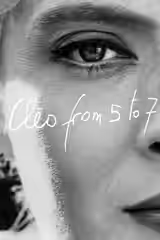
  5. Cléo from 5 to 7 (1962) · not on Fi1m yetA city excursion that gradually makes its central character’s worries matter to us.