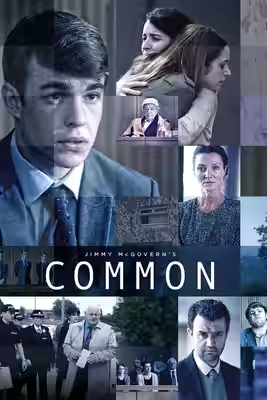
A forceful crime drama whose political message sometimes presses too hard, Common earns its emotional weight through Susan Lynch. Her portrayal of grief makes the case more persuasively than the insistence surrounding it.
Common is worth watching for Susan Lynch, with a warning about the force with which it delivers its politics. Written by Jimmy McGovern and directed by David Blair, it wants us to be distressed by suffering and angry about justice. Those are reasonable ambitions for a crime drama, and there is nothing inherently suspect about making the audience uncomfortable. The difficulty comes when the film seems unwilling to let that discomfort speak for itself.
Lynch plays Margaret Ward, a bereaved mother, and her performance supplies the strongest reason to stay with such bleak material. We found her grief upsetting because it keeps a mother’s loss at the centre of a drama with a political point to make. There is a difference between understanding that somebody has suffered and being made to attend to that suffering for more than a passing moment. Lynch makes the latter unavoidable, giving the film an emotional seriousness that cannot be supplied simply by choosing a serious subject.
The reservation is the political emphasis, which sometimes becomes heavy-handed. McGovern has something he wants said, and the determination to say it can make the drama feel too insistent. We do not need a crime film to be impartial, nor do we need every question settled before it is allowed to take a position. But once the suffering has registered, further insistence risks treating the audience as though it has failed to understand what is plainly in front of it.
David Blair directs an ensemble led by Nico Mirallegro as Johnjo O’Shea, with Daniel Mays as Tommy Ward and Jodhi May as Coleen O’Shea. Dirk Nel supplies the cinematography, Patrick Hall the editing and Adrian Johnston the music. Yet the clearest achievement here belongs to Lynch: the grief associated with Margaret gives us something particular to care about within the broader concern with justice. That matters because a film asking for anger still needs people whose distress remains interesting after we have understood its cause.
Against the expectations of campaigning crime drama, Common offers a familiar strength and a familiar frustration. Its willingness to hurt is valuable; an easier, more reassuring treatment would scarcely serve this material. Its eagerness to make the point unmistakable is less useful, especially when Lynch has already made the human cost difficult to dismiss. We can agree with a film’s concerns and still wish it would stop pressing them quite so firmly.
At 90 minutes, this is a substantial but manageable commitment to difficult material. The recommendation is for those willing to accept some forceful political instruction in return for a performance that makes grief matter. Lynch is the reason to choose it, rather than a general appetite for crime stories. Save it for an evening when being upset is something both people on the sofa have agreed to.