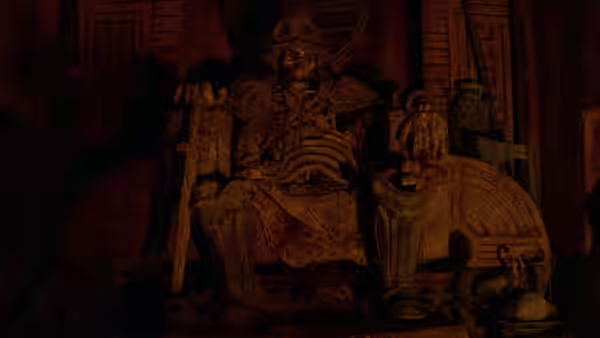
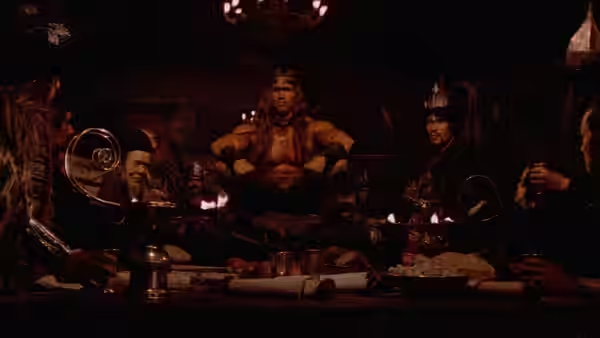
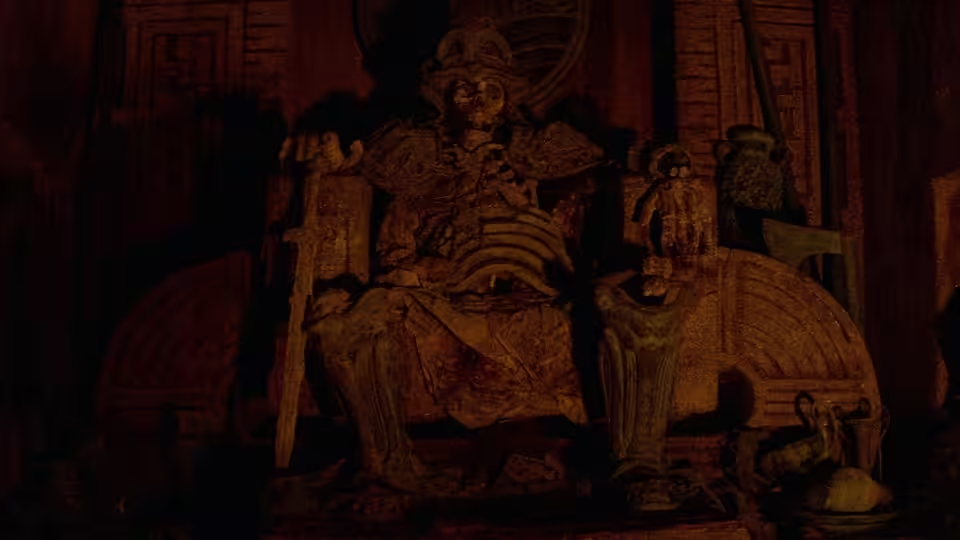
A massive armored figure sits on a throne in a shadowy hall
Film review

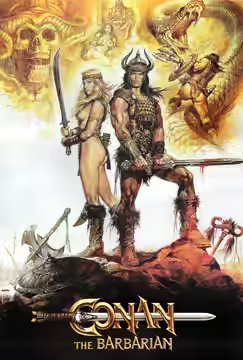
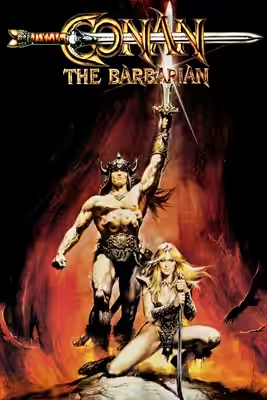
Conan the Barbarian

1982 · Directed by John Milius · 2h 10m · Eirin G

In a sentenceSchwarzenegger barely speaks, James Earl Jones barely blinks, and the orchestra never stops

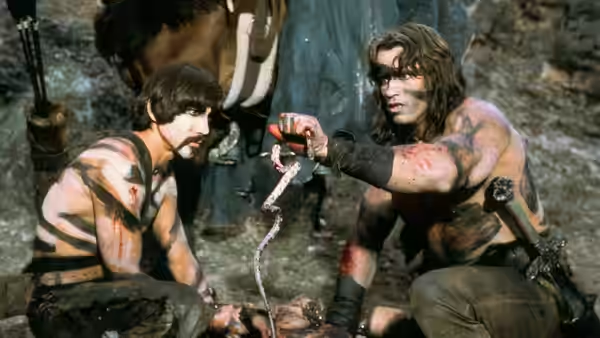
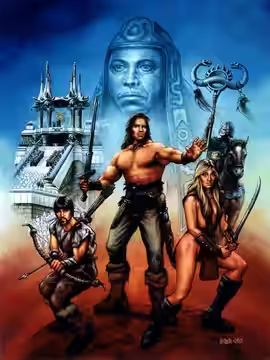
In the Hyborian Age, riders led by the warlord Thulsa Doom (James Earl Jones) burn a Cimmerian village, kill Conan’s Father (William Smith) and chain the surviving boy to a wooden wheel. Years of pushing it make him Conan (Arnold Schwarzenegger), who is sold as a pit fighter, taught to kill and one day set free. He takes a sword from a dead king’s tomb and falls in with the thief Subotai (Gerry Lopez). In the city of Zamora they meet Valeria (Sandahl Bergman), and the three rob the Tower of the Serpent, where Doom’s snake cult keeps its treasure. The theft brings them before King Osric (Max von Sydow), whose daughter has gone over to the cult. He wants her back; Conan wants Doom’s head.

Plays from YouTube when you press play; nothing loads from them until then.

Fi1m review

John Milius treats a pulp barbarian with total seriousness, and for long stretches it pays off, carried by Basil Poledouris’s thunderous score. The middle sags, the snake is rubber and the lead cannot yet act, but it has a weight its imitators never found.

John Milius’s Conan the Barbarian takes Robert E. Howard’s pulp swordsman and treats him as if he had come out of scripture. The script, by Milius and Oliver Stone, has no small talk in it; people speak in pronouncements or not at all, and for long stretches nobody speaks. It is slow, it is humourless, and its star cannot yet act. It is also, at its best, stirring in a way few films of its kind have managed, and if the genre is yours it is worth the evening. It is 130 minutes long and certified 15.

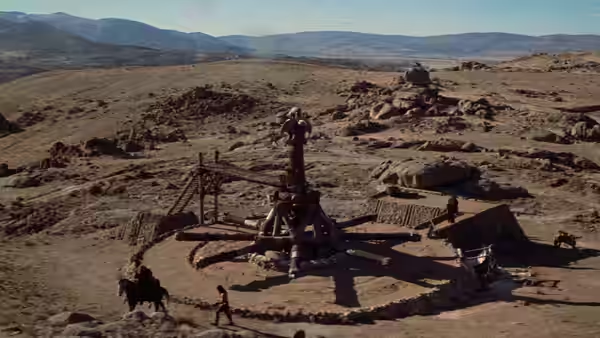
It opens with a sword being made. Conan’s Father (William Smith) hammers a blade in the snow and tells his small son that steel is the one thing he can trust, and Basil Poledouris’s score comes in under him, drums, brass and a male chorus, as if the forging were a coronation. Then riders led by Thulsa Doom (James Earl Jones) burn the village, and the boy is chained to a great wooden wheel and left to push it for years. The cut from the child at the wheel to Arnold Schwarzenegger at the wheel is the film’s first joke and its first act of faith, and it got us: we laughed, and then the chorus came back and we found we had stopped. Poledouris wrote something close to a continuous score, and it carries every scene the dialogue cannot.

Schwarzenegger in 1982 is not an actor. He is a shape, and Milius films him as one, against skylines, hauling chains, on thrones. Given a line he reads it off the back wall; given a task he is entirely convincing, and the film sensibly gives him many more tasks than lines. Jones goes the other way. His Thulsa Doom hardly raises his voice, talks about flesh and steel in a tone of grave reasonableness, and is more frightening for it. Sandahl Bergman’s Valeria, a thief Conan meets on a rooftop in Zamora, moves better than anyone else here, and her scenes with Schwarzenegger are the only ones in which he looks like a man rather than a monument. Gerry Lopez’s Subotai supplies the few grins. Max von Sydow’s King Osric has one scene, mourning a daughter who has gone over to Doom’s cult, and it is the best-acted five minutes in the film.

Duke Callaghan shoots wide and still: plains, snowfields, a low horizon and small people against it, and indoors he lights by torch, so that faces come and go in the dark. Ron Cobb’s sets do as much as the music. The Tower of the Serpent is a black cylinder with a pit at its foot; Doom’s mountain temple is terraced in white and gold and looks like a holiday resort run by a death cult, which is about right. John Bloomfield puts Doom’s lieutenants in helmets crested with snakes and horns, and Conan in furs or nothing much. Carroll Timothy O’Meara cuts to the music rather than against it, holding shots long and letting scenes end some time after they have finished, and that is where the trouble starts.

The middle hour is slow in a way that is not always on purpose. Once Osric sends the thieves after his daughter (Valérie Quennessen), the film spends a long time crossing country, climbing a mountain and watching white-robed followers file about, and somewhere on that mountain we were bored, properly and restlessly. Milius does not do jokes, and a film this solemn needs one now and then to let the air out. The giant snake in the tower is a rubber tube with a face, and the camera stays on it long enough to make sure. The ideas the film is proudest of, about steel and flesh and what a man should trust, are said three or four times, and saying them is as far as it gets.

The second half takes a turn we will not describe, and it is where the film finds its grief and earns its finish. Set against the sword-and-sorcery films that followed it through the 1980s, most of them cheap and jokey, this looks like the real thing: a film that believes in its barbarian and lets the orchestra do the believing where its star cannot. Watch it on the largest screen you have, with the sound up. The long silences were written for an orchestra, and at low volume they are only silences.
Critical consensus AI synthesised

60
Positive
4
Mixed
3
Negative
2
Empire
1 January 2000 · Clark Collis
75*

The critic finds the film an epic, entertaining piece of mythmaking that rises above its pulp origins and technical limits. He singles out Milius’s earnest, serious approach for elevating the story, despite an unconvincing giant snake.

Read the full review →
Slant Magazine
30 January 2024 · Budd Wilkins
75*

The critic treats the 1982 film as a rousing, thoughtful epic and finds its ideas more complicated than its macho reputation suggests. He particularly praises the warmth of Conan and Valeria’s relationship, which softens the film’s otherwise bellicose outlook.

Read the full review →
Time Out
15 March 2012
64*

The page frames Schwarzenegger’s later action-star fame as hard to imagine at the time. Its available blurb highlights the contrast between his early persona and eventual celebrity, but gives no clear overall verdict.

Read the full review →
RogerEbert.com
14 May 1982 · ★★½/4 · Roger Ebert
62

Ebert finds the film ponderous and often boring, though it has some interesting elements. He singles out Sandahl Bergman’s striking athletic presence as a strength.

Read the full review →
Radio Times
★★★ · Tom Hutchinson
60

Hutchinson finds the sword-and-sorcery adventure entertaining but too humourless. He praises its fabulous look and the movie’s fantasy atmosphere.

Read the full review →
Variety
31 December 1981 · Variety Staff
35*

The review finds the film promising at first but ultimately weakened by a thin script and Schwarzenegger’s limited acting. It praises Milius’s setup and the anticipation around Conan’s emergence, while faulting the adventures that follow as meaningless.

Read the full review →

Straight answers AI written, from our review

Is Conan the Barbarian worth watching?
Conan the Barbarian is worth watching for sword-and-sorcery fans who can tolerate a slow, solemn adventure; we score it 74/100. Basil Poledouris’s orchestral score and the imposing landscapes give it unusual weight, though the middle drags and Schwarzenegger is much more convincing wielding a sword than delivering a line.
How long is Conan the Barbarian, and what is it rated?
Conan the Barbarian runs 2h 10m and is rated G by the Eirin in Japan. It is an adventure and fantasy film.
Where can I watch Conan the Barbarian in Japan?
Conan the Barbarian is streaming on Disney+ in Japan, and it is also available to rent from Apple TV from ¥440. Availability is checked daily; the links above go straight to each service.
How violent or frightening is Conan the Barbarian, and is it suitable for children?
Conan the Barbarian carries a UK 15 certificate and is not suitable for children: its opening includes a village being burned, a parent killed and a boy enslaved. Pit fighting and a threatening snake cult make it a better fit for older teenagers and adults comfortable with violent fantasy; James Earl Jones’s quiet menace supplies much of the fear.
How does Conan the Barbarian compare to Excalibur?
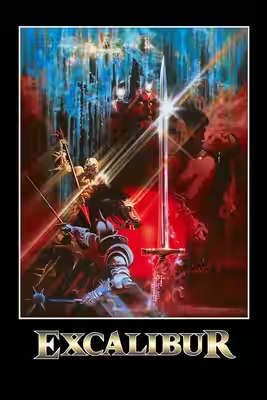
Conan the Barbarian is a slower, more physically grounded fantasy than Excalibur, which is equally solemn but much wilder in its bloodshed and sorcery. We favour Excalibur for its photography and supporting performances, though its characters sometimes get lost in the spectacle. Conan better suits an appetite for muscular adventure carried by an orchestra, provided patience survives its sagging middle.

Cast

Awards

Golden Raspberry Award for Worst Actor, 1983

Nominated
Golden Raspberry Award for Worst Actor

If you liked this, try…

  1. Excalibur (1981, Fi1m 79)Boorman’s Arthur, equally solemn and far wilder, with armour that gleams green in the forest.

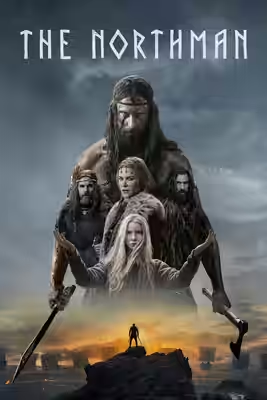
  2. The Northman (2022) · not reviewed yetEggers’ Viking revenge film takes its mud, blood and gods just as seriously.

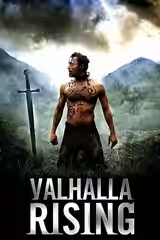
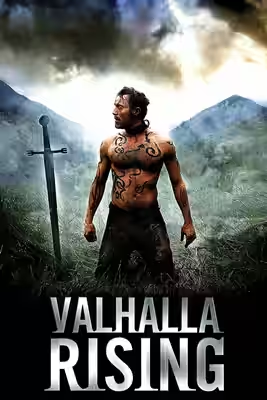
  3. Valhalla Rising (2009) · not reviewed yetRefn’s near-silent Norse film: one mute warrior, a lot of fog, no jokes at all.

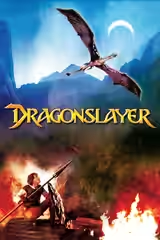
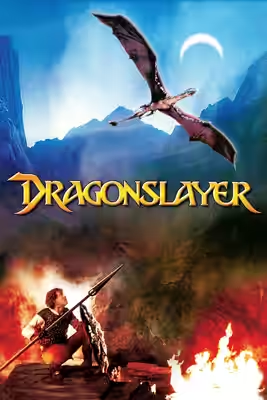
  4. Dragonslayer (1981) · not reviewed yetThe decade’s best dragon, and an apprentice sorcerer plainly out of his depth.

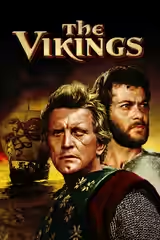
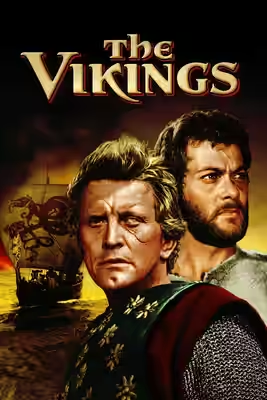
  5. The Vikings (1958) · not reviewed yetKirk Douglas and Tony Curtis hack through fjords; the 1950s version of the same appetite.

Free account

Know what to watch tonight

Two lists that know where things are streaming, collections you can share, your own score beside ours, and Discover that remembers what you have seen.

  • Want to see, sorted by what is streaming now
  • Seen, with your score out of ten
  • No adverts, ever